May 8, 1945
BluebeardMay 8, 1945, marks both the end of the war in Europe and the moment Rabo Karabekian later makes the center of his monumental painting Now It’s the Women’s Turn. The date links his private memory of liberation to a crowded landscape of people caught between war and its aftermath, preserved not as a conventional victory scene but as an image whose full meaning emerges only when viewed from the right position.
The End of the War and the Valley
The war in Europe ended on May 8, 1945, but Rabo and hundreds of other captured officers had not yet been freed by the Russians. They were marched out of their prison camp into the countryside. After their guards vanished, the former prisoners awoke on the rim of a green valley, on what is now the border between East Germany and Czechoslovakia.
Below them, Rabo saw thousands of people: concentration-camp survivors, slave laborers, people released from asylums and prisons, and captured soldiers from armies that had fought Germany. The scene also included the last remnants of Hitler’s forces, still armed despite their battered uniforms. The date therefore joins the fact of European victory to an unresolved, densely populated aftermath rather than to a simple image of peace.
From Recollection to Painting
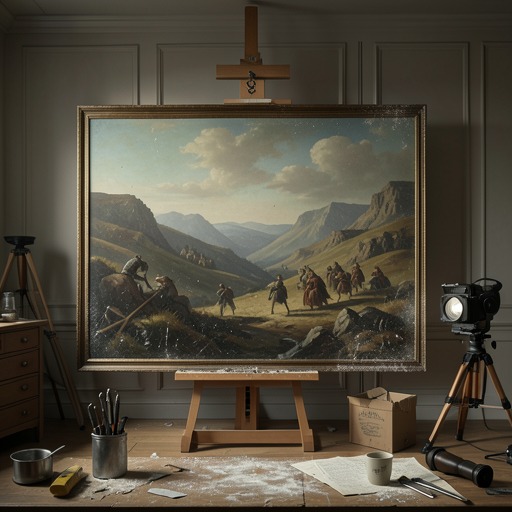
Decades later, Rabo translates that morning into an eight-foot-high, sixty-four-foot-long painting. When he first shows it to Circe Berman, she and Rabo stand at its extreme right end. From there, the work is compressed by foreshortening into an apparent triangle only five feet wide; its subject cannot yet be understood. Rabo switches on the floodlights, and Circe responds with a gasp as the view opens up.
The revealed scene places the viewer on the valley’s rim in springtime. It contains 5,219 people, with farmhouses and the ruins of a medieval watchtower; from a distance, its realism makes it resemble a photograph. Rabo identifies the painted location as the place where he stood when the sun came up on the day the war in Europe ended. The work thus presents the date through a remembered vantage point, while its extreme dimensions make the act of seeing dependent on movement and scale.
The Date Inside the Image
The date is not merely supplied by Rabo’s account. Within the painted landscape, a Polynesian figure sits on a discarded German ammunition box, which still contains three bullets, and studies a newspaper page caught by the breeze. The page comes from an anti-Semitic weekly published in Riga during the German occupation and is six months old; its subject is gardening and home canning. The figure’s attention to it evokes a search for orientation—where he is, what is happening, and what may come next.
Rabo tells Circe that a stepladder and magnifying glass would allow her to read the tiny inscription on the ammunition box: May 8, 1945. The date is therefore embedded in the scene as a small, material detail amid the valley’s human multitude. Its scale contrasts with its historical weight: it can be read only by close inspection, while the event it names organizes the whole composition.
Public Afterlife
After revealing the painting, Rabo opens the potato barn as part of a regular museum tour. Visitors pass through it from one end to the other, and many walk through more than once. The work’s first appearance as a foreshortened triangle gives way to this bodily passage through its length, turning the encounter into an experience of changing perspective rather than a single, immediate view.
Rabo predicts that Now It’s the Women’s Turn will become the most popular painting in his collection. May 8, 1945, consequently serves as more than a caption for a historical scene: it is the point at which his wartime recollection becomes an encounter shared with visitors, who must approach the image to discover the date and the human world it contains.