The lady in black velvet
CarmillaThe lady in black velvet is the commanding and enigmatic mother of Carmilla, whose brief but decisive appearance sets the entire supernatural plot of the novella in motion. She arrives at Laura's family schloss under the cover of a dramatic carriage accident, manipulates Laura's father into accepting her daughter as a guest, and imposes a strict injunction of secrecy before departing on a journey she describes as one of "life and death." Her presence, though fleeting, establishes the conditions for Carmilla's predatory intimacy with Laura and introduces the atmosphere of concealed identity and veiled threat that pervades the story.
Appearance and Bearing
The lady in black velvet is described as a "fine looking woman for her time of life" who "must have been handsome." She is tall but not thin, dressed in black velvet, and has a "proud and commanding countenance" that is nevertheless "agitated strangely" during the crisis of the carriage accident. Her air and appearance are so distinguished and imposing that Laura is immediately convinced she is "a person of consequence," quite apart from the dignity of her equipage. Yet there is a theatrical quality to her manner; she breaks out in what Laura calls "that theatrical way which is, I believe, natural to some people," clasping her hands and looking upward in a "momentary transport of gratitude" before immediately resuming her agitated lamentations.
The Carriage Accident and Manipulation
The lady in black velvet first appears as the central figure in a carefully orchestrated crisis. Her traveling carriage, drawn by four horses and accompanied by two outriders in front and two horsemen behind, thunders across the steep Gothic bridge near the schloss. One of the lead horses takes fright, and the entire team breaks into a wild gallop, the carriage lurching dangerously as a female voice screams from within. The carriage overturns near a lime tree and an ancient stone cross, and the lady emerges "with a commanding air and figure," standing with clasped hands and raising a handkerchief to her eyes. Through the carriage door, a young lady who appears lifeless is lifted out. The lady declares herself the girl's mother and immediately launches into a speech calculated to elicit sympathy and an offer of hospitality: "Here am I, on a journey of life and death, in prosecuting which to lose an hour is possibly to lose all." She claims she must leave her daughter behind and asks for directions to the nearest village, a request that Laura's father, prompted by his daughter's whispered entreaty, counters with an offer to take the young lady into their own care. The lady protests with theatrical reluctance, but her objections are perfunctory, and she quickly accepts.
The Private Interview and Injunction of Secrecy
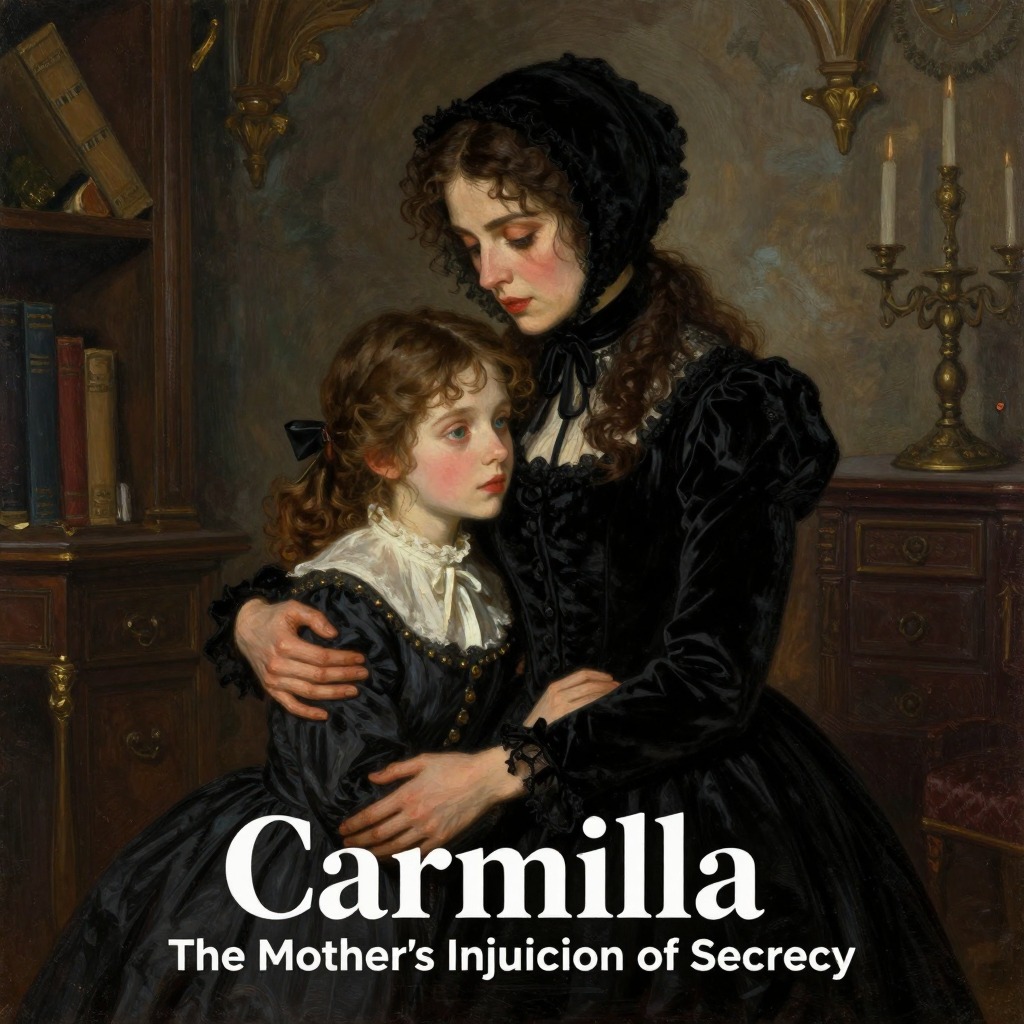
Once the carriage is righted and the horses are again tractable, the lady throws a glance at her daughter that Laura fancies is "not quite so affectionate as one might have anticipated." She then beckons Laura's father aside and speaks to him with a "fixed and stern countenance, not at all like that with which she had hitherto spoken." In this brief, earnest interview, she expresses reluctance to trouble them with her daughter's care, volunteering that the girl is "in delicate health, and nervous, but not subject to any kind of seizure" nor to "any illusion; being, in fact, perfectly sane." She then imposes a solemn condition: her daughter is to remain silent as to who they are, whence they come, and whither they are traveling. When she says the word "secret," she pauses for several seconds, looking sternly with her eyes fixed on Laura's father. She emphasizes that her journey is of "vital importance"—rapid and secret—and that she will return for her child in three months. Having secured his agreement, she kneels beside her daughter, whispers what Madame Perrodon takes to be a benediction, hastily kisses her, steps into the carriage, and is whirled away at a furious canter, followed by the two horsemen in the rear.
Significance and Thematic Role
The lady in black velvet functions as the architect of the vampire's access to its victim. Her staged accident, her theatrical appeals to chivalry, and her stern imposition of secrecy all serve to deliver Carmilla into Laura's household under conditions that prevent any inquiry into her origins. The contrast between her public performance of maternal distress and her private, stern demeanor with Laura's father hints at a calculated ruthlessness beneath the veneer of aristocratic refinement. Her injunction of silence ensures that Carmilla's identity remains hidden until it is too late, and her promise to return in three months is never fulfilled within the narrative—she vanishes from the story as abruptly as she entered, leaving her daughter to pursue her predatory designs until the final confrontation at the Karnstein chapel. The lady in black velvet thus embodies the theme of concealed danger entering the domestic sphere under the guise of polite hospitality, a central anxiety of the Gothic tradition.