Doctor Spielsberg
CarmillaDoctor Spielsberg is the elderly, grave physician who attends Laura during the strange malady that descends upon her after Carmilla's arrival at the schloss. He is the first character in the narrative to move beyond superstitious rumor and peasant terror, applying a physician's trained eye to the physical evidence on Laura's body and thereby confirming the presence of a supernatural predator. His role is that of the diagnostician who names the unnameable, transforming Laura's vague sensations of horror into a clinical reality that her father can no longer ignore.
Appearance and Demeanor
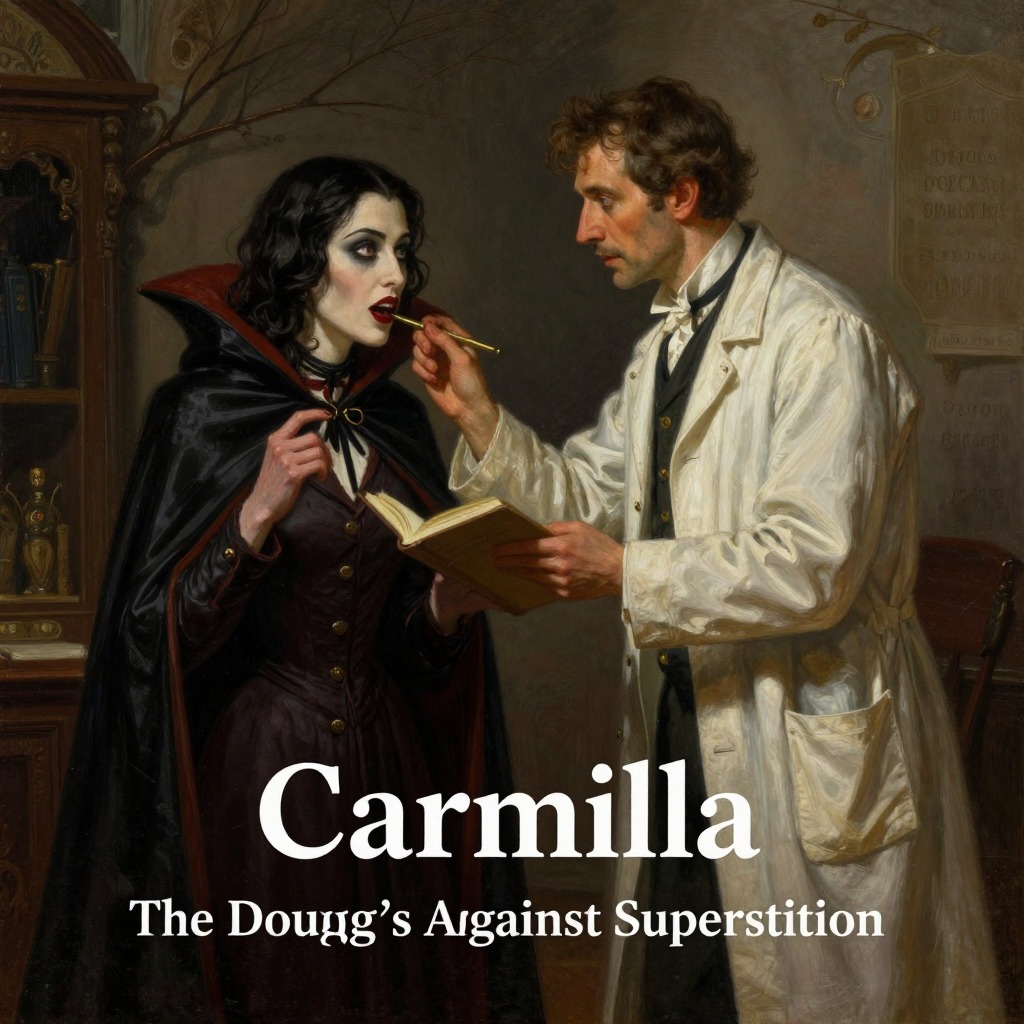
Doctor Spielsberg is described as a "grave little doctor, with white hair and spectacles," a man of sixty and upwards who wears powder and shaves his pale face as smooth as a pumpkin. When Laura first sees him as a child after her early fright, she remembers his "long saturnine face, slightly pitted with smallpox, and his chestnut wig." His professional manner is serious and deliberate; when Laura recounts her symptoms to him in the library recess, he leans with his shoulders against the wall, his eyes fixed on her "earnestly, with an interest in which was a dash of horror." He does not laugh at the fantastic, nor does he dismiss it—he listens, examines, and acts.
The Examination and Discovery
When Laura describes the sensation of two needles piercing her skin near her throat, Doctor Spielsberg asks her to indicate the exact point. With her father's permission, he has Laura's dress lowered a little below the collar, and there he reveals to Laura's father a "small blue spot, about the size of the tip of your little finger." This is the first objective, visible proof that Laura's suffering is not merely nervous fancy or dream. The doctor's grim triumph is audible in his words: "You see it now with your own eyes." He then confirms that this same point is the center of the cold-stream thrill Laura described and the place where the sense of strangulation begins. Having established the physical stigmata of the vampire's attack, he turns immediately to the question of what must be done.
The Prescription and Protective Measures
Doctor Spielsberg's first and most urgent directive is that Laura must never be left alone for a single moment. He gives this instruction to Madame Perrodon with the weight of an absolute necessity: "It is indispensable." He does not explain the nature of the threat to Laura herself, but his grave conference with her father in the window recess—conducted in low tones that the others cannot hear—makes clear that he understands the mortal danger. He also arranges to examine Carmilla later that same evening, recognizing that her symptoms, though milder, are "quite of the same sort." His actions set in motion the chain of vigilance—the constant attendance on Laura, the watch kept in her room at night—that prevents Carmilla from completing her fatal work.
Narrative Significance
Doctor Spielsberg functions as the bridge between the world of rational medicine and the reality of the supernatural. He does not preach about vampires or invoke folklore; he reads the body's testimony and acts on it. His discovery of the puncture mark is the moment when Laura's private horror becomes an objective, shared fact, and his prescription of constant companionship is the practical measure that keeps Laura alive until the vampire can be destroyed. He is the figure who, without ever uttering the word "vampire" in Laura's hearing, nevertheless sets in motion the protective regime that saves her.