The mountebank
CarmillaThe mountebank is a grotesque and itinerant figure who arrives at the schloss twice a year, a wandering entertainer and peddler whose appearance and wares inadvertently expose the supernatural danger lurking within the household. His brief visit functions as a darkly comic prelude to the horror, as he sells protective charms against the very vampire who is already a guest under the same roof, and his sharp eye detects a physical anomaly in Carmilla that marks her as something other than human.
Appearance and Identity
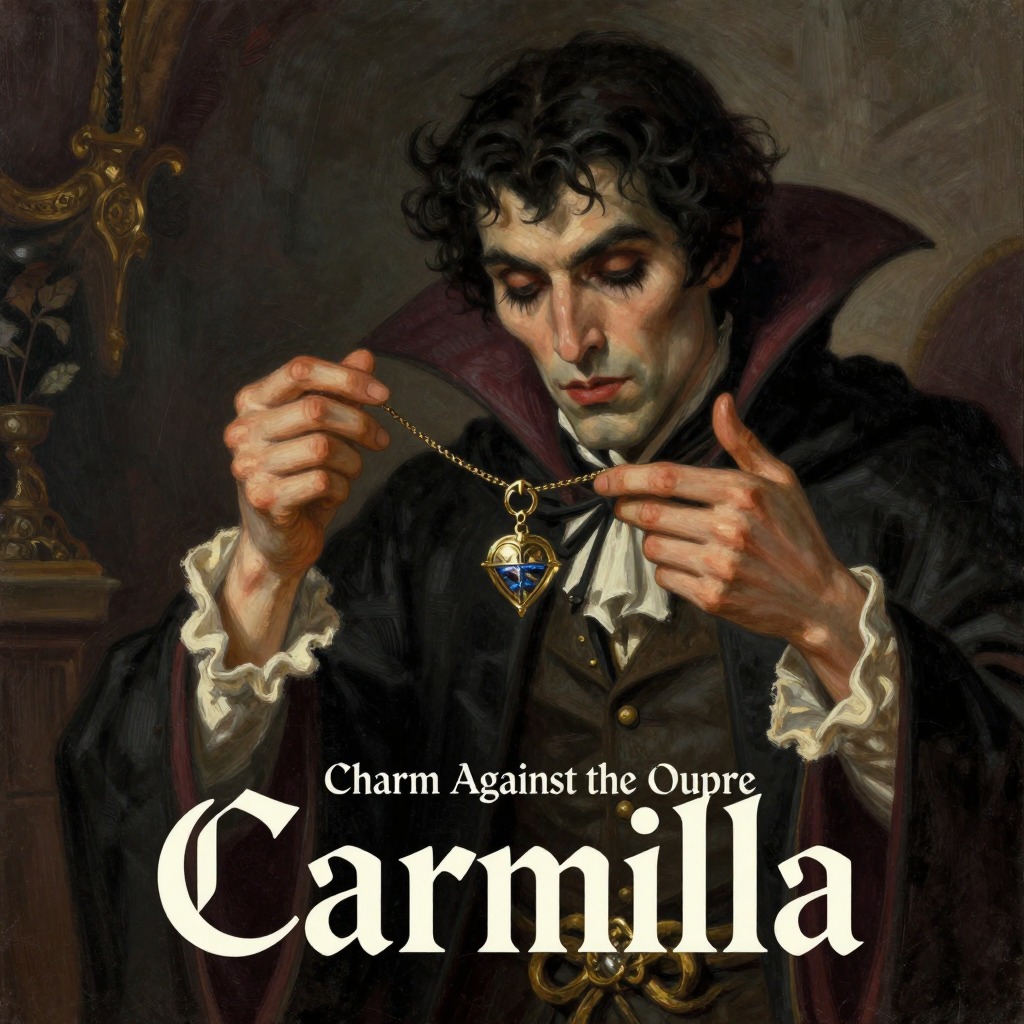
The mountebank is a hunchback with the sharp, lean features that often accompany deformity, a pointed black beard, and a perpetual smile that reveals his white fangs. He is dressed in a motley of buff, black, and scarlet, crossed with more straps and belts than can be counted, from which hang all manner of objects: a magic lantern, two boxes containing a salamander and a mandrake—monsters compounded from parts of monkeys, parrots, squirrels, fish, and hedgehogs, dried and stitched together—a fiddle, a box of conjuring apparatus, a pair of foils and masks, and several other mysterious cases. He carries a black staff with copper ferrules. His companion is a rough, spare dog that follows at his heels but stops suspiciously at the drawbridge and begins to howl dismally. The mountebank speaks volubly in execrable French and German not much better, and he performs with a merry discord, scraping a lively air on his fiddle and dancing with ludicrous airs and activity.
The Sale of Charms and the Ominous Observation
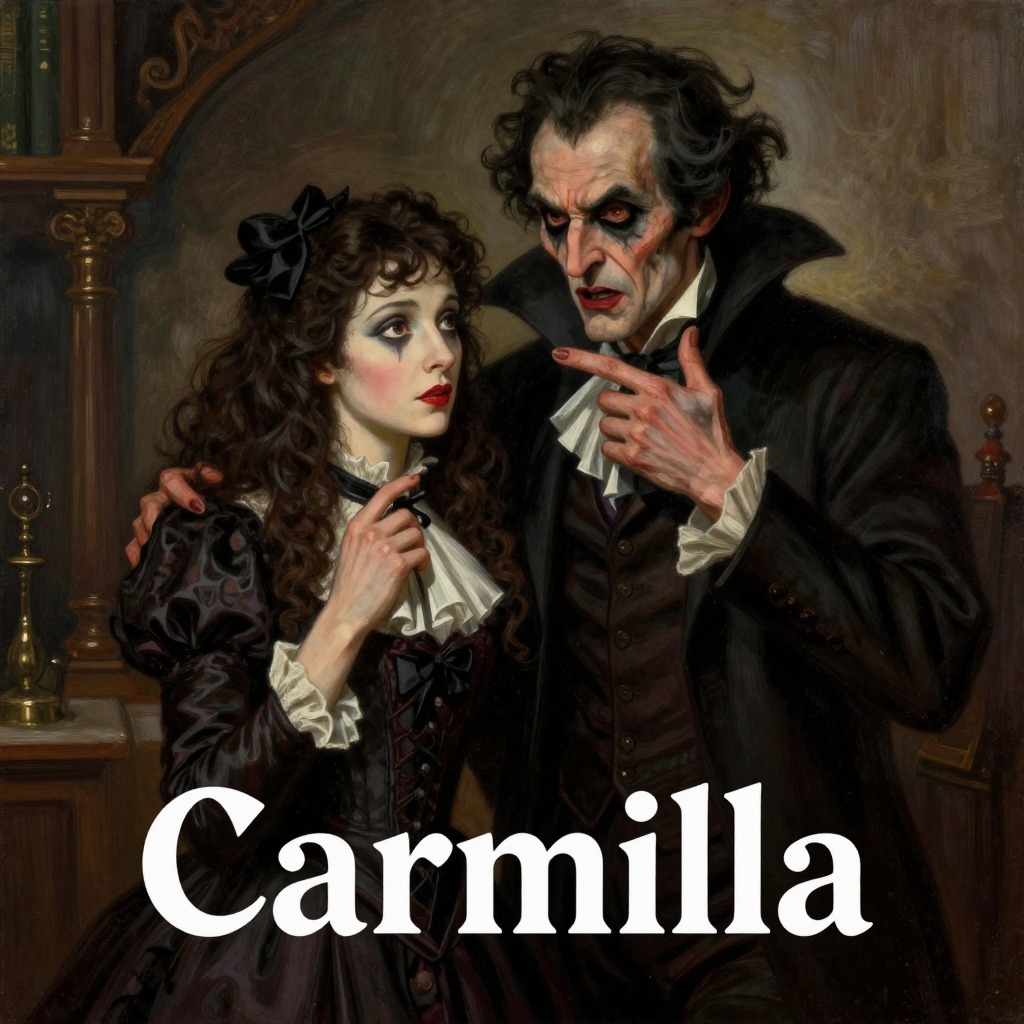
Standing in the courtyard, the mountebank raises his grotesque hat and makes a ceremonious bow, then launches into a long, breathless advertisement of his accomplishments. He offers for sale an amulet against the oupire, which he says is "going like the wolf" through the woods, with people dying of it "right and left." The charm, he claims, never fails—it need only be pinned to the pillow. These charms are oblong slips of vellum with cabalistic ciphers and diagrams. Carmilla instantly purchases one, and Laura does as well. As the mountebank looks up at the two young women in the window, his piercing black eye seems to detect something that fixes his curiosity. He unrolls a leather case full of odd little steel instruments and professes the art of dentistry. Addressing Laura, he declares that her "noble friend, the young lady at your right, has the sharpest tooth,—long, thin, pointed, like an awl, like a needle." He offers to file it round and blunt, to make it "no longer the tooth of a fish, but of a beautiful young lady." Carmilla reacts with sudden, violent anger, demanding that her father have the wretch tied up, flogged, and burnt with the cattle brand, but her wrath subsides as quickly as it rose.
Narrative Role and Significance
The mountebank functions as a threshold figure and an unwitting revealer of truth. His physical deformity and carnivalesque performance mark him as an outsider, yet his sharp sight penetrates the disguise that the rest of the household cannot see. He names the threat—the oupire—and offers a charm against it, a charm that Carmilla herself buys, an act of dark irony. His observation of Carmilla's unnaturally sharp tooth is the first explicit, external confirmation of her predatory nature, a detail that aligns with the vampire's defining characteristic. The mountebank's brief appearance thus weaves together the comic and the ominous, the mercantile and the monstrous, and his words linger as a clue that the reader, and eventually the characters, will come to understand.