The Narrator's Bank Robbery with Ryder
CherryThe Narrator's Bank Robbery with Ryder is a weekday robbery undertaken by the narrator and Rider, but its decisive turn comes after they leave the bank: confronted with a police car, Rider runs, and the narrator continues alone. The episode joins a carefully prepared crime to an almost casual aftermath, exposing the fragility of the partnership and the narrator’s ability to treat danger, drug obligations, and domestic routine as parts of the same day.
The Plan and Its Distrust
Rider proposes a bank in Bath, Ohio, as a suitable target. The narrator rejects the proposal as another of Rider’s schemes, recalling that Rider had previously wanted him to travel to Bath under the pretext of a robbery and then kill a man instead. Rather than risk being drawn into that plan, the narrator tells Rider he can go to Bath if he wants; the narrator intends to rob a bank downtown. The distinction matters: this is not a partnership built on trust, but an arrangement in which the narrator sets the destination while remaining alert to Rider’s capacity for deception.
The narrator picks Rider up in the morning. Pistol is with him, carrying a gun and advancing two grams of heroin; the narrator has promised to give him some money that afternoon. The robbery is therefore bound from the outset to a separate debt and supply arrangement. The gun and money come through Pistol, while Rider is to accompany the narrator on the job. The narrator is not simply assembling a crew: he is managing several obligations at once, with the risk of imprisonment shaping what he does before they even reach the bank.
Emily and the Preparations
Because it is a weekday, Emily has classes. The narrator wants to ensure she will have her share of heroin in case he is sent to prison, so he and Rider stop first at her college. Emily leaves the main building and meets them in a parking lot across the street. The narrator asks Rider to give her the front passenger seat, and Rider does so. The brief stop places the possibility of arrest beside an intimate, practical act of provision: before committing the robbery, the narrator is already planning for Emily’s access to heroin if he disappears into custody.
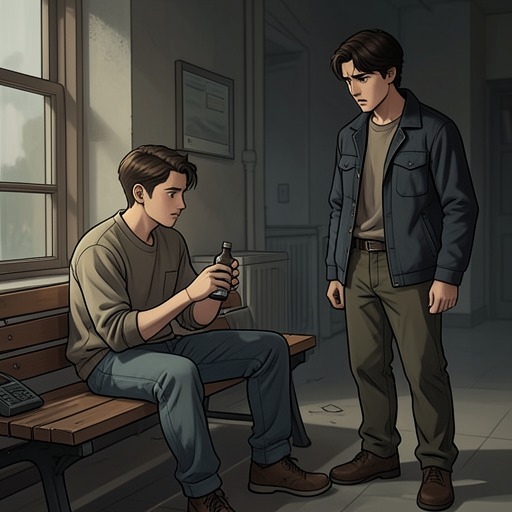
After Emily returns to the college buildings, Rider borrows the narrator’s phone and makes a call, saying that he will go now. The narrator senses that Rider is frightened, despite his effort to appear willing. While Rider takes the driver’s seat, the narrator changes into an Adidas tracksuit, a black fleece, and a balaclava. He describes his appearance to Rider, who criticizes it; the narrator accepts the insult and says they should go. Their exchange does not resolve the unease between them. It instead carries that unease forward into the robbery, with Rider’s fear visible before either man reaches the bank.
The Robbery
The bank is only a few blocks west. They park across the street, positioned to leave east, and the narrator tells Rider not to lock the doors because he expects to be back in under two minutes. The weapon sits in the waistband of his trousers, but neither pair of trousers holds it securely, leaving him with only one free hand. Inside, the branch is nearly empty: a female teller, the manager, and a customer are present. The two men are occupied in conversation and ignore him as he approaches the counter.
The teller, identified by her name badge as Sheina, pushes forward bundles of one-dollar bills banded in groups of fifty. The narrator addresses her by name and tells her not to be foolish. She brings out the cash in the drawers. His account shifts unexpectedly from threat to compassion: he feels sorry for her and reflects that her appearance is not something she chose. The moment does not undo the coercion of the robbery, but it complicates the narrator’s posture within it. He can intimidate the teller and take the money while also turning his attention toward an ordinary feature of her face and imagining her blamelessness.
Once they are on the highway, Rider wants to see the money. The narrator counts the bundles and gives Rider half as he goes. Rider repeatedly demands more. That insistence turns the division of the proceeds into a struggle over trust and entitlement even before the escape fails. Traffic is heavy, but the narrator believes they are nearly clear and that the getaway is going well. Then Rider moves into an exit lane. The narrator tells him to stay on the highway and continue toward Route 271, but Rider does not listen.
Abandonment and Aftermath
Rider exits only three exits from where they entered the highway. A police car is coming up the bottom of the ramp. Rider cries out in panic, then opens the door and runs from the car. The narrator finds the reaction strange and says he does not understand what the problem is. The mismatch is stark: Rider experiences the police car as a reason to flee immediately, while the narrator treats the escape as still manageable. The partnership formed for the robbery dissolves at the first visible sign of police attention.
The narrator gets back onto the highway, takes Interstate 90 east to Route 271, smokes Pall Mall cigarettes, and burns the paper bands from the bundles, dropping them into the ashtray. He says the Gunsmoke is still taking effect and that nothing worries him. Rather than describe a prolonged chase or an arrest, the account follows his practical movements away from the scene: he exits at Chagrin, buys burgers at Wendy’s, goes home, takes Livinia out, and feeds her. The sequence sets the disposal of robbery evidence beside the ordinary tasks of returning home and caring for the dog.
The narrator then calls Pistol to say he has the money. When he meets him, he does not tell him that Rider lost his nerve. He wants to spare Rider the humiliation and also fears that Rider might kill him if he learned the narrator had disclosed how he behaved. The narrator gives Pistol the money owed for three and a half grams, returns the clothes worn during the robbery and asks Pistol to get rid of them, gives back the gun, and adds five hundred dollars for the trouble. The episode ends not with an account of what happened to Rider or the stolen cash, but with the narrator closing out his obligations to Pistol and keeping Rider’s failure private. That discretion is both a gesture of protection and a response to the danger he believes Rider could pose.