The narrator and Emily’s partnership and shared addiction
CherryThe narrator and Emily’s partnership and shared addiction is a relationship in which affection remains real but is increasingly organized around obtaining and using drugs. Their home life offers tenderness and routine, yet the same dependence that binds them also turns money, care, and withdrawal into sources of conflict. The narrator describes the bond as a joint movement toward self-destruction: they cannot manage to stop, even as they recognize what their life together is costing them.
Intimacy and Shared Routine
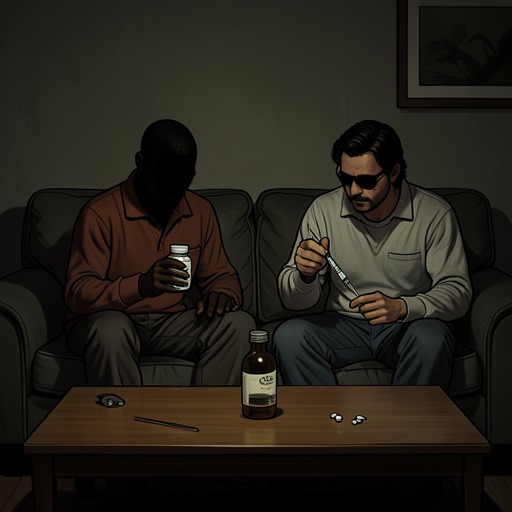
On Valentine's Day, Emily wishes the narrator a happy holiday, but the evening does not follow the expected script of romance. They inject drugs and watch late-night television; neither cares about the holiday or feels that sex is necessary. The narrator says that coming home to Emily never grows tiresome, and that their shared interest in drugs is what keeps them together. The scene holds affection and dependence in the same frame: the comfort of returning to a partner is genuine, but the activity around which they spend the evening is also the force narrowing their life.
Their domestic life includes ordinary work and care. Emily works, tends the plants, prepares the narrator’s meal, and has to write a course. Those responsibilities become sharply visible when the narrator loses money. After a loss of $180, Emily objects that she is carrying work at home while he plays the big shot and loses their money. She says they spend more than a thousand dollars a week on drugs and cannot continue at that rate. Her anger is not presented as a rejection of the relationship so much as an attempt to name its material limits: their shared habit consumes money that her work and household labor cannot replace.
Money, Blame, and Mutual Harm
The conflict recurs around losses and bad judgments. Emily blames the narrator for what is going wrong in her life, while he sometimes wants her to stop talking. He describes both of them taking whatever drugs they can obtain and becoming so intoxicated that he nods in his seat, dropping lit cigarettes onto his knees. Emily follows him through the house with a video camera, recording his condition and confronting him about how high he is. Yet she is also intoxicated. The camera makes his deterioration visible, but it does not place her outside the same condition; her accusation and his resentment take place within a shared addiction rather than between an observer and someone untouched by it.
A separate $600 loss intensifies the same pattern. Manny has led the narrator into a supposed deal for twenty-eight grams of cocaine at a price that should have made him suspicious. Hoping to resell it at a profit, the narrator imagines that the deal will bring money and admiration; instead, he discovers what the purchase really is and cannot recover the loss. Emily has been angry with him for days. The episode makes their financial stress concrete and connects the household’s needs to the narrator’s growing involvement with dealers. He recognizes that needing money and spending too much time among dealers have helped make him a corrupt person, while the relationship bears the consequences of those choices.
Addiction as a Shared Physical Condition
The couple’s dependence is also shaped by what substances remain available. Their supply of OxyContin is shrinking, not because Big has stopped supplying it, but because the pills have been reformulated. The new tablets are hard like rubber and turn to gel when crushed and mixed with water, making them unusable for injection. The older pills are still circulating, but their numbers are falling. Since the couple cannot use substances they cannot inject, they anticipate being driven toward heroin. Big does not sell heroin, leaving them dependent on an unreliable dealer and facing more severe withdrawal.
When they try to stop, they cannot even lie beside one another. Emily is on a mattress on the floor beneath a window, tangled in blankets; both are sweating and vomiting into small plastic wastebaskets. After more than twenty-four hours without injecting, they have no money and feel that they are finished. The narrator stands at the kitchen sink for three quarters of an hour, drinking water only to bring it back up mixed with bile and mucus. The detail of the sink and the plastic bins makes withdrawal a shared domestic ordeal, but not a comforting one: each is physically overwhelmed in a separate place, while both remain caught in the same crisis.
Even in that state, the narrator’s attention to Emily is intensely tender. Her groans hurt him, and he feels the urge to hurry to her side. He notices her lower lip, sweat, closed eyes, damp pajamas, and a strand of hair against her cheek. He describes the brief pleasure they can find in such moments while sick with withdrawal. This closeness does not undo the bodily damage or provide a way out; instead, it shows how desire and care persist inside the conditions that are harming them.
Criminal Entanglements and the Relationship’s Limit
The narrator’s pursuit of money draws him further into criminal company. He spends a night driving with Raul and Rider while they search for a particular car belonging to a man they intend to rob, but they never find it. Rider later proposes a bank in Bath, Ohio, as a target. The narrator distrusts the suggestion because Rider had previously asked him to kill someone in Bath, offering him money to settle Rider’s debt. He refuses that request and sees Rider as a habitual liar who pulls others into dangerous situations; Raul, however, continues to protect and believe his protégé. These dealings make the narrator’s claim about needing money more than an abstract explanation: his financial desperation is entangled with people and plans that threaten to carry violence further.
On the day of another planned robbery, Rider has Pistol bring a gun and advance two grams of heroin. The narrator tells Emily to be careful before she returns to the university buildings, then gives Rider his phone. Rider makes a call and tries to sound willing, though the narrator can see that he is frightened. Later the narrator tells Rider that he has $400, owes $360 to Pistol, and needs to obtain heroin quickly and take it back to Emily at the university. He says that he is beginning to feel sick and that Emily is beginning to feel sick too. The robbery, the debt, and the effort to secure drugs converge in one practical demand: he needs money and heroin not only for himself but also for the partner waiting for him.
The relationship’s decisive tension is therefore not a simple opposition between love and addiction. The narrator still wants to come home to Emily, notices her suffering, and acts with her needs in mind; at the same time, their shared dependence consumes their money, shapes their fights, and drives him toward dangerous criminal arrangements. His account of them as a team destroying their lives captures both their solidarity and its cost. They remain attached, but the evidence offers no recovery or resolution: at this point, recognition that they are harming one another has not become the ability to stop.