United States Army
CherryThe United States Army enters the account both as an employer offering training and benefits and as a combat institution that assigns a new medical specialist responsibilities he does not yet feel equipped to bear. Through recruitment, induction, service in Iraq, and the aftermath of deployment, the Army’s professional promises repeatedly meet the uncertainties and human consequences of war.
Recruitment and the Promise of a Career
In the first week of 2005, the narrator encountered a recruiter eager to secure his enlistment. News coverage of young soldiers being killed or wounded had made recruiting more difficult, and the recruiter treated the narrator’s interest as an easy success. The exchange presents enlistment as a transaction shaped by institutional need: the Army was seeking recruits while the prospective soldier was looking toward a professional qualification and a possible route into medical work.
The narrator was told that, after passing the required examination, he could pursue vocational training. He was also encouraged to rank preferred assignments, with the assurance that most recruits received one of their first three choices. Since the narrator expected those choices to keep him near Ohio, he imagined that military service might still allow frequent trips home. The offer of $300,000 in life insurance, available through an additional payment, made the risks of service tangible even before he left for training.
At the physical and other tests, the narrator learned that he was color-blind. That condition did not prevent him from entering the 91W medical specialty, one of the few Army specialties open to color-blind recruits. The detail captures the gap between a broad image of military eligibility and the specific administrative rules that determine an individual’s place in the service: a disqualification in some fields could coexist with a viable medical assignment.
Induction and Medical Training
Induction turned the recruits into a group through a sequence of procedures and issued equipment. They received roughly a hundred injections, collected uniforms, boots, helmets, and other Army gear, and carried paperwork from office to office for signatures. In an auditorium they learned basic drill commands and the Army song. Even their reaction to the meals became a small performance: they acted as though the food was worse than it was, taking up the familiar role of complaining recruits.
The trainees assigned to medical services traveled by bus to Fort Sam Houston in San Antonio, Texas. Their driver, a Vietnam veteran whose right hand had been badly damaged by white phosphorus, encouraged them to drink and smoke during the trip. At Fort Sam Houston, new recruiting sergeants shouted at the arrivals, but the recruits had already learned to regard the performance with indifference. They pretended to be impressed so that the sergeants would not notice that they were drunk and smelled of cigarettes. The episode makes military discipline look less like a simple transfer of authority than a routine whose theatrical elements the trainees were already learning to recognize and evade.
The training battalion’s prescribed identity was Warrior Medic. The trainees regarded the label as ridiculous, although they understood that the hierarchy expected them to use it. The course was planned to last fourteen weeks, with weekend leave expected after an initial period. The slogan joined two roles—caregiver and fighter—before the trainees had learned how difficult that combination could become in practice.
The hospital experience gave the narrator early contact with the vulnerability and practical demands behind the medical designation. While taking a patient’s blood pressure after a motorcycle accident, he placed the cuff incorrectly and inflated it in a way that alarmed the patient’s wife. He then continued his rounds, including care for a man injured in a street fight who needed assistance with basic hygiene. The narrator understood these tasks as a form of service, even when they were uncomfortable and he was inexperienced.
Another patient, an adult with severe cognitive and physical impairments after being struck by a car, was attended by his grieving mother. The narrator was relieved that he had learned to use the blood-pressure device correctly; he feared that a mistake would add to the mother’s distress. These encounters show medical training not simply as the acquisition of procedures but as responsibility toward patients and families. They also establish how little room the narrator felt he had for error once another person’s suffering was in front of him.
Assignment and Army Structure
After training, the narrator received orders assigning him to Fort Hood in Killeen, Texas. He describes Fort Hood as a bleak environment, a different kind of desert that seemed to cultivate a sense of fatalism among the young. The setting marks the transition from training to an Army organized around deployment and combat units.
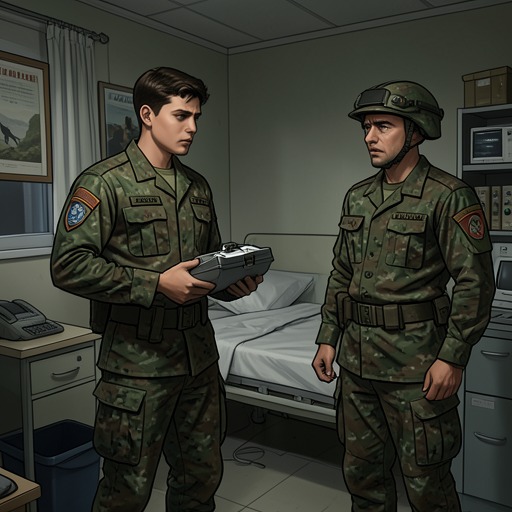
The 4th Infantry Division had assigned him to an armored battalion, but the battalion was not composed only of armored companies. Its organization mixed armored and infantry companies with a mechanics company, a support company, and a command-and-logistics company. The latter units included a range of functions, such as cooks, mechanics, scouts, mortars, intelligence, and finance. The medical section was part of the command-and-logistics company. From there, the narrator might remain in a medical staff role or be attached to one of the combat companies, including Delta Company or Echo Company. The arrangement placed medical personnel inside the same mixed structure as the formations they could be sent to support.
The Army’s combat patch gave deployment a visible institutional marker, but the narrator distinguishes it from an award for fighting. Issued to new soldiers at Easter, the patch was worn on the right sleeve and identified a unit associated with a deployed theater. It did not certify that its wearer had been shot at or had taken part in a particular engagement. Soldiers who had spent time in the barracks—sleeping, cleaning weapons, repairing tracks, playing cards, or doing little—received the same sign of deployment. The patch therefore records presence in a theater rather than an individual measure of combat or merit.
Medical Duty and the Costs of Deployment
During Operation Radiant Honor, the narrator and other soldiers were sent to a school on the operation’s final day to establish a treatment center for Iraqi patients. An older man waiting outside had injuries to his wrists that he said had been caused by restraints during an earlier detention. The narrator cleaned and dressed the wounds, then became concerned when one hand was swollen and shaking. Unsure how serious the condition was, he sought guidance from two sergeants from the command-and-logistics company who had accompanied the medical team. The scene places a young provider’s immediate uncertainty beside a system in which he was expected to act while relying on more experienced personnel for judgment.
In another emergency, the narrator treated a man with a gunshot wound to the abdomen. He packed the wound with gauze, covered it with plastic, and asked Sullivan to hold the dressing in place while he looked for an exit wound. He later recognized that he should have used more gauze and positioned the patient differently. He also tried to establish an intravenous line but could not find usable veins. North had called for a medical helicopter, and the narrator urged that the request identify the case as requiring emergency surgery, but the helicopter did not arrive promptly. The sequence links clinical responsibility to the limits of the narrator’s experience and to the delay in evacuation; his later account returns to what he believes he should have done differently.
The demands of medical service also placed soldiers close to grief that they could not manage. After a death, an older woman and other family members came out of a house in distress as soldiers carried a body bag away. The narrator closed the bag while the family continued to mourn. Sullivan later told him that the older woman had been struck by their own fire that morning; the narrator believed Sullivan because he trusted his word. In the narrator’s account, the Army’s role as an armed force and its duty to control a scene collide with the suffering of civilians, and the possibility of friendly fire turns that collision into a lasting burden of knowledge.
The narrator also confronted the consequences of command decisions. He had warned a lieutenant against taking a vehicle into soft ground because he expected it to become stuck. The unit did become stuck, and four soldiers were killed. Later, the narrator angrily reminded the lieutenant that the warning had been given and that the dead had been his friends. The passage portrays hierarchy not as a neutral chain of command but as a structure in which advice can be disregarded and the costs of a decision borne by soldiers in the field.
Institutional Tensions and Aftermath
As autumn arrived, the narrator saw the soldiers as worn down and no longer able to imagine themselves fitting into ordinary civilian society. He describes a unit whose members had forced entry into homes and fired on people, and whose deployment had lost any remaining sense of purpose. Their conclusion that they had wasted their time and lost expresses a collapse of the institutional language of mission into exhaustion and futility.
The Army’s administrative decisions could also unsettle its own personnel. At a gathering in the dining facility, the senior enlisted leader announced a change to retirement pensions: future enlisted personnel would receive them only on reaching retirement age, described as after sixty. He said the change applied only to future service members, but that limitation did not prevent veterans in the room from reacting. The episode sets the institution’s public thanks for hard work beside a policy change affecting the material terms of service.
The narrator’s account of life after Iraq returns to the Army through unresolved medical needs. When he later sought care for pain and said he thought he was being treated for post-traumatic stress related to Iraq, an examiner challenged the connection, noting that the war had ended by the time of his service. The narrator left because he could not remain in the appointment. He also recalled that, while deployed, he had experienced severe chest pain outside the base and that Shoo had taken him to the battalion aid station; the medical officer would not see him outside consultation hours and told him to return the next morning. The narrator did not return. These memories do not establish a diagnosis, but they show how symptoms and access to care remained entangled with the routines of military service.
The Army also provided a route into civilian education. Years later, when asked about his plans, the narrator explained that he had started late and was using the GI Bill, the veterans’ education benefit. In this respect, the institution’s promise of practical support extended beyond enlistment and deployment. Yet the benefit sits alongside the narrator’s continuing recollection of injury, failed care, and lost friends, making the Army’s legacy in his life neither a simple rejection nor a straightforward success. Its training and benefits were real; so were the costs that its institutional routines and combat decisions could not resolve.