Echo Company
CherryEcho Company appears as a deployed Army unit whose members receive a combat patch at Easter, then as one side of a confused exchange of fire involving American snipers and Delta Company. The patch marked time spent in a theater of operations, not proof of combat; the later incident shows how little certainty that distinction could offer in the field, where Echo Company mistook fellow soldiers for enemy fighters and returned fire.
Deployment and the Combat Patch
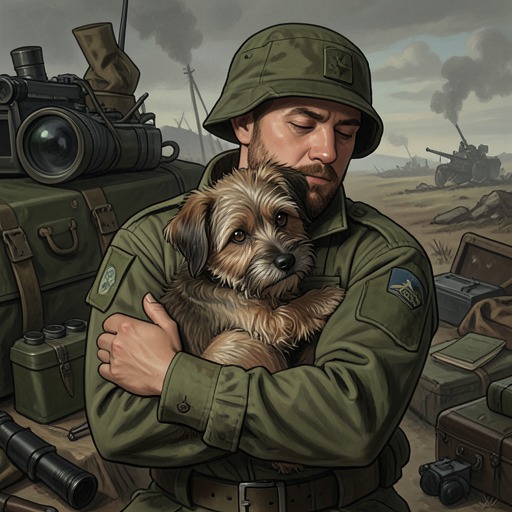
At Easter, everyone from the company who was at the barracks was ordered to stop what they were doing and assemble in the motor pool. The narrator’s catalogue of interrupted activities ranges from sleeping and cleaning weapons to taking apart tank tracks, watching pornography, playing cards, and inhaling computer duster. A boombox connected by an extension cord from the mechanics’ shed hinted that a ceremony was coming; the soldiers learned they were to receive combat patches.
The narrator emphasizes that the patch was not an official combat award like an infantry or medical combat badge, which required exposure to enemy fire or comparable action. It was an ordinary unit patch, generally a division insignia, worn on the right sleeve to indicate deployment to an operational theater and a period of service there. That distinction drained the ceremony of honor in the soldiers’ eyes: they regarded the patch as insignificant and resented being made to line up for it. Rodgers said the unit could keep the insignia if he ever saw combat, making the ceremony’s claim to significance collide with the soldiers’ skepticism about what it proved.
The Base and the Threat Outside
Echo Company’s position also figures in an attack on Delta Company’s patrol base. The western-bank road was the base’s only access route, and a homemade bomb had been placed along it. Because it was dark and the base was being shot at, the attackers’ apparent plan was to fire into the perimeter and rely on the explosive to hit the quick reaction force if it came to the base. The first armored vehicle and the Humvee carrying the narrator passed the trigger; the charge was large enough to destroy the Humvee. The device lay across the remaining pavement in a stretch already badly damaged by earlier explosives, so the ruined road both concealed the danger and made it possible for a driver to miss the trigger.
Mistaken Identification and Crossfire
A separate confusion began when battalion snipers climbed the scaffolding at a power plant. A soldier outside Delta Company’s COT mistook them for enemy fighters and fired, missing them; bullets then fell onto Echo Company’s COT. Echo Company also saw the snipers on the scaffolding and, believing they were enemy fighters, opened fire. Delta Company then fired on the same men, leaving the snipers caught between two American light-infantry companies. None of the snipers was hit, but the exchange shows how one mistaken identification spread from one position to another through ricocheting fire and mutual misreading.
The confusion created an opportunity for an interpreter to plant an explosive device in the gym. The account reports no serious injuries, but the incident joins the external bomb threat to an internal breakdown of identification: while the unit faced a concealed explosive on its access road, American fire itself became a danger to American soldiers. Echo Company’s episode therefore complicates the language of combat readiness and recognition suggested by the Easter patch ceremony.