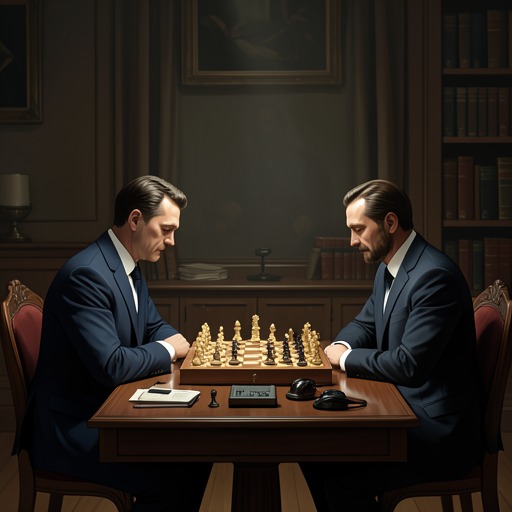
Jacopo Lomeli–the late Pope relationship
ConclaveThe relationship between Jacopo Baldassare Lomeli and the late Pope combines long-standing confidence with a painful final estrangement. The Pope refuses Lomeli’s request to leave his post, insisting that the Church needs his administrative gifts, and the exchange leaves them cold when they part. After the Pope’s death, Lomeli’s grief and sense of duty lead him back through their last conversation, while the Pope’s hidden papers reveal a reforming pontificate marked by growing isolation and secrecy.
A trusted adviser at a spiritual low point
During the year before the Pope’s death, Lomeli increasingly found prayer difficult. The words of the liturgy could pass through his mind without meaning, and he experienced what he understood as a kind of spiritual insomnia: the more earnestly he sought communion with the Holy Spirit, the less accessible it seemed. He eventually confessed this crisis to the Pope and asked permission to leave Rome, give up the deanship, and withdraw to a religious order. At seventy-five, he was at retirement age, and the request was both practical and deeply personal.
The Pope did not grant it. Instead, he distinguished between shepherds and administrators, telling Lomeli that his role was not pastoral but managerial and that he was needed where he was. He also reassured him that God would return to him. The assurance was meant to sustain Lomeli, but the description of him as a manager wounded him: Lomeli wondered whether that was how the Pope truly saw him. Their meeting ended with a chill between them, and it was their last.
The last meeting, reconsidered
Lomeli later dates the meeting precisely: 17 September, after a Mass commemorating the Impression of the Stigmata upon St Francis. It had been the longest interval since the Pope’s election in which Lomeli had gone without a private audience. In the immediate aftermath of the death, he grieves that their long association ended on such a note and wonders whether the Pope’s irritation had been connected to his awareness that death was near, or to a sense that his mission would remain unfinished. These possibilities are Lomeli’s reflections, not settled explanations.
The last conversation becomes a recurring presence in Lomeli’s private prayers. Kneeling before the Pope’s sealed apartment, he acknowledges that the Pope knew of his difficulties yet refused his resignation, and asks for strength and wisdom to meet the trial ahead. The request shows that the hurt has not displaced his reliance on the Pope’s judgment. Even after death, Lomeli addresses him as someone whose reasons may have exceeded what he could understand at the time.
Loyalty amid secrecy and suspicion
The Pope’s death makes Lomeli’s relationship with him part of a struggle over how the Church will preserve and explain its recent past. Cardinal Tremblay gives Lomeli a prepared timeline of the final evening, specifying the Pope’s supper with Archbishop Woźniak, his reading and meditation on The Imitation of Christ, his bedtime, the discovery that he had no vital functions, the doctor’s treatment, and the pronouncement of death at 12:12 a.m. Later, Woźniak tells Lomeli that after the Pope died, Tremblay asked what had been on his mind at supper. Woźniak had answered only that the Pope seemed agitated, withholding details because he was frightened and believed he was not supposed to know them. He suspects Tremblay then discouraged the Pope’s secretary, Monsignor Morales, from speaking about the meeting. The account raises questions about what the Pope had disclosed before his death, without resolving what Morales knew or what Tremblay intended.
Lomeli responds to the risks of conflicting accounts with procedural care. When discussing the official statement, he proposes adding the Pope’s attendance at vespers while issuing the account otherwise as written, and preparing a fuller record of the day to hold in reserve. His intervention protects the reliability of the public account while leaving room for later clarification. It is an administrative response, but one shaped by his personal responsibility to the dead Pope and by the danger that discrepancies could generate malicious rumours.
Lomeli also initially approaches the Pope’s final actions with caution. After learning that the Pope had created Vincent Benítez a cardinal in pectore, he privately wonders why the elevation had been secret and hurried, particularly given Benítez’s recent attempt to resign as archbishop on grounds of ill health. Lomeli says that he holds Benítez in high esteem, but questions whether the secrecy was necessary. He tells O’Malley that the Pope may not have been entirely himself in his last weeks, perhaps becoming paranoid or unusually secretive. At the same time, he insists that the Pope’s wishes should be honoured and argues that the rules allow Benítez to participate in the election if he arrives before a new pope is elected. His loyalty is therefore not blind agreement: he questions the judgment behind the appointment even as he defends its legal force.
A legacy of reform and isolation
Bellini helps Lomeli understand the Pope’s last weeks within the pressures of his pontificate. The Pope had refused the full regalia of office and chosen to live at Casa Santa Marta rather than in the Apostolic Palace. He demanded financial transparency from the Curia, including proper books, disclosed accounts, outside tenders for building work, and receipts. He brought in accountants and management consultants to examine files, housing them on the first floor of Casa Santa Marta. Bellini describes resistance not only from the old guard but from others within the Curia, alongside leaks and public embarrassment over associates who were allegedly diverting funds intended for the poor.
Bellini also recalls opposition from Goffredo Tedesco and his allies, who treated the Pope’s comments on gay people, divorced couples, and the promotion of women as grounds for accusations of heresy. In Bellini’s account, the Pope’s popularity beyond the Holy See grew while his isolation within it deepened. By the end, he trusted few people; Bellini was unsure whether the Pope even trusted him. Lomeli’s earlier disappointment at being called a manager thus sits within a larger pattern: the Pope depended on administrators to carry out reform, yet the work of reform left him increasingly alone and suspicious.
That isolation is also reflected in the Pope’s use of secrecy. Bellini tells Lomeli that the Pope had doubts, but clarifies that these were not doubts about God: what the Pope had lost faith in was the Church. Later, standing outside the sealed apartment, Lomeli remembers Benítez’s report of the Pope’s description of the Secretary of State as brilliant but neurotic and wonders whether the Pope had trusted Benítez enough to criticize a senior official so candidly. The remark sounds authentic to him, but the question of how much the Pope confided in others remains unsettled.
The apartment and the hidden record
During the conclave, Lomeli eventually enters the late Pope’s sealed apartment with a pass key he had kept. He finds the sitting room as he remembers it from the night of the death: the drawn curtains, sofa, chairs, prie-dieu, desk, and the Pope’s battered black leather briefcase. Inside are ordinary personal and devotional belongings, including a breviary and The Imitation of Christ, the book identified in the Vatican Press Office account as the last one the Pope had been reading before his heart attack. A bus ticket from the Pope’s home city, more than twenty years old, marks the passage on the dangers of intimacy.
The desk contains no papers. Lomeli remembers that the Pope used the office of his predecessors in the Apostolic Palace, carried work home in his briefcase, and had once sat at this desk signing letters and documents. The absence of paperwork therefore suggests either that the Pope stopped working in his final days or that someone had cleared the desk. Lomeli considers the possibility that Monsignor Morales, described as an efficient private secretary, did so, but does not establish when or why the papers disappeared.
The Pope’s simple white cassocks and the old bed he had chosen to bring to Casa Santa Marta intensify Lomeli’s grief. The bed, used by generations of popes, stood in sharp contrast to the more elaborate furnishings to which the Pope was entitled. Kneeling beside it, Lomeli thinks of the old man’s solitude. He cannot say how long he remains there; what he knows is that he entered the prayer in despair and rose with a sense of what he must do. The experience is presented as a possible inward encounter with the dead Pope, while Lomeli leaves open the rational possibility that it was his imagination.
Searching the bed, Lomeli finds a concealed wooden case inside a bedpost. Among its documents are financial figures, bank statements, money transfers, addresses, and notes in the Pope’s handwriting. One list compares official apartments occupied by Church officials, including Lomeli’s 445-square-metre residence, with the Pope’s 50-square-metre accommodation at Casa Santa Marta. An attached report estimates the APSA patrimony at 347,532 square metres and more than €2.7 billion in potential value, against a stated book value of €389.6 million; it also reports a paid occupancy rate of only 56 percent and concludes that much income may not be properly declared. The concealed record gives material form to the reforming concerns Bellini described and suggests that the Pope had been investigating financial irregularities himself.
The discovery changes the meaning of Lomeli’s earlier hurt without erasing it. The Pope had called him a manager, and Lomeli had heard the word as a diminishment; now the hidden papers and the history of administrative reform underscore how central management, disclosure, and accountability were to the Pope’s struggle. Lomeli’s bond with him survives as a difficult inheritance: affection mixed with grievance, confidence shadowed by secrecy, and a continuing obligation to act on what the Pope left behind.