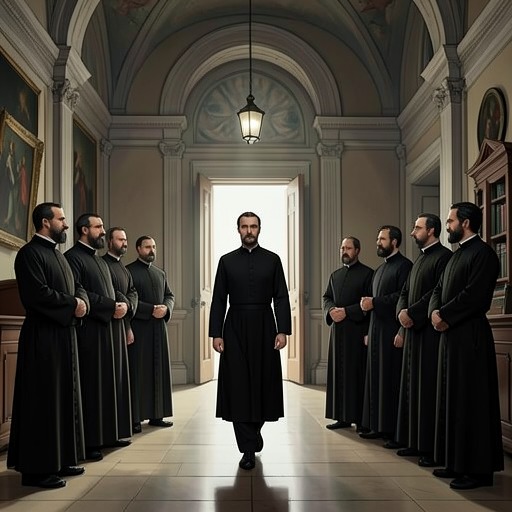
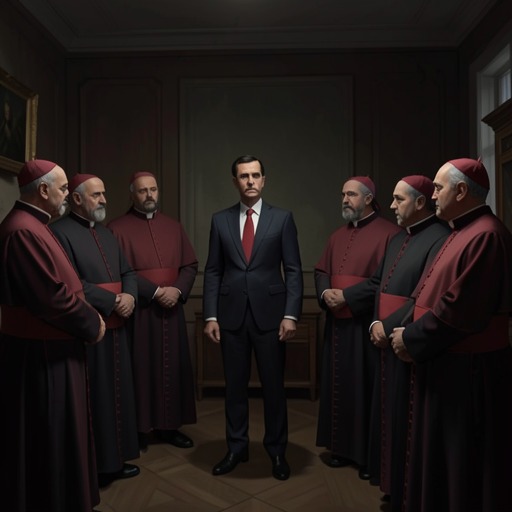
Jacopo Lomeli—Vincent Benítez relationship
ConclaveJacopo Lomeli—Vincent Benítez relationship is a bond formed during the papal election and sharpened by disagreement over what deserves a person’s ultimate loyalty. Benítez’s unexpected support unsettles Lomeli’s effort to direct votes toward a viable candidate; his deeper challenge—that Lomeli may have worshipped the Church rather than God—becomes a turning point in the Dean’s crisis of prayer. Their relationship joins political choices to spiritual discernment, and ends not in agreement about every institutional question but in friendship and Benítez’s counsel to follow conscience.
An Unexpected Vote
When Benítez tells Lomeli that he voted for him, the Dean is startled. Lomeli considers himself no serious candidate and answers that he is unworthy of the papacy. Benítez does not accept that self-assessment as a reason to withdraw support: he recalls Lomeli’s homily on doubt and faith, and says the Dean’s reflections resonate with his own experience, particularly what he witnessed in Africa. The vote is thus more than a gesture of personal loyalty; Benítez understands Lomeli’s acknowledged uncertainty as compatible with faith and leadership.
Lomeli responds by asking Benítez to vote instead for Cardinal Bellini, whom he regards as a more realistic candidate. Benítez refuses, contrasting Lomeli’s appeal with Bellini’s characterization by the late Pope as “brilliant but neurotic”. Lomeli repeats his request, but Benítez says he will continue to vote for him. The exchange establishes an enduring tension: Lomeli treats support as something that must be redirected for the good of the election, while Benítez insists that each elector must choose the person he believes most worthy.
The Election as a Moral Question
Later, Lomeli returns to the matter privately. He recalls that Benítez had voted for him and asks him to stop, with greater urgency than before. He advises Benítez to support Cardinal Tremblay and, if he knows who else voted for him, to urge those electors to do the same. Benítez suspects that two fellow countrymen, Cardinals Mendoza and Ramos, supported him despite his own requests that they not do so. He adds that Tremblay has spoken to him about the issue as well. The conversation makes clear that votes for Benítez have become a matter of competing influence, not simply a private expression of esteem.
Lomeli also assumes that Benítez, given his close relationship with the late Pope, would oppose Cardinal Tedesco. Benítez answers that his faith is in God alone and says he is not alarmed by a long conclave or even a schism: perhaps, he suggests, either is what God wills. Lomeli identifies the unity of the universal Church as the work to which he has devoted his life. Benítez then asks whether preserving institutional unity is worth doing at the price of breaking a sacred oath. The question forces into the open a distinction Lomeli would rather hold together: the Church as institution and the Church as the living embodiment of the Holy Spirit.
Benítez grounds his challenge in the suffering of people beyond the election. He says that he is more likely to encounter the Holy Spirit in the millions of women raped as an act of military policy during the civil wars of central Africa than in the institution whose unity Lomeli is trying to preserve. Lomeli is taken aback and insists that he would never knowingly break his oath to God, whatever the consequences for the Church. The exchange does not resolve their disagreement about schism or institutional unity; instead, it makes the Dean confront the moral cost of treating the preservation of unity as an answer in itself.
From Resistance to Recognition
As they part, Benítez apologizes if he has caused offence but remains firm: he cannot vote for someone unless he believes that person is the most worthy candidate, and for him that person is Lomeli, not Tremblay. Lomeli, frustrated, says he does not want the vote. Benítez nevertheless offers his hand and proposes that they go to dinner together. The gesture keeps personal friendship open where their political judgment remains opposed. It also marks a limit to Lomeli’s efforts to manage Benítez’s choice: the Dean can plead, but he cannot make Benítez vote according to strategic calculations.
At dinner, Lomeli cannot put the conversation out of his mind. He recognizes the force of Benítez’s accusation: perhaps for thirty years he has worshipped the Church rather than God. He experiences this as sin and heresy, and connects it to his difficulty in praying. The realization recalls an earlier epiphany in St Peter’s, indicating that Benítez’s words do not introduce an entirely new doubt so much as give language to a crisis already taking shape. Lomeli leaves the table, unable to remain among his fellow cardinals while he wrestles with it.
Conscience and Consequence
Their relationship continues beyond the private challenge. After Lomeli circulates a report implicating Tremblay, other cardinals object that Tremblay has had no opportunity to defend himself and accuse Lomeli of acting as judge and jury. Benítez brings Lomeli bread and fruit, asks a nun to pour coffee, and urges him to eat rather than make himself ill. Lomeli asks whether he did the right thing. Benítez answers that a person following conscience does not thereby do wrong, even if the consequences differ from what was intended or later reveal a mistake. Conscience, he says, is where a person most clearly hears the voice of God.
That reassurance does not promise that Lomeli’s actions will succeed or that his judgment cannot be mistaken. Its importance lies in separating the moral basis of a decision from its eventual outcome. Earlier, Benítez had questioned whether unity could justify breaking an oath; now he offers Lomeli a principle for facing the uncertainty that follows action. The relationship therefore links spiritual doubt to practical responsibility: the Dean cannot guarantee the consequences of his decisions, but neither can he avoid choosing by handing judgment over to institutional advantage alone.
Canon Law and Recognition
Their conversations take place amid a dispute about Benítez’s standing as a cardinal. Lomeli invokes the late Pope’s revision of the canon law governing secret appointments and argues that the relevant provision of the Apostolic Constitution allows an elector arriving before a new Pope has been elected to join the conclave at the stage it has reached. He therefore maintains that Benítez is legally a cardinal. This defense of Benítez’s right to participate gives their personal connection a procedural dimension: Lomeli’s insistence on the validity of Benítez’s place in the election is expressed through legal interpretation, not merely private sympathy.
The voting ritual itself makes the weight of each choice visible. Under the prescribed procedure, each elector carries a folded ballot to the altar, swears before Christ that the vote is for the person he believes should be elected, and places it in the receptacle. Benítez’s vote for Lomeli, and Lomeli’s later efforts to redirect it, thus stand against a formal oath that places judgment in the conscience of each elector. Their relationship’s central tension is not resolved by the rules: procedure specifies how the vote is cast, while Benítez and Lomeli continue to dispute what a faithful choice demands.
Benítez’s influence on Lomeli is consequential without becoming a conversion to Benítez’s every position. The Dean remains committed to the unity of the Church and concerned with the election’s lawful legitimacy; Benítez makes him examine whether such commitments have displaced his faith in God. From the first unexpected ballot to the counsel offered after Lomeli’s report, Benítez serves as friend and spiritual interlocutor rather than a subordinate whose support can be managed. Their bond matters because it leaves Lomeli with no easy guarantee—neither unity, institutional authority, nor good intentions can remove the risk of error—and presses him to act with conscience amid that uncertainty.