Trauma as a new organ
CrashWounds as sexual organs names the novel’s most disturbing erotic and technological conversion: injuries produced by automobiles cease to function merely as evidence of pain and become new bodily interfaces, orifices, and signatures of desire. The concept joins trauma to sexuality by treating the damaged body as a record of mechanical impact and as a site where forms of pleasure unavailable to an uninjured body can be imagined. Its decisive significance is that the car crash does not simply destroy the body; it redesigns the body’s erotic grammar.
Definition and Material Basis
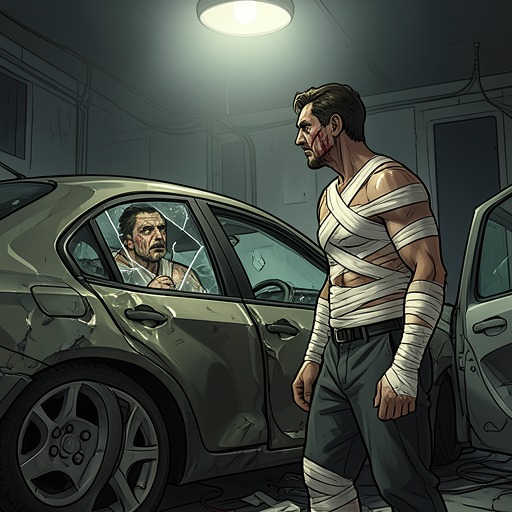
The concept begins with the narrator’s recovery after his collision on the Western Avenue flyover. His bruised chest, fractured knees, and damaged scalp preserve the arrangement of the car that struck him: the steering wheel leaves its profile across his chest, the instrument panel is reproduced on his knees and shins, and the horn boss has driven upward into the lower edge of the sternum. The injuries make the automobile legible through flesh. A vehicle engineer could reconstruct the car’s make and model-year from the pattern of the wounds, so that the body becomes both damaged organism and technical diagram.
This inscription is not presented as a neutral medical fact. The narrator compares the pressure-patterns left by the instrument panel with the remembered pressure of a woman’s body after sexual intercourse. The comparison shifts the wound from forensic evidence toward erotic memory, while also making sexual sensation resemble mechanical imprinting. Pain, touch, and machinery occupy the same descriptive field. The injured body is therefore not simply acted upon by technology; it becomes a surface on which technology produces new forms of sensation and new possibilities for interpretation.
The hospital intensifies this process of translation. The narrator lies in a casualty ward reserved for possible air-crash victims, surrounded by empty beds that seem to contain projected histories of collision and bereavement. Doctors identify fractured kneecaps and damaged nerves, while nurses handle the patient’s most infantile zones, emptying his urine bottle, adjusting drainage tubes, and cleaning his wounds. Their practical care establishes the body as a medical object, but the narrator’s attention repeatedly redirects that objectification toward sexuality. Even a nurse’s examination of the dressings becomes an occasion for reading automobile components as contact prints in skin and muscle.
From Injury to Auxiliary Anatomy
The concept becomes explicit in the narrator’s encounters with injured bodies whose relation to automobiles has altered their sexual selfhood. Photographs of a young woman recovering in a chromium wheelchair and learning to drive an invalid car show her moving from conventional femininity into a body reorganized by injury, rehabilitation, and technology. Her adapted controls, treadles, braces, and damaged thighs are interpreted as a new erotic system. The narration claims that the crushed sports car has released sexual possibilities within its twisted bulkheads and leaking engine coolant, but the scene also exposes the violence of converting a disabled woman’s concrete bodily experience into another person’s fantasy.
Gabrielle provides the fullest enactment of the idea. Her adapted car contains inverted treadles, clutch levers, a laterally extended gear lever, and a chromium control moulded to the driver’s palm. Her leg brace and spinal supports leave grooves, depressions, and reddened marks across her skin. The narrator treats these marks as embryonic sexual organs: the buckle groove in her thigh, the indentation beneath her breast, and the red mark beneath her arm become templates for organs that technology has not yet fully invented. The prosthetic and assistive apparatus is thus given a double function. It enables Gabrielle to drive, while the narrator erotically reads it as an instrument for remaking the body.
Their sexual encounter confirms the concept through reciprocal examination rather than through conventional genital contact. Gabrielle explores the narrator’s dashboard scars with her tongue, while he traces the wounds on her thighs, arms, breast, neck, and shoulder. The scars become codes that both bodies can decipher because both have been shaped by car crashes. His orgasm occurs within a wound in her thigh, and the semen is wiped against the silver clutch controls. Later, the narrator describes further orgasms taking place in scars beneath her breast and in the wounds of her armpit, neck, and shoulder. The damaged bodies and the machines that damaged them are joined in a single circuit of touch, memory, and desire.
Repetition, Photography, and the Crash Imagination
The transformation of wounds into sexual organs is inseparable from repetition. Robert Vaughan repeatedly stages, photographs, and rehearses crashes, treating each impact as a possible experiment in bodily redesign. His apartment is covered with photographs of Elizabeth Taylor, especially magnified details of her knees, hands, thighs, and mouth, which he compares with photographs of grotesque surgical wounds. He imagines a final collision in which the actress’s body and his own would receive corresponding injuries, including damage to their genitals. In his fantasy, the crash becomes an erotic tableau whose mechanical violence produces a new anatomy.
Vaughan’s own body supplies the concept with an earlier, public example. His face bears the displaced and reassembled appearance of a serious motorcycle accident, and his legs were broken by the rear wheels of a truck. The scars, missing teeth, altered nose, and damaged posture preserve the history of impact as visible form. Yet the body is also made into an object of voyeuristic and sexual attention. When Vaughan describes wounds and collisions, he becomes calm, and the narrator observes his groin as another object casually offered within the same field of provocation. Vaughan’s damaged body therefore models the conversion he teaches: injury is simultaneously evidence, spectacle, weapon, and erotic invitation.
Photography extends this conversion beyond the body present in the room. Vaughan’s album records the narrator’s accident, hospital admission, and recovery, but the photographs reveal more about Vaughan’s obsessions than about the patient. Cars, roads, flyovers, traffic jams, car parks, and lovers’ lanes recur as the true background. The narrator appears less as an individual than as an anonymous body moving across polished metal, vinyl seating, and instrument dials. The photograph turns flesh into an object of technical study, while the repeated automobile setting turns the whole of ordinary life into a possible crash scene.
Escalation into Future Bodies
Once the narrator accepts the logic of wounds as sexual organs, he begins to imagine injuries that would enlarge the body’s erotic repertoire. During sex with Gabrielle, he projects future accidents involving more complex automobile engineering and then extends the fantasy to thermonuclear chambers, computer circuitry, and white-tiled control rooms. The body becomes a field awaiting technological inscription. Auxiliary orifices would emerge wherever machinery fractures, punctures, or reshapes flesh, and sexual acts would celebrate the possibilities of technologies not yet imagined.
This escalation reveals both the conceptual power and the ethical danger of the idea. The narrator’s fantasies move from his own injuries and Gabrielle’s disabled body to the imagined mutilation of his wife, film actresses, television personalities, his mother, and children. The repeated structure is clear: a famous or intimate body is injured, the injury is converted into an erotic aperture, and technology supplies the form of the new anatomy. The fantasy claims to overcome fear by giving death and injury an erotic meaning, but it also strips other people of bodily autonomy by making their possible suffering available for someone else’s desire.
The concept therefore cannot be separated from the narrator’s unreliable and increasingly compulsive perspective. Gabrielle’s car, braces, and wounds have practical functions within a disabled person’s life, yet the narrator repeatedly subordinates those functions to his own erotic interpretation. The text presents the intensity of this perception without granting it a stable moral authority. The wound is real, painful, and materially specific; its status as a sexual organ belongs to a fantasy that appropriates that reality. The tension between lived impairment and erotic projection is central rather than incidental.
Narrative and Thematic Significance
Wounds as sexual organs reorganizes the novel’s understanding of technology, trauma, and identity. The automobile is not merely a tool of transport or a cause of accidental death. Its controls, panels, restraints, and wreckage enter the body and alter the terms by which the body can be seen, touched, and desired. The narrator’s scars, Gabrielle’s brace marks, and Vaughan’s facial injuries become a shared vocabulary of mechanical impact, allowing bodies to be read as maps of the machines surrounding them.
The idea also makes repetition a form of psychological compulsion. Crashes are rehearsed, photographed, remembered, fantasized, and reenacted; each recurrence promises to reveal a more complete relation between technology and flesh. Vaughan’s final collision with Elizabeth Taylor’s limousine gives the pattern its fatal culmination, while the narrator later imagines that Vaughan cannot truly die in a crash because he will be reborn through twisted radiator grilles and cascading windshield glass. Death does not end the system of signs. It becomes its most extreme inscription.
At the same time, the concept converts trauma from an event into an ongoing method of perception. The narrator’s hospital wounds remain readable long after the collision, and his later sexual encounters treat scars as active openings rather than healed remnants. The body carries the past forward as a set of possible future contacts. In this sense, wounds as sexual organs is not simply a metaphor for perverse desire; it is the novel’s governing proposition that modern technology generates new bodily meanings by breaking, marking, and reorganizing the human form.