Car crash eroticism
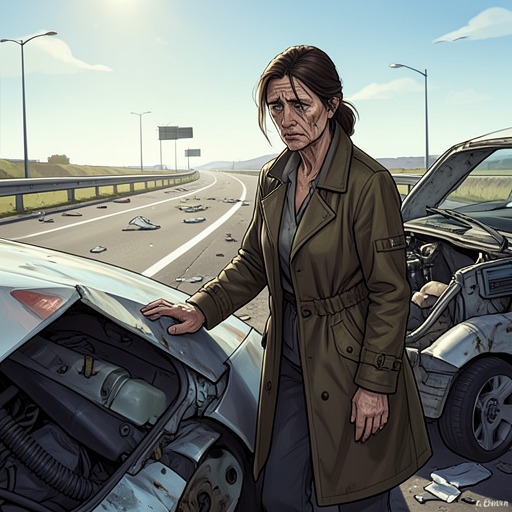
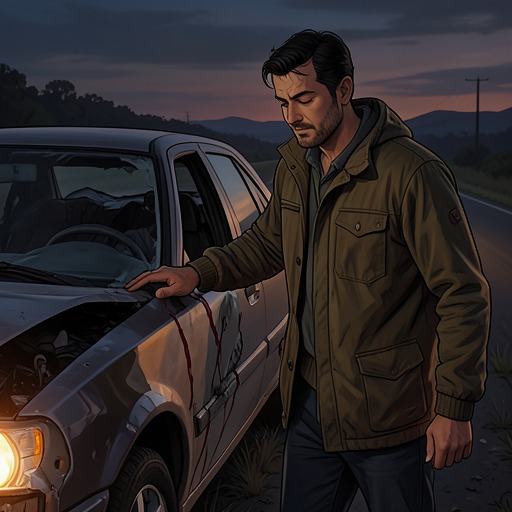
CrashThe eroticism of the car-crash is the governing idea of Crash: a vision in which the motor-car converts speed, power, injury, sexuality, and death into one technologically mediated experience. What begins as James Ballard's response to the collision in which he kills Dr Helen Remington's husband becomes a widening system of desire. Under Robert Vaughan's influence, damaged vehicles, clinical photographs, crash tests, motorway accidents, and sexual acts acquire related forms, until the car-crash appears as both a trauma and a new erotic language.
Definition and Origins
The concept arises from the contradiction surrounding the automobile. Modern societies depend on the motor-car and resist attempts to restrict it even though crashes kill and injure enormous numbers of people. The crash therefore embodies the fantasies that ordinary safety discourse tries to suppress: velocity, force, aggression, penetration, spectacle, and bodily vulnerability. Road-safety propaganda had already made Ballard anticipate his own death as though it were being rehearsed in advance, but the actual collision gives that abstract fear a physical reality. His wounds, pain, guilt over the dead man, and confrontation with the car's interior become more compelling than the regulated fictions of prevention.
The idea also develops from Robert Vaughan's fascination with damaged automobiles. Vaughan treats crashed vehicles as records in which a human body, a machine, and a moment of violence have been permanently joined. His apartment contains photographs of wounds and collisions, and he describes his imagined final crash with an erotic tenderness that makes injury resemble the body of a desired lover. The crash is not simply a source of excitement for him; it is the form through which his sexuality recognizes itself. His scarred face, itself marked by the motorcycle accident that ended his television career, makes his body a living continuation of the wreckage he studies.
Wounds, Bodies, and Machines
For Vaughan, every wreck contains an erotic geometry. Blood-soaked instrument panels, seat-belts smeared with excrement, brain tissue on sun-visors, crushed radiator grilles, and dashboards forced against a driver's crotch turn the passenger compartment into a record of contact between metal and flesh. The intimate time and space of a person are fossilized in chromium, glass, vinyl, and distorted bodywork. Injury is therefore both physical evidence and sexual image: the machine appears to penetrate, restrain, expose, and preserve its occupants.
Vaughan extends this logic to the women he meets. He photographs injured women and stages sexual postures in abandoned cars, treating their strained bodies as related to the wounds documented in surgical textbooks. His attention moves obsessively among facial damage, genital wounds, and infections, collapsing medical observation into voyeurism and desire. The injured body becomes an object of study, a scene of erotic projection, and a possible rehearsal for the fatal collision he wants to create.
The concept also structures James Ballard's relation to Helen Remington. Their attraction begins in the aftermath of the crash that killed her husband, and Ballard imagines sexual union with her as a way of re-conceiving or re-seeding the dead man within her. Their encounters occur only inside Ballard's automobile; in an ordinary bedroom, desire fails, while the car's metal and vinyl compartment supplies the necessary setting. Each act repeats the husband's death through new arrangements of mouths, thighs, nipples, and tongues. Sexuality does not escape the crash but re-enacts it, making grief, guilt, and bodily pleasure inseparable.
Spectatorship and Social Contagion
The eroticism of the car-crash spreads beyond Vaughan and Ballard into the crowd that gathers around accidents. At a major collision, children sit on parents' shoulders while hundreds of spectators study the damaged vehicles with calm, almost expert attention. Their interest settles on the displaced radiator grille, distorted taxi frame, and frosting patterns on shattered windshields. The scene suggests that technological violence has become a shared visual culture: spectators no longer respond only with fear or pity but with absorbed interpretation.
The crowd's fantasies are described as extending the crash into imagined sexual acts performed on the injured occupants. Violence and desire appear to generate one another, while the broken limousine becomes a chamber in which private fantasies are projected by an audience. Traffic continues to accumulate around the scene, producing a paradoxical image of a modern system immobilized by the spectacle of its own danger. Ballard experiences an unusual calm at the centre of this congestion, as though the multiplying vehicles and the crash have finally aligned with the obsessions that had previously remained private.
The concept is likewise transmitted through repeated images and mechanical observation. Ballard and Vaughan visit the Road Research Laboratory to watch calibrated vehicles strike concrete target blocks, then view slow-motion films of the impacts in Vaughan's apartment. The silent sequences first calm Ballard and then arouse him. Police broadcasts guide them from one accident to another, and Vaughan competes with rescuers for photographs. The technological systems designed to measure, prevent, and document injury become instruments through which injury is consumed and desired.
Vaughan's Programme of Desire
Vaughan gives the concept an organized, almost scientific form. His questionnaires are completed by programmers, medical workers, airport stewardesses, Vera Seagrave and Seagrave, a television producer, and Gabrielle; every participant has experienced some kind of automobile crash. They are asked to imagine the death of a celebrity in a car accident, choosing among carefully researched forms of impact and bodily damage. The exercise turns private fantasy into a survey, converting the erotic imagination of catastrophe into data gathered from a social cross-section.
His own project is more specific and more destructive. Vaughan is obsessed with dying in a collision with Elizabeth Taylor, and the ten-year-old Lincoln Continental he drives recalls the limousine associated with President Kennedy's assassination. When James Ballard asks whether Vaughan sees Kennedy's death as a special kind of car-crash, Vaughan accepts that such a case can be made. The vehicle consequently carries historical violence as well as personal desire: celebrity, political murder, technological display, and sexualized death converge in the car Vaughan uses to pursue his fantasy.
Ballard's relationship with Vaughan is established through this shared but unequal fascination. From their first meeting, Ballard's hostility gives way to deference and a form of subservience. Vaughan's driving, alternately aggressive, distracted, clumsy, and brutal, establishes the pattern of their entire relationship. Ballard is both witness and participant, repelled by Vaughan's violence yet drawn into the images and bodily possibilities that Vaughan makes available. Vaughan's sexuality is used as another instrument of control; he understands that provoking Ballard with his body can keep him from leaving.
Repetition, Trauma, and Final Meaning
The concept is inseparable from repetition. Crashes are revisited in photographs, laboratory films, police scenes, staged sexual postures, questionnaires, and imagined celebrity deaths. Ballard's first collision returns through his guilt, his physical wounds, his encounters with Helen Remington, and the recurring conviction that sexuality inside the car repeats the dead husband's destruction. The crash is therefore not a single past event but a structure that continually reappears in altered forms.
Robert Vaughan's death gives this structure its most extreme expression. After stealing Ballard's car, Vaughan dies beneath the flyover, his body displaying the broken postures and bloody geometry that resemble the crash photographs covering his apartment. The film actress remains nearby, and Vaughan has dreamed of dying at the moment of her orgasm. His death appears to complete the union of sexuality and collision, yet it does not end the concept. Ballard understands Vaughan as capable of being reborn through twisted radiator grilles and cascading windshield glass, as though the crash has converted him from an individual into a recurring technological image.
The ending broadens the idea beyond Vaughan's private programme. Ballard sees Catherine's aircraft above the motorway and reads the moving cars below as possible trajectories of a future passage through a technology with wings. The motorway, the aircraft, the damaged body, and the remembered lover belong to one continuous landscape of technological desire. The eroticism of the car-crash thus names not a decorative motif but the novel's final account of modern subjectivity: bodies seek intimacy through machines, trauma returns as fascination, and death becomes the ultimate, repeatedly rehearsed form of sexual and technological contact.