Collision as a death rehearsal
CrashCrash as rehearsal for death is a central organizing concept in Crash: automobile accidents are not merely sudden disasters but repeated approaches to an anticipated end. The novel shows death being rehearsed through public warnings, laboratory simulations, private fantasies, photographic records, sexualized observation, and increasingly deliberate collisions. Repetition promises knowledge and control, yet it also deepens compulsion, until Robert Vaughan’s planned death becomes the literal completion of a sequence he has practiced in imagination and in stolen cars.
Public Anxiety and the Anticipated Accident
The concept begins with the ordinary modern fear that death has already been scripted by technological culture. The narrator recalls being bombarded by road-safety propaganda, billboard warnings, and television films of imaginary accidents. Rather than reassuring him, these campaigns create the sense that the gruesome climax of his life is being rehearsed years in advance on an unknown highway or road junction. He has even speculated about the kind of traffic accident in which he will die. The accident therefore exists before its occurrence as a cultural image, a possibility continually circulated until personal mortality seems to possess a prefabricated form.
This public rehearsal reflects the novel’s wider paradox. The motor-car fascinates millions even while car crashes kill and injure vast numbers of people, and efforts to regulate driving meet resistance. The crash concentrates fantasies of speed, power, violence, and sexuality that ordinary safety discourse tries to suppress. Its danger is consequently not outside modern desire but embedded within it: the warnings display the event they seek to prevent, making the accident both forbidden outcome and recurring spectacle.
Vaughan’s Repetitions and Imaginary Almanac
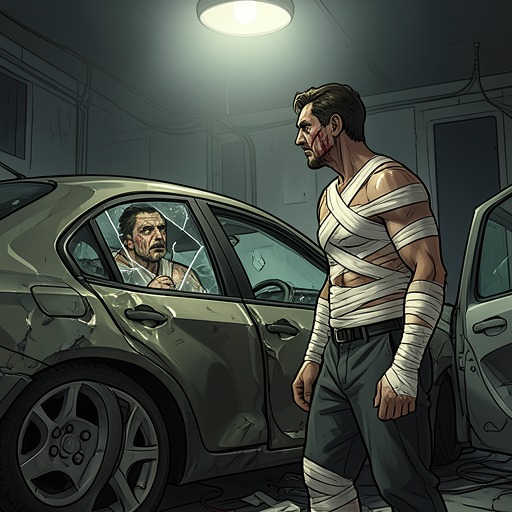
Robert Vaughan converts anticipation into a private discipline. Before his final accident, he rehearses his death in many crashes, using stolen and damaged cars as instruments through which an imagined ending can be approached repeatedly. The narrator finds him after an early rehearsal on the airport flyover, sitting in a wrecked white convertible and studying his own posture amid blood, vomit, broken glass, and photographs of Elizabeth Taylor. Vaughan treats the damaged vehicle and his injured body as parts of a composition that can be inspected, revised, and repeated.
His imagination extends the rehearsal beyond his own body. He devises an almanac of automobile disasters and insane wounds: lungs punctured by door handles, chests impaled by steering columns, and faces pierced by chromium fittings. These imagined injuries are not incidental horrors but, for Vaughan, the keys to a new sexuality born from technology. He also invents crashes involving limousines, tankers, taxis, children, criminals, lovers, honeymoon couples, automobile stylists, and laboratory workers. Each scenario gives a particular body, social role, and relationship its appointed collision, turning mortality into an expandable catalogue of forms.
The repetition has a double effect. It appears to make death legible by isolating its mechanisms—the ejection of passengers, the deformation of compartments, the geometry of wounds, and the sequence of impact. At the same time, the catalogue multiplies rather than resolves uncertainty. Every imagined crash generates another variation, so that knowledge becomes an appetite for further images. Vaughan’s preparation is therefore both an attempt to master death and a surrender to the compulsive production of its scenes.
Simulation, Spectatorship, and the Real Crash
The novel places private rehearsal beside institutional simulation. The narrator and Vaughan visit the Road Research Laboratory, where calibrated vehicles are driven into concrete target blocks. Later Vaughan screens slow-motion films of test collisions, and the repeated impacts first calm and then arouse the narrator. The controlled experiment turns violence into measurable procedure, while the film transforms it into a replayable image. The crash can be stopped, examined, and shown again, but its repetition also removes the boundary between scientific observation and erotic fascination.
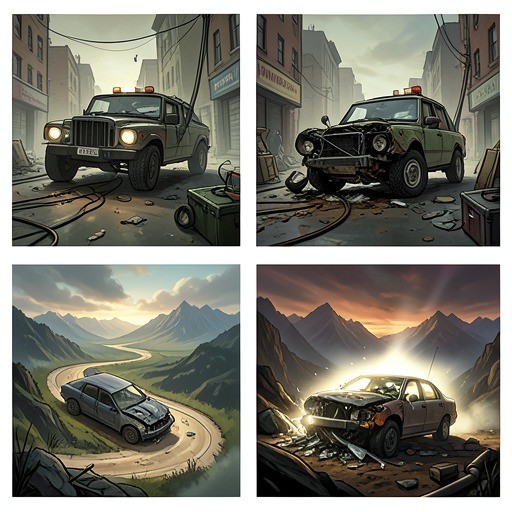
A public recreation of a multiple pile-up makes the same process theatrical. The programme announces the recreation of a spectacular road accident, and five cars are arranged to reproduce a previous disaster in which seven people died on the North Circular Road. The event is presented as entertainment, yet the phrase “The real thing is available free of charge” exposes the tension between staged and actual catastrophe. A simulated collision involving a motorcycle and a saloon car produces a violent metallic impact, crushed bodywork, a decapitated mannequin, and fragments scattered around the test vehicle. Engineers reassure the crowd and collect the artificial body parts, making the scene resemble a ritual recovery of victims while preserving the knowledge that the destruction can be repeated.
The ordinary public responds to actual crashes with a similarly rehearsed attentiveness. At a major collision, spectators—including children lifted onto their parents’ shoulders—watch without alarm. Their calm, studied interest suggests that they understand the fine points of displaced grilles, distorted frames, and shattered windshields. The accident has become a spectacle whose meanings are collectively recognized. Observation prepares the spectators for imagined participation, while the repeated public gaze makes catastrophe part of the landscape of everyday traffic.
From Accident to Deliberate Script
The distinction between accident and intention becomes increasingly unstable. The narrator’s own crash kills Dr Helen Remington’s husband, yet the police investigation returns a verdict of accidental death and brings no charge of manslaughter or negligent driving. Institutional language closes the case even as the narrator and Helen continue to experience the collision as a charged conjunction of wounds, grief, desire, and memory. Helen’s persistent questioning about the wrecked car and the crushed radiator grille shows how the accident remains active after its legal classification has ended.
Other scenes place sexual activity beside fresh traffic violence. At the airport, the narrator is interrupted by the sound of an airline coach ramming a taxi, a traffic jam, injured passengers, and police moving through the concourse. The collision does not cancel the sexual scene; it becomes part of its atmosphere and structure. Rescue, injury, machinery, and bodily arousal occupy the same field, as though the public accident were another rehearsal whose gestures have already been absorbed into private conduct.
The concept reaches its most dangerous form in Vaughan’s pursuit of Elizabeth Taylor. He photographs her body from bridges, motorways, and the roof of the car park, matching magnified details of her knees, hands, thighs, and mouth with images of surgical wounds. Her death is imagined as a coronation of wounds, a final composition prepared with the devotion of a ceremonial planner. The photographs function as rehearsal materials: they allow Vaughan to study the person who will occupy the desired collision before the collision occurs.
Completion in Vaughan’s Final Crash
Vaughan’s final crash is the point at which rehearsal becomes reality. He drives on a collision course toward Elizabeth Taylor’s limousine, his chosen destination not simply the actress herself but a death staged around her body and public identity. His car jumps the rails of the London Airport flyover and plunges through the roof of a bus filled with airline passengers. The result exceeds the private script: package tourists are crushed, the chauffeur is killed, and Vaughan’s intended encounter with the actress is transformed into a mass casualty event.
Yet the ending also confirms the power of the rehearsal. Vaughan dies in the posture and setting toward which his fantasies have been moving, beneath police lights and beside the actress for whom he had imagined dying. The narrator recognizes that Vaughan had dreamed of dying at the moment of her orgasm, linking the anticipated collision to a final sexual consummation even though the actual crash produces only wreckage, blood, and witnesses. The planned death is therefore both fulfilled and defeated: its central image is realized, but its consequences escape the aesthetic and erotic control Vaughan sought.
The aftermath makes the concept ethically unstable. Vaughan’s death is not an isolated private act but an imposed disaster involving passengers, drivers, rescuers, police, and spectators. Earlier, Vaughan’s random violence includes striking a dog and leaving the damaged car behind, while later the police pursue him after an American serviceman is killed on the Northolt overpass. Rehearsal thus progresses from imagined wounds to repeated experiments and finally to the destruction of other people. What begins as a fantasy of mastering one’s own death becomes a practice of distributing death among unwilling bodies.
Narrative and Thematic Significance
Crash as rehearsal for death gives the novel its circular structure. The opening announces that Vaughan died yesterday in his last car-crash, then moves backward through earlier crashes, photographs, simulations, fantasies, and encounters that explain how the ending was prepared. The reader knows the outcome from the beginning, but repetition changes its meaning: each return to damaged metal, scarred flesh, police lights, and watching crowds makes the final accident appear less like a surprise than like the unavoidable completion of a technological ritual.
The concept also explains the novel’s treatment of trauma. The narrator’s first collision is physically over but continues through dreams, fantasies, hospital procedures, the inquest, the wrecked car, and his repeated return to crash scenes. Rescue itself acquires stylized gestures, and the injured body becomes an object to be photographed, examined, and mentally replayed. The inability to separate witnessing from participation gives repetition its disturbing force: the crash must be looked at again because it has not become intelligible, yet looking again also turns it into desire.
Ultimately, the rehearsal of death exposes a culture in which risk is simultaneously calculated and consumed. Laboratories measure impacts, safety campaigns dramatize them, questionnaires ask people to invent celebrity deaths, spectators study wreckage, and Vaughan converts the whole system into an erotic programme. The automobile promises movement and control, but the repeated crash reveals the opposite: modern technology supplies an elaborate language for approaching death while making the approach itself fascinating. In that sense, Vaughan’s final collision is not an aberration from the world around him. It is the most literal and catastrophic version of a rehearsal already being performed by institutions, images, drivers, and spectators.