Technology generated new properties
CrashTechnology-generated new sexuality is the novel’s radical account of desire after the automobile crash has become an erotic and imaginative system. It emerges from the conjunction of damaged bodies, engineered surfaces, traffic infrastructures, cameras, hospitals, and fantasies of celebrity catastrophe. Rather than treating sexuality as a stable relation between intact human bodies, the concept relocates desire in wounds, controls, impact forces, and the abstract designs of modern technology.
Definition and Origin
The concept is first articulated through Robert Vaughan’s conviction that wounds are the keys to a sexuality born from perverse technology. He composes an imaginary almanac of automobile disasters: lungs punctured by door handles, chests impaled by steering columns, and cheeks pierced by chromium quarter-light latches. These injuries are not merely scenes of suffering. In Vaughan’s mental gallery they become exhibits, each wound converting mechanical damage into a new erotic possibility. The accident therefore does not interrupt sexuality from outside; it generates another sexuality from within the collision between flesh and machine.
This sexuality is also described as potentially divorced from physical expression. Catherine Ballard’s desire for her secretary Karen increasingly depends on the idea and language of a lesbian act rather than on any confirmed act itself. Her fantasies become necessary to orgasm, yet they circulate among descriptions of bodies and anatomical details without requiring a corresponding physical encounter. Desire becomes an abstract system searching for objects, a language whose intensity no longer depends on conventional consummation. The distance between imagined contact and actual contact is not a deficiency in the novel’s logic but one of the concept’s defining conditions.
The Automobile as Sexual Apparatus
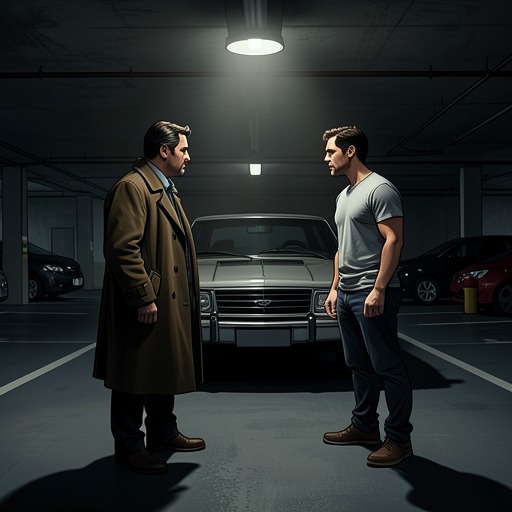
The automobile supplies the concept’s central grammar. Through Vaughan, James Ballard learns to read whiplash, rollover, and head-on collision as forms of bodily knowledge. At the Road Research Laboratory, calibrated vehicles strike concrete target blocks while cameras record the impacts in slow motion. Later, the repeated sequences calm and arouse James as they flicker across Vaughan’s apartment wall. The test vehicle, the concrete block, the recording apparatus, and the spectator form a single erotic circuit in which technology produces an affective response before either man names it as emotion.
The same circuit extends across the airport expressways. James and Vaughan follow police broadcasts from one crash site to another, watching firemen and police engineers cut trapped passengers from wreckage. Vaughan waits especially for vehicles crushed against motorway pillars, where deformed metal meets the apparently serene geometry of concrete. The road system is not a neutral background to desire: its lanes, overpasses, emergency services, warning signals, and engineered speeds organize the scenes through which desire travels. Traffic becomes a social and technological assemblage whose accidents expose possibilities that ordinary driving conceals.
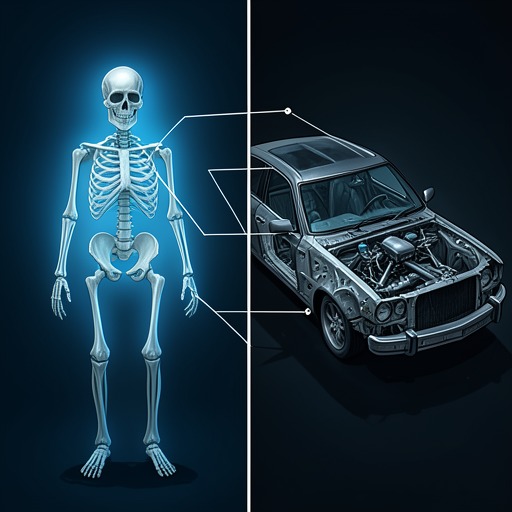
The concept also reverses the ordinary hierarchy between person and machine. In the hospital, James experiences his injured body as an inexhaustible encyclopedia of pain and discharge, while a technician arranges his legs around X-ray equipment like a jointed humanoid dummy. At the Laboratory, plastic mannequins occupy damaged cars with predicted wound areas marked on their heads, chests, and abdomens. The human body is rendered measurable, replaceable, and reproducible; at the same time, the machines and instruments become extensions of bodily sensation. The boundary between apparatus and organism consequently becomes one of the principal sites of erotic invention.
Wounded Bodies and Transformed Identity
Gabrielle provides the most sustained image of a body transformed by this process. Her crushed sports car does not simply leave her injured; in the narrator’s interpretation, it releases sexual possibilities that had not existed within her former, conventional life. During recovery she learns to use a chromium wheelchair and later an invalid car, handling its treadles and gear changes with a new bodily expertise. The car’s controls become extensions of her altered body, while her posture at the wheel echoes the geometry of the damaged vehicle.
The photographs of Gabrielle’s recovery make transformation visible as a sequence. She moves from the wrecked car to the wheelchair, from assisted movement to propelling herself, and finally to driving. Her crippled thighs, wasted calf muscles, scars, and altered facial planes are read alongside the car’s twisted panels and leaking mechanical systems. The narrator imagines her new skills as an analogue of the specialized capacities produced by the technologies of the twentieth century. Disability is thus represented not only as loss or medical damage, but as an opening into a different bodily repertoire—although the account remains filtered through Vaughan’s and James’s eroticizing gaze rather than through Gabrielle’s independent explanation of her experience.
James’s response marks his own conversion to the concept. Vaughan’s photographs of violence and sexuality expose a latent homoerotic dimension in James’s imagination and give a positive form to his otherwise confused response to his crash. The damaged woman and the damaged automobile appear to reveal a new sexuality at once. James can imagine sexual contact with Vaughan without conventional sensuality; the very absence of ordinary erotic feeling makes the act possible as an abstract, stylized event. Sexuality here is not intensified intimacy but the removal of intimacy’s customary emotional coordinates.
Expansion into Fantasy and Celebrity
Once absorbed into James’s imagination, technology-generated sexuality expands beyond existing bodies toward hypothetical future technologies. While embracing Gabrielle, he imagines wounds connected to thermonuclear chambers, computer circuitry, and white-tiled control rooms. Future machines become potential anatomical systems, and unknown injuries become prospective sexual openings. The fantasy does not seek a return to natural sexuality. It projects desire forward into increasingly elaborate technical environments, as though every new apparatus might create another organ.
The same logic makes famous and beautiful bodies especially charged. James imagines film actresses and television personalities injured in collisions, their bodies flowering into auxiliary orifices that establish sexual conjunctions with their audiences. Celebrity is therefore not merely an object of voyeurism; it is a mass technological relation in which the public encounters transformed bodies through media images. Vaughan’s fixation on Elizabeth Taylor’s possible crash joins the private fantasies of injury to the public machinery of cinema, publicity, cars, and spectatorship.
Vaughan’s own body is another technical archive. The scars across his abdomen and chest are described as handholds created by cars in deliberate crashes, furnishing a future map for sexual acts. His damaged skin records the collision history that produced his theory, while his cameras convert other wrecks and wounds into images that can be replayed, enlarged, and recombined. His body and his photographic album thus perform the same operation: each turns trauma into a surface on which new arrangements of sex and machinery can be designed.
Circulation, Consequences, and Significance
The concept ultimately changes James’s relation to fear, death, and Catherine Ballard. As he embraces Gabrielle, he can visualize injuries he had previously feared, including catastrophic damage to his wife’s face and body. The fantasy is presented as a way of making feared deaths imaginable by converting them into erotic forms. This is not healing in a conventional sense. It is a reorganization of terror in which the wound becomes an object of attachment and the accident becomes a route toward mental control.
The concept also carries a disturbing violence. Vaughan’s calmest moments occur when he describes his final imagined crash, speaking of wounds and impacts with the tenderness of a separated lover. He uses his own sexuality to keep James from leaving him, while his camera and his driving repeatedly draw other people into the same system. James recognizes that Vaughan’s conduct has become random and that he has been reduced to a captive spectator, yet he continues to absorb Vaughan’s vocabulary of impact. The new sexuality therefore spreads through bodies and relationships as an affective contagion, not simply as an intellectual theory.
Its final image is infrastructural and collective. After Vaughan’s death, Catherine and James move among derelict cars and begin imagining the elements of their own crash. The expressways contain what James calls formulas for an infinity of sexual bliss, and every passing car carries a fragment of the sun. Meanwhile, aircraft rise from the airport carrying the remnants of Vaughan’s semen toward the instrument panels and radiator grilles of countless crashing cars and the bodies of millions of passengers. Vaughan’s death does not close the system: it disperses his sexual and technological logic through the traffic network. Technology-generated new sexuality consequently names both a private transformation and a wider modern condition, in which machines do not merely transport desire but manufacture its objects, wounds, repetitions, and possible futures.