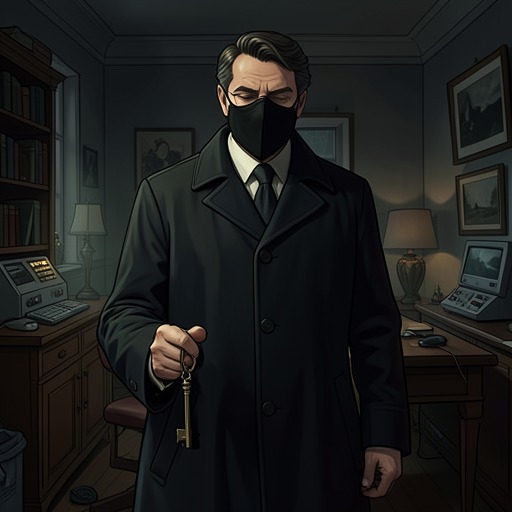
Death of Hercule Poirot
CurtainThe Death of Hercule Poirot closes the partnership between Hercule Poirot and Arthur Hastings while leaving its final mystery unresolved. Poirot dies after Stephen Norton’s death, and although the explanation given is a heart attack, Hastings refuses to accept that his friend’s death was natural. The final letter makes the death more complicated still: Poirot says he moved his amyl nitrite ampoules away from his bed and entrusted himself to God, a choice that turns his last hours into an act of deliberate surrender without establishing who, if anyone, killed him.
The death and its immediate aftermath
When Curtiss came to attend to his master, he found Hercule Poirot dead. Hastings later describes the news as a loss that diminished his own life as well as ending Poirot’s: with Poirot, he says, a good part of Arthur Hastings died. His grief shapes the account’s form. He does not want to write about the death and says he wants to think about it as little as possible; what follows, he insists, will be bare facts rather than an embellished narrative.
The reported cause of death was natural: Poirot had suffered a heart attack. John Franklin had expected that this was how Poirot would die, and Hastings considers the possibility that the shock of Norton’s death brought on the attack. But the amyl nitrite ampoules that should have been beside Poirot’s bed were not there. That absence initially presents itself as a possible oversight, then becomes the detail that makes the official account difficult for Hastings to accept.
Hastings’s unanswered suspicion
Hastings asks whether someone deliberately removed the ampoules, but he cannot make the evidence settle into a definite explanation. He reasons that X could not have counted on Poirot suffering a heart attack. His conclusion is not a solved case but a refusal: he will not believe Poirot’s death was natural, yet he does not know why Poirot, Barbara Franklin, and Norton were killed, or who killed them. Suspicion and uncertainty remain together, without a final accusation supported by proof.
The contrast with Norton’s death sharpens that uncertainty. Norton’s death had been ruled a suicide at an inquest, despite the surgeon’s observation that shooting oneself in the exact centre of the forehead was unusual. Other details made the verdict appear straightforward: the door was locked from inside, the key was in Norton’s pocket, the windows were shuttered, and a pistol was in his hand. The pistol had been seen on his dressing table during his stay at Styles, while headaches and failing investments were offered as possible reasons for suicide. Hastings calls the death another beautifully staged crime, but the apparent completeness of that scene does not give him a solution to Poirot’s death.
Poirot’s final choice
Poirot’s final letter supplies a crucial fact about the missing ampoules. He writes that he moved them away from beside his bed and says he prefers to leave himself in the hands of God, hoping that punishment or mercy will be swift. The absence was therefore not simply an unnoticed failure to keep the medicine close: Poirot himself had arranged it. Yet the letter does not identify a killer or explain whether he expected a particular outcome. It establishes a deliberate decision to leave himself without the ampoules, while preserving uncertainty about the precise circumstances and cause of his death.
That choice gives the ending its moral and emotional weight. Poirot had killed Norton, believing that taking Norton’s life had saved innocent people, but his letter does not claim certainty about the rightness of what he had done. Instead, he acknowledges that he may have been too sure and says that he no longer knows. His decision to move the ampoules away from his bed and place himself in God’s hands follows this admission of uncertainty; it is evidence of surrender, not a complete explanation of how he died.
The end of the partnership
The death also ends the shared investigative life that has defined the relationship between Poirot and Hastings. In the letter, Poirot says that they will not hunt together again and recalls that their first hunt was at Styles and their last was there as well. The return to Styles gives their partnership a final frame: the place associated with their first investigation becomes the setting of its end.
Hastings’s narrative cannot provide the certainty Poirot once supplied. He records the reported heart attack, the absent ampoules, his suspicion, and his ignorance, leaving the reader with the same gap between an official account and an unproved alternative. Poirot’s death is therefore both a personal bereavement and the last unresolved event of the story. His final act does not restore the detective’s authority or produce a definitive verdict; it leaves Hastings, and the investigation, without the companion whose judgment had so often made the facts cohere.