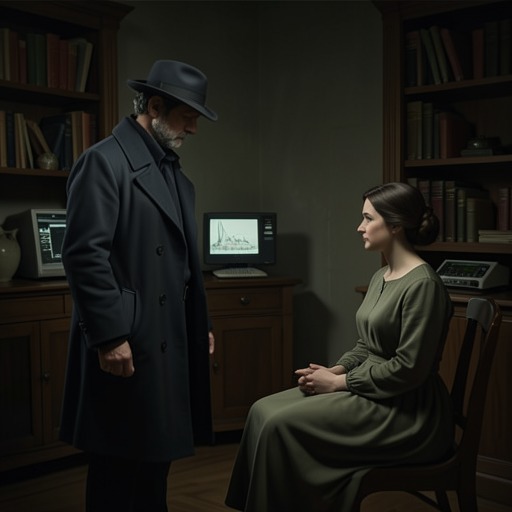
Leonard Etherington poisoning case
CurtainThe Leonard Etherington poisoning case begins with a death that seemed at first to be food poisoning and ends with an acquittal that did not restore the accused woman’s life. In Hercule Poirot’s later case précis, the case is both an unresolved question of guilt and one strand in a pattern of five deaths linked by the elusive figure X.
Death and investigation
Leonard Etherington is described in Poirot’s précis as an unpleasant, sadistic man who took drugs and drank. His young and attractive wife was desperately unhappy with him and had been badly treated. Etherington died apparently from food poisoning, but the doctor was dissatisfied with that explanation. An autopsy established that he had been poisoned with arsenic.
There was weed killer in the house, but it had been ordered long before the death. Its presence offered a possible connection to the poison without, on its own, establishing who had used it. The case against Mrs Etherington was therefore circumstantial: the account stresses both the absence of another likely suspect and the perceived unlikelihood of an accident.
Trial and acquittal
Mrs Etherington had recently become friends with a man in the Civil Service who was returning to India. There was no suggestion of actual infidelity, but there was evidence of deep sympathy between them. The man later became engaged to a woman he had met on the voyage out. A letter informing Mrs Etherington of that engagement was central to an uncertainty in the case: she said she received it before her husband died, but there was doubt about whether it had reached her before or after his death.
At trial, the account says, the jury felt considerable sympathy for Mrs Etherington because of her husband’s character and his treatment of her. The judge’s summing-up was in her favour, emphasizing that guilt had to be established beyond any reasonable doubt. She was acquitted. The verdict settled the legal question in her favour, but Poirot’s précis records that general opinion nevertheless held her guilty; it does not present that public belief as proof.
Aftermath and unresolved judgment
The acquittal did not end the case’s consequences for Mrs Etherington. Friends and others cold-shouldered her, and her life afterward became very difficult. Two years after the trial, she died after taking an overdose of sleeping draught. The inquest returned a verdict of accidental death. That finding is distinct from the public opinion that she had murdered her husband: the account supplies no definitive resolution of either the original poisoning or the later overdose beyond the formal verdicts.
Place in Poirot’s pattern
Poirot introduces the Etherington case as the first of the cases in a précis he has prepared for Arthur Hastings, distinguishing these summaries from newspaper cuttings that he says may be inaccurate or merely suggestive. His account gives the reader a compact record of the evidence and its uncertainties rather than a courtroom reconstruction.
Later, Poirot identifies Etherington as one of five deaths connected by X’s presence in the lives or surroundings of the people involved. He says X was on intimate terms with Etherington. This connection does not establish that X poisoned Etherington, nor does Poirot’s account here disclose a motive. Instead, the case becomes part of a larger puzzle: circumstances that might be coincidence in isolation appear more significant when considered alongside X’s other associations. That framing preserves the gap between suspicion, public judgment, and demonstrated guilt that had already defined the case itself.