Knatton
CurtainKnatton is Sir William Boyd Carrington’s large, old-fashioned estate: a Tudor house with a later wing, neglected gardens, and rooms that have scarcely been modernized. It embodies both the wealth inherited from a reclusive uncle and the loneliness that wealth cannot remedy. Through the visit that Arthur Hastings makes with Boyd Carrington, the house becomes more than a setting: its architectural neglect, remembered history, and place in the neighborhood reveal the distance between possessing a home and knowing how to live in it.
House and Setting
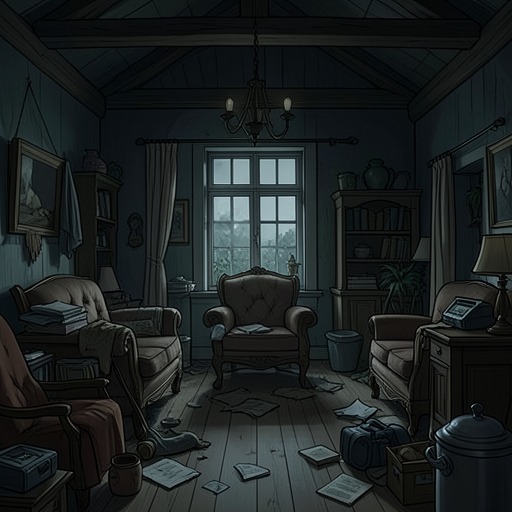
Knatton is described as a mausoleum, a judgement that joins its imposing character to its failure as a comfortable home. Boyd Carrington despairs of making it livable, and his first practical ideas are limited to baths and comfortable chairs. He thinks the place needs a woman’s touch; Barbara Franklin, by contrast, sees in it the possibility of making something marvelous. Their difference makes the house a space of unrealized potential: its scale and age inspire admiration, but its upkeep has not yet become a coherent domestic project.
The estate’s architecture makes that neglect concrete. Knatton is mainly Tudor, with a wing added later, and it has remained unmodernized since two primitive bathrooms were installed around the 1840s. The young architect who comes forward to meet the visitors marks an attempt to assess the work required, but the account does not say that a renovation is completed. The house is therefore presented in the interval between inheritance and improvement, its historic fabric still dominant over the modest changes made to it.
The Estate’s Past and Inheritance
Boyd Carrington explains that Knatton belonged to his uncle, Sir Everard, a man who disliked people and lived in a corner of the vast house. As boys, Boyd Carrington and his brother were tolerated there during their holidays; later, Sir Everard became an even more complete recluse. The detail of his life confined to one corner gives the estate’s size an emotional counterweight: this was not a bustling ancestral home but an immense dwelling occupied by someone who withdrew from company.
Sir Everard never married and spent only a tenth of his large income. After death duties, the inheritance still left Boyd Carrington very rich. Yet Boyd Carrington calls himself a lonely man, so the transfer of wealth does not resolve the human isolation associated with the house. The estate carries forward the material consequences of Sir Everard’s solitary existence while placing its new owner in a position to change the building, if not simply to escape the bachelor life he says he has made for himself.
People, Memory, and the Neighborhood
Knatton connects Boyd Carrington to an earlier chapter of Barbara Franklin’s life. She explains that her people used to live in that part of the country and that Boyd Carrington visited his old uncle at Knatton. His visits overlapped with her childhood: he remembers giving her piggybacks when she was a small child and later taking her out to play golf as she approached her debut in society. The estate is thus not only his inheritance but also a place threaded through a shared history of family visits and changing ages.
When Arthur Hastings visits the estate, he enjoys the summer weather and Boyd Carrington’s company. Boyd Carrington tells him stories about his administrative years in India and details of East African tribal lore; Hastings finds the conversation diverting enough to forget, for a time, his anxieties about Judith Hastings and Hercule Poirot’s revelations. The visit gives Knatton a social life beyond its shut-in history, though that liveliness belongs to a guest’s afternoon rather than to any described transformation of the house.
Boyd Carrington knows the neighborhood and many of its residents, though he recognizes that newcomers have arrived since his earlier years there. He also knows Colonel Luttrell from the past and hopes the Luttrells’ venture at Styles will succeed. He describes the family’s financial difficulty and considers Daisy Luttrell sharp-minded enough to make the place pay, while characterizing her husband as a poor businessman. Knatton’s local connections therefore place the estate within a community shaped by changed circumstances, not simply apart from them.
Gardens and Narrative Significance
After acknowledging that he is now cut out for bachelor life, Boyd Carrington invites Hastings to see the gardens. They have been badly neglected, but Hastings finds them fine in their way and is impressed by the estate overall. The gardens echo the house: both retain qualities worth admiring, yet both show the marks of insufficient care. That contrast lets the visit register the estate’s beauty without suggesting that it is already restored or fully lived in.
Knatton’s role rests on this tension between grandeur and incompletion. Its architecture recalls a long private history; its wealth has passed to a new owner, but does not make him less lonely; and its gardens and rooms remain works in need of attention. At the same time, the estate serves as a point of contact among Boyd Carrington, Barbara Franklin, Arthur Hastings, and the Luttrells. Its past is solitary, but the narrated visit opens its doors to friendship, remembered intimacy, and the practical concerns of the surrounding community.