Styles St Mary
CurtainStyles St Mary is the village beside Styles Court, introduced through Arthur Hastings’s return after many years and revisited in the aftermath of Mrs Franklin’s inquest. Its altered streets and unchanged reputation make it more than a backdrop: it is a place where modern development coexists with an older landscape, while remembered violence shapes how residents interpret a new death.
Setting and Changes
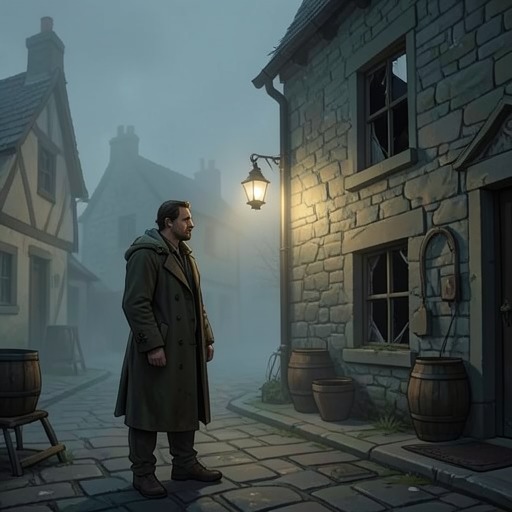
On arriving by train, Arthur Hastings finds the station much as he remembers it, isolated among fields and seemingly without purpose. The apparent stillness of that first view gives way during the taxi ride through the village: Styles St Mary has changed almost beyond recognition, with petrol stations, a cinema, two additional inns, and rows of council houses. The contrast is between a station that time appears to have passed by and a village visibly reshaped by it.
The approach to Styles Court offers another contrast. The park remains much as Arthur Hastings remembers it, but the drive is neglected, weeds have grown over the gravel, and the house, unchanged in its exterior, badly needs paint. The village and estate therefore register time differently: the settlement has acquired conspicuous signs of modern life, while the old house retains its appearance amid physical decline. That contrast gives the return a sense of both recognition and loss without making the place wholly unfamiliar.
Local Memory and the Earlier Murder
Styles St Mary’s identity is also formed by what its inhabitants remember about the Court. At Mrs Franklin’s funeral, attended by many curious local people, an elderly villager recognizes Arthur Hastings from the time of the earlier death at the house. She recalls that, when the old Mrs Inglethorp died, local opinion held her husband responsible, despite the uncertainty surrounding what had happened. Her account establishes that the first murder at Styles has endured in village conversation as a story of suspicion, not merely as a closed case.
The villager treats the two deaths as a possible pattern. She suggests that Mrs Franklin’s husband might likewise be suspected, dismissing the suicide verdict as potentially mistaken and remarking that doctors know how to dispose of their wives. This is local conjecture, not proof: the official verdict is suicide, and her insinuation does not identify the true killer. Its importance lies in showing how readily the old case supplies a template for judging the new one.
Suspicion and Narrative Significance
The exchange draws Arthur Hastings into the village’s remembered history. He angrily challenges the woman’s suggestion because the coroner’s verdict was suicide; she retreats, saying that a second similar death seems odd and that his presence at both occasions is itself striking. Her observation briefly makes him wonder whether she suspects him of having committed both crimes. The village’s gaze thus turns not only toward the households at Styles but toward a returning witness whose repeated presence can itself seem suspicious.
Arthur Hastings recognizes the power of local suspicion as something haunting and difficult to dismiss. The thought is sharpened by the closing realization that the villager’s suspicion was not wholly misplaced: someone had killed Mrs Franklin, notwithstanding the suicide verdict. Styles St Mary consequently holds together mistaken accusation and a genuine, concealed crime. Its remembered first murder encourages a new suspicion, while the truth behind the second death confirms that the village’s unease has a real object, even if its guesses do not settle who is responsible.