Fiction and lived reality
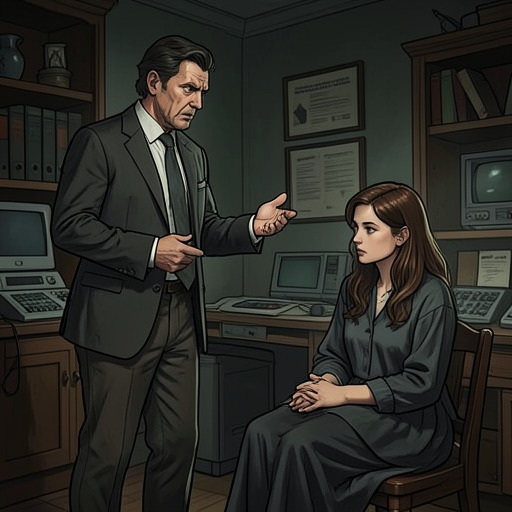
DeceptionFiction and lived reality is the conflict between a writer’s experience of a relationship and the story that writing makes from it. In the exchanges between a writer and an Unnamed English woman, the boundary is neither simply erased nor securely maintained: he admits that writing altered what happened, while she recognizes parts of their life in the resulting account and resists being reduced to its version of her. The notebook becomes the material proof of this tension, turning questions of invention into questions of privacy, memory, and who has authority to represent a shared past.
The notebook and the dispute over invention
The conflict becomes concrete when the woman explains that she found the writer’s notebook after he left it outside his briefcase. She distinguishes it from his novel: what she encountered was not the finished work but the private record behind it, and she regrets having opened it even as the discovery changes what she knows about his writing. The notebook unsettles any easy separation between literary invention and private life. It is a writer’s working document, but it also exposes material that the woman understands as connected to their relationship.
Her discovery leads into a separate, explicit dispute about the writer’s ability. He asks her to tell him what he does wrong as a writer, framing criticism as something she may deliver bluntly and acknowledging the value he places on her judgment. His appeal makes literary evaluation part of the relationship: he seeks not only a verdict on the work but a response from someone whose taste he respects. Her discovery of the notebook, however, makes the question of what the writer does with experience more urgent than the question of whether his books succeed.
How writing alters its source
The writer does not claim that his fiction reproduces events without change. He says that, at a certain point, the writing took over and altered things. His account gives composition an active role: the written story does not merely preserve a settled experience but changes its arrangement and meaning as it develops. When he encounters a character who seems terribly passive, he says he had not known the character would appear that way. He recognizes a possible connection to himself, but qualifies that recognition rather than treating the character as a transparent self-portrait.
His explanation of the Ivan and Olina episode makes the distinction sharper. He says that he and Ivan had lunch after Olina left, and that Ivan told him what had happened; he denies having betrayed Ivan with Olina or having been accused of doing so in life. The accusation belongs to the notebook’s version. The writer explains that he made himself implicated because merely being present would not produce the same force: compromising the writer himself, rather than only a fictional character, made the indictment more charged. He points to the argument with the woman as evidence of the effect. In this account, invention is not a neutral disguise placed over experience; it can redistribute blame and intensify conflict, including conflict that then occurs between the people whose lives supplied its material.
The imagined relationship and the remembered one
The woman questions whether the writer’s remembered image of her has become idealized at a distance. She suggests that the actual person may not match either his present memory or the figure he wrote. The writer answers that his representation depended on her: he could not have written about the woman in that way without having known her. Yet he also describes a life with her that extended beyond their time together. He says that while writing he lived with her in his imagination, including when she was absent, and that this imagined relationship was powerful alongside the hours they actually shared.
The woman identifies the asymmetry in that account. She argues that an imagined life and a real life cannot simply be possessed at once in the same way, and proposes that the writer may have had an imagined life with her while living his actual life with another woman. Her response does not deny the reality of his imaginative attachment; it distinguishes that attachment from a shared, lived relationship. The writer’s admission therefore cuts both ways. The writing testifies to the force of his experience, but its intensity may reflect a life of composition that the woman did not inhabit on equal terms.
Speech, privacy, and competing authority
The disagreement extends from the transformation of events to the use of people’s words. The writer objects to recording exactly what people said and to taking their lives into fiction. He also objects to a famous author resenting critics for claiming that he does not make things up: for him, the claim to invention is compromised if actual people and speech are treated as raw material while the writer insists on artistic independence. His objection does not resolve the contradiction, because the woman has already encountered the notebook and recognizes their shared life within its pages.
The writer’s answer is that the woman’s existence does not prevent him from making a fictional version of her. Her having had a baby, he argues, does not establish that he did not invent a baby; her being herself does not mean that he did not invent her. The woman’s brief insistence that she exists meets a larger claim about authorship: the represented figure can be made from a real person without being identical to that person. The writer then grants that she exists and has also been made up, making the relation additive rather than a choice between a real woman and an unreal character. But that formulation cannot settle who controls what is exposed or how the fictional version will be understood.
Recognition without resolution
The woman recalls reading the notebook as a strange experience. She says she felt certain that some passages were addressed to her and that other parts were not, while allowing that her certainty could have been mistaken. The distinction makes the notebook’s address unstable: it contains writing that can feel intimate without being wholly intended for its reader. The writer responds by treating the material as their life as it might have been, and as another version of their life. The woman sees the story too, but their recognition does not produce a single agreed account of what it means.
The final exchange preserves that uncertainty rather than deciding between testimony and invention. The woman calls the story strange and beyond belief; the writer agrees that no one would believe it. Their shared recognition confirms that the story draws on something they both identify, while the dispute over the notebook, the altered character, and the invented relationship prevents that recognition from becoming proof of literal fidelity. Fiction remains answerable to lived experience, but it cannot simply be equated with it: the writing transforms what happened, and the people represented continue to exist beyond the writer’s version.