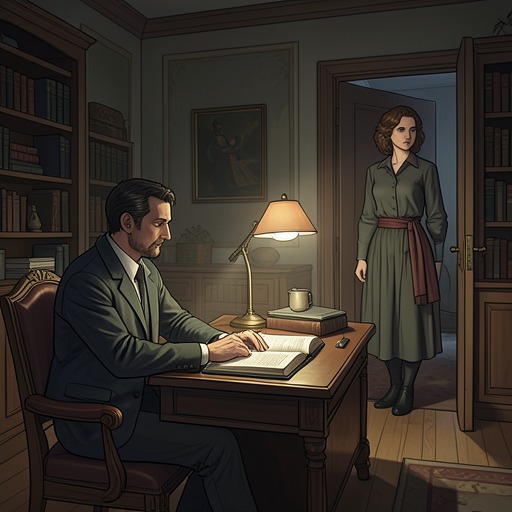
Philip’s notebook
DeceptionPhilip’s notebook is the material object through which the novel makes the unstable border between lived experience and literary invention newly visible. Left outside Philip Roth’s briefcase, it is picked up and read by his wife, who finds not neutral notes but recorded conversations mixed with invented exchanges. The notebook becomes evidence in their argument, but not decisive evidence: Philip presents it as a record of his imaginative process, while its contents make it harder to tell where remembered speech ends and authored fiction begins.
Object and Discovery
The notebook enters the conflict through an ordinary lapse. Philip’s wife says he left it out of his briefcase; she picked it up and opened it, then regretted doing so. Her alarm centers on what she has found: these are not simply notes, but conversations with a woman. The distinction matters. A notebook that might have seemed like a writer’s private working tool now contains other people’s speech and versions of their lives, and its reader must confront the possibility that intimate exchanges have been preserved for later use.
Philip resists treating the object as a transparent account of events. He says he would not have left it lying around if he had feared her reading it, a claim that complicates the discovery without resolving what the notebook means to her. Its circulation is itself part of the dispute: he describes carrying it between their present location and his studio, while his wife’s reading has already carried its contents into their shared conversation. What had served as a private instrument of composition is now an object both of scrutiny and explanation.
Record, Invention, and the Ivan–Olina Example
Philip describes the notebook as a mixture of accurate reporting and imaginative reconstruction. He acknowledges writing down some conversations and making up material that was never said; he also admits that he can no longer remember where the actual exchange gives way to invention. His explanation is not that the notebook is wholly factual or wholly fictional. Rather, remembered circumstances provide a basis for imagining what cannot be recovered with certainty.
He tests that distinction with the story of Ivan and Olina. According to Philip, he did have lunch with Ivan after Olina left him, and Ivan told him what had happened. But Philip denies that Ivan accused him of betraying him with Olina, and denies that he had betrayed Ivan. That accusation, he says, exists in the notebook’s account rather than in the events he remembers. The example makes the notebook’s risks concrete: it can preserve a real meeting and real distress while adding an invented rupture that changes the relationships among the people represented.
Philip further explains that he writes himself into compromising positions because merely compromising a fictional character does not achieve the effect he wants. In the Ivan and Olina material, he says, he made himself implicated to intensify the indictment. His account therefore presents self-accusation not as proof that the depicted event happened, but as a deliberate compositional choice. The notebook records both the invented charge and the writer’s later explanation of why he put it there.
Sources and the Dispute over Representation
When his wife asks to go through the notebook, Philip offers to distinguish passages drawn from conversations with people including Rosalie Nichols, a Polish woman, and an American person he describes dismissively, from passages that were not drawn from conversations. He says the invented material makes up most of what she read. He also traces some of the writing to an earlier affair with Rosalie Nichols, before he met his wife. When Rosalie later appeared with her husband in their building on Eighty-first Street after moving from England, Philip says, her circumstances may have supplied the English woman’s England and marriage in the writing his wife has read. He presents this as a possible source, not as proof that the fictional account simply reproduces Rosalie’s life.
The notebook thus gathers materials from different people and periods without keeping their boundaries secure. Philip’s wife encounters them as conversations with a woman; Philip answers by separating source material from invention, while conceding that the separation has become indistinct even to him. His offer to explain the notebook line by line recognizes the scale of her concern, but the explanation also asserts his authority as the person who knows how the writing was made. The object preserves a record of speech, yet its maker claims the right to alter, extend, and rearrange that speech in the name of imagining.
The Writer and the Imagined Life
The argument over the notebook belongs to a larger exchange about Philip’s writing and the judgment of his wife, whose taste he says he respects and from whose conversations he has learned. His request for criticism makes their relationship part of the artistic question: she is not only someone represented in writing, but also a reader whose response matters to him. At the same time, the notebook unsettles the distinction between asking a person to judge a work and turning that person’s words or circumstances into material for one.
His wife asks whether the notebook itself is meant to be published after the novel, imagining it as a lament for the life he once led. Philip rejects that account and describes the writing instead as the story of an imagination in love. Elsewhere in their discussion, he credits her with enabling him to write about the English woman as he did, and describes having an imagined life with her while she was absent. These remarks give the notebook a significance beyond its disputed entries: it belongs to a creative process in which actual relationships continue in memory and imagination outside the moments when the people involved are together.
As an object, Philip’s notebook cannot settle the truth of the scenes it contains. Its importance lies in making the problem unavoidable: conversations can be recorded, reconstructed, and altered, while the resulting account may implicate its author as much as its subjects. The discovery turns that process into a conflict between the writer’s freedom to imagine and another person’s recognition of herself, or of people she knows, in the material he has made.