The Rong Family’s Decline and Poverty
DecodedThe Rong Family’s Decline and Poverty is a gradual reversal of fortune in which educational ideals and public commitments outlast the wealth that once sustained the family. The loss is not attributed to a single misfortune: the family’s business weakens as its young people turn away from it, its salt income disappears under a government monopoly, and Old Lillie gives up major assets to support the Northern Expedition. By the time Young Lillie is asked to help Jinzhen study abroad, the family’s remaining property and his own resources cannot meet the need.
Sources of the Decline
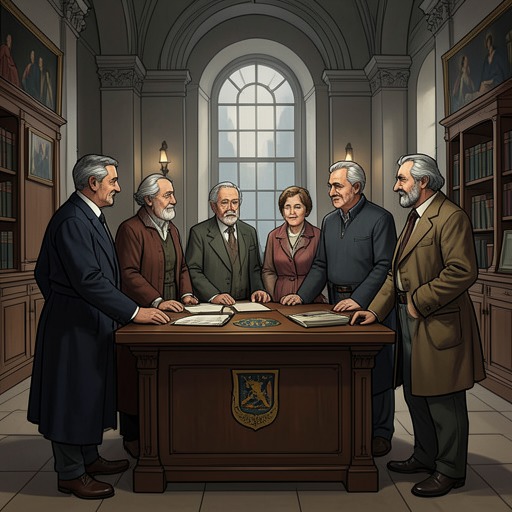
The Rong Family Mansion at Tongzhen once occupied half the village, its many roofs packed closely together. Its decline began as members of the family left for the provincial capital to study at Old Lillie’s academy. Few of the younger generation wanted to return to continue the family business. The movement that brought education and new commitments also left the old household with fewer prospective successors to its commercial life.
The family’s circumstances worsened when the government established a state monopoly on salt, removing its chief source of income. Members of the family who had studied with Old Lillie increasingly valued scientific method and the pursuit of truth over wealth or luxurious living. Their intellectual priorities did not reverse the family’s financial deterioration; instead, the narrative sets their concern for ideas beside a business that was losing both its principal income and the interest of its younger generation.
Within a decade, the family had lost virtually everything it had once owned. The narration notes that its members did not openly discuss how this had happened, although the cause was legible in the family’s public history and the condition of its estate. The decline was not simply a private accounting of assets: it altered the character of a household that had once combined commercial power, public standing, and a large residential compound.
The Northern Expedition and the Placard
A visible reminder of the family’s sacrifice hung above the mansion’s main gate: a gilded placard commemorating it as a supporter of the Northern Expedition. When the National Revolutionary Army reached C City, Old Lillie saw students collecting money in the streets. Moved by their activity, he returned to Tongzhen that night and sold the family’s docks and half its shops, businesses built up over generations. He used the proceeds to buy a boatload of ammunition for the campaign. The placard he received in recognition turned a substantial loss of family wealth into a public mark of patriotism.
That honor became politically complicated when the famous general who had written the inscription was later pursued as a criminal by the KMT government. A replacement placard was prepared, with the same words and gilding but different calligraphy. Although the government sought permission to exchange it for the original, Old Lillie refused. He insisted that it would come down only over his dead body. The decision preserved the object and its original inscription, but the account connects it with the family’s subsequent difficulties with the government and the damage those difficulties did to its business. Old Lillie was willing to see the business suffer; he would not surrender the placard.
A Mansion Becoming Ruin
The physical change at the Rong Family Mansion makes the family’s declining fortunes perceptible. Paint had flaked from pillars and eaves, leaving bare patches across the once-imposing buildings. Where masters and servants had once filled the compound with activity, there were now few people, many of them old; women outnumbered men, and servants outnumbered masters. With fewer residents, especially fewer young people, the immense house seemed larger and quieter.
The grounds, too, registered the retreat of human activity. Birds nested in the trees, spiders spun webs across doorways, and weeds obscured the paths between buildings as they disappeared into darkness. Pet birds flew away; the artificial mountain became indistinguishable from a real one, the flower garden turned wild, and the rear courtyards became a maze. The mansion still retained traces of its former color and design, but the underlying outlines of the earlier structure had re-emerged and blurred the finished elegance. The setting’s gradual transformation makes the decline more than a report of lost income: the once-managed estate increasingly belongs to growth and neglect. Its quiet, obscured spaces also provide a place to conceal an anonymous woman whose background is unsatisfactory.
The Last Property and Its Consequences
After the establishment of the People’s Republic of China, the family’s remaining resources contracted further. A couple of months before Jan Liseiwicz doubted Young Lillie’s account of their financial troubles, the remnants of the family property at Tongzhen had been seized in the Land Reform. Only a few ramshackle buildings in the old mansion remained in the family’s possession. One commercial property still stood in the provincial capital, but Young Lillie gave it to the People’s Government of C City at a welcome ceremony for the new mayor, presenting the gift as support for the new government.
The public setting for the donation could have looked like an attempt to curry favor, but the account explicitly distinguishes appearance from motive: the recipients selected the occasion because they hoped the example would encourage other wealthy and socially prominent families to support the government. Young Lillie agreed to that reasoning. The donation was thus both a public political gesture and the transfer of the family’s last commercial property. The narrative presents the family as patriotic, while also showing the material consequence of its successive acts of giving: by the time its inherited property had passed through gifts, spending, ruin, and division, nothing remained of it.
Young Lillie’s own finances offered no substitute. His personal savings had been spent trying to save his daughter’s life; his salary had not kept pace with rising living costs, and he had lost every other possible source of income. He supported Jinzhen’s wish to study abroad but could not pay for it. Jan Liseiwicz initially suspected that the family could not truly be so poor; he learned the circumstances when a Stanford scholarship offer for Jinzhen arrived, secured through Liseiwicz’s lobbying and accompanied by a $110 money order for travel. Young Lillie was delighted by the news, but the funding came through the university rather than the family. In this contrast, the decline’s consequence is sharply defined: his support for Jinzhen remains wholehearted, while the wealth that might once have made that support practical has disappeared.