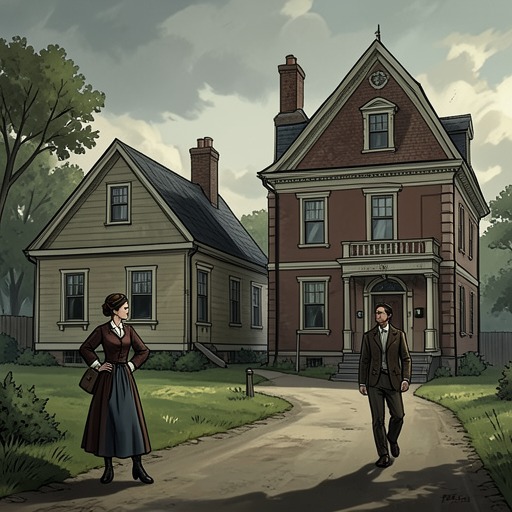
Devdas’s letter to Parvati
DevdasDevdas’s letter to Parvati is the written rejection that closes the possibility of their marriage while exposing the conflict between Devdas Mukherjee’s stated feelings and his conscience. In it, he presents his parents’ opposition and Parvati Chakravarty’s family status as barriers he cannot overcome, and denies feeling a deep love for her. But the act of mailing the letter immediately unsettles him: he imagines its words wounding Parvati, recalls her distress, and questions whether preserving social status can justify ruining a person’s life. The letter matters both for what it tells Parvati and for the remorse it awakens in its writer.
Background and Form
The letter follows Parvati’s private visit to Devdas and the previous night that he later says is causing him pain. Before receiving it, she has been caught between hope and fear, imagining that Devdas might return and prevent her marriage to someone else. Instead, a few days later, she receives a letter that begins by saying he has been thinking of her. Its epistolary form makes the rejection direct: Devdas addresses Parvati in writing, attempting to explain a decision whose consequences he cannot control once the letter is sent.
The prospect of their marriage had already been raised within the families. Parvati’s grandmother had tried to suggest the match to Devdas’s mother by pointing to how closely the two children had grown up. His mother answered that they had grown up like brother and sister. That exchange had turned their shared childhood into an argument against marriage; Devdas’s letter makes the family opposition explicit rather than treating their closeness as sufficient grounds for a match.
The Rejection in the Letter
Devdas says that neither his father nor his mother wants them to marry. He presents himself as unable to make Parvati happy without inflicting a wound on his parents, and asks how the two of them could marry against their wishes. His explanation is not a simple declaration of personal choice: it makes filial obedience and family authority central to the refusal. He also tells Parvati that he does not know when he will write again, giving the letter the weight of a final explanation even as it stops short of promising that it will be their last communication.
He names social standing as another obstacle. He tells Parvati that her family is not high-born, then explains that his mother refuses an alliance with a trading family and considers a marriage between neighbors indecent. His brief reference to his father’s position assumes that Parvati already knows it. The letter thus gives separate reasons for the family’s opposition: rank, occupation, and the impropriety his mother attaches to marrying nearby. These restrictions are presented as facts shaping the decision, not as judgments Parvati can answer or change.
The letter is also a personal assessment of their relationship. Devdas says he has never felt that he loves Parvati tremendously and cannot find a deep well of sorrow in himself for her, though he feels bad that she will suffer because of him. He asks her to try to forget him. This attempted distinction between love and pity makes the rejection especially stark: he does not offer a hidden promise of affection to soften it, but acknowledges her likely suffering while denying the feeling she might have hoped would lead him to act.
The Sender’s Reversal
Before mailing the letter, Devdas is in one frame of mind; as soon as it leaves his hands, he begins to feel differently. The narration compares the dispatched letter to an arrow already shot from a bow. He watches its imagined course with consternation and wonders how it will strike Parvati, whether it will hurt her badly, and whether she will survive it. The metaphor makes the letter’s movement away from him irreversible, while his sudden fear shows that he has not made peace with the consequences of sending it.
On his walk back from the post office, Devdas dwells on the night when Parvati placed her head at his feet and wept. He questions whether he did the right thing and asks why his parents object to her when her birth is not her fault. His time in Calcutta has led him to believe that destroying an individual’s life to preserve status is wrong when that status rests on narrow-minded thinking. He then imagines Parvati giving up her life or rushing to the riverside with that intention, and fears that such an outcome would remain on his conscience. This is his fear, not a report that Parvati attempts suicide; its importance is that he already understands the rejection as potentially devastating even while he has chosen to send it.
After returning from the post office, Devdas goes back to the shared accommodation where he is living, having left his uncle’s home because it did not suit him. Chunilal, a young man who has stayed in the next room for nine years while trying unsuccessfully to pass his BA examination, is out for the evening. The maid comes to light the lamps. The letter’s aftermath therefore unfolds in the ordinary solitude of Devdas’s room: Parvati is absent, but the memory of her distress and the possible effects of his decision occupy his thoughts.
Consequences and Significance
The letter makes the failed marriage more than a private misunderstanding. Devdas’s account shows how family authority and social rank constrain the choice, while his post-office reflections expose his awareness that those barriers are not morally neutral. He can describe the reasons for refusing Parvati and still recognize the injustice of making her bear the cost of her birth. The gap between his explanation and his misgivings is central to the letter’s force: its language closes an immediate prospect, but it does not settle his responsibility for what follows.
Later events confirm the separation the letter announces. Parvati arrives as a bride in Bhuvan Chowdhury’s large household and is addressed by his eldest son as his mother. Much later, after his father’s death, Devdas remains at home for six months before restlessness and the absence of peace or joy take hold; thoughts of Parvati return to him often. His mother too comes to feel that it might have been better if they had arranged his marriage to Parvati when the opportunity arose. These later developments do not change what the letter said, but they place its rejection at the beginning of a lasting absence: the match is refused, Parvati enters another family, and Devdas continues to be troubled by what he sent.