Amor no correspondido
DianaUnrequited love in Los siete libros de la Diana is not simply the pain of loving without return; it is a condition that tests what a lover owes to memory, how affection changes with absence, and whether constancy can survive the beloved’s indifference. The clearest contrast is between Sireno, who comes back to find Diana married to Delio, and Silvano, who remains devoted to Diana even though she has always rejected him. Around their stories, songs and disputes give private grief a public language, while other lovers show that steadfastness and freedom need not lead to the same outcome.
A Pastoral World of Unequal Affection
The book establishes this pattern in the fields and beside the Ezla River, where Diana is loved by two shepherds in sharply different ways. She and Sireno have loved each other deeply, but his forced departure separates them. During his absence, Diana’s feelings change and she marries Delio; after a year away, Sireno learns of the marriage before he can see her. The loss is therefore not the result of a lack of affection from the beginning. It is the reversal of a once-mutual attachment, made decisive by distance and by the passage of time.
Silvano’s love is unequal from the outset. He loves Diana more than himself, while she abhors him, yet he does not treat Sireno as an enemy for receiving the affection he himself lacks. He tells Sireno that he would not take revenge even if he could, because his love for Diana prevents him from acting against the man she chose. His response makes unreturned love an ethical trial as well as a personal wound: he must reckon with his own disappointment without turning it into hostility toward either rival or beloved.
Constancy, Memory, and the Beloved’s Absence
On returning to the pastures, Sireno encounters the places where he and Diana once shared happiness. The familiar landscape sharpens the contrast between his former freedom and his present subjection to grief. A beech tree, the riverbank, and the place where he first saw Diana call up memories that he cannot silence. His pain is not only that she is now another man’s wife; it is that remembered promises and present reality no longer agree.
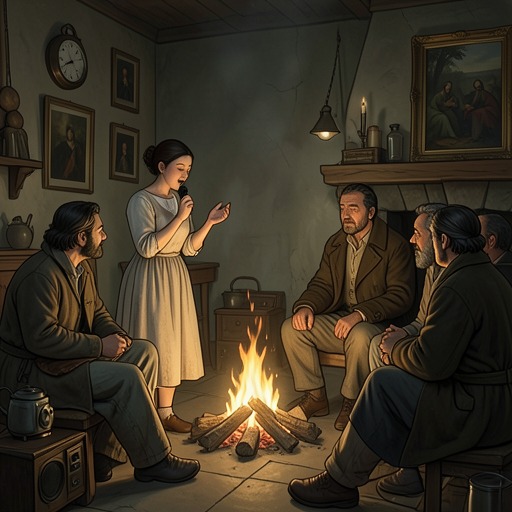
The shepherds’ songs make that conflict audible. Silvano sings of the lover who receives no return, while Sireno answers with sighs and tears. Their exchange distinguishes the two men’s experiences: Sireno has lost a love he once possessed, whereas Silvano has endured a love Diana never shared. Even so, Silvano regards Sireno’s former favor as a happiness great enough to last a lifetime. The comparison reveals how the same beloved can represent both remembered intimacy and permanent exclusion.
The book repeatedly makes song a way to stage such differences rather than merely interrupt the narrative. Selvagia’s sonnet and later singing place the uncertain promises of love alongside the awareness that hope cannot command events. A song heard by the shepherds becomes an occasion for them to debate whether a lover can recognize when affection is not returned. In another lyrical exchange, the image of fastening a nail to the wheel of fortune expresses a wish to hold change still—an impossible remedy for feelings and circumstances that keep moving. The songs turn inward sorrow into shared, interpretable speech, while their varied forms allow hope, warning, and lament to coexist.
Dispute over Change and Responsibility
When Selvagia joins Sireno and Silvano, their private disappointments become a debate about women’s changeability. Silvano argues that a woman may forget a lover during an absence, while Sireno suggests that women do not understand what love requires. Selvagia rejects the idea that women alone are responsible for forgotten attachments. In her account, lovers of either sex may be changed or silenced by time and place; she also points out that men interpret women’s behavior against them whether women speak or remain silent, show affection or reserve, or respond freely or cautiously.
Her intervention complicates the language of rejection. A lover’s complaint may describe genuine suffering, but it does not settle who is to blame for a changed relationship. Silvano’s loyalty does not erase Diana’s established rejection of him, and Sireno’s memories do not undo her marriage to Delio. The conversation holds several positions together: the pain of abandonment, the persistence of desire, and the difficulty of judging another person’s feelings from a lover’s own disappointment.
Fidelity Without Possession
The work also places unrequited love beside forms of fidelity that do not guarantee possession or reunion. Selvagia’s singing presents forgetting as a danger against which the lover must guard, while a later Portuguese song sung by Duarda declares that life and time will pass but faith will remain. In the surrounding conversation, Duarda recalls that Danteo promised to marry her, then married another woman within days. After that wife has died, Danteo begins turning his thoughts back toward Duarda; she answers that she now belongs to herself and cannot again belong to him. Her refusal distinguishes constancy from surrender: past love does not give the former beloved a permanent claim.
Felismena’s story offers a related but unresolved case. After Celia’s death, Don Félix disappears, and Felismena spends more than two years searching for him in a shepherdess’s disguise. She describes the service she can still render the nymphs as a great consolation, even while her hope remains fixed on finding him. The evidence here establishes separation, continuing devotion, and prolonged searching, but not a final answer to whether her attachment will be returned. Her story therefore broadens the theme beyond rejection that has already been made explicit: absence can keep love painfully unequal even before its outcome is known.
Narrative Significance
As the first pastoral novel in Castilian literature, Los siete libros de la Diana combines prose narrative with verse and places the complaints of love within idealized shepherd country. Yet the fields do not protect the characters from the pressures of time, marriage, separation, and changing affection. The Ezla River and its meadows provide settings for remembrance and song, while journeys and absences carry consequences that pastoral beauty cannot reverse.
Unrequited love thus gives the book both an emotional pattern and a means of argument. Sireno’s lost mutual love, Silvano’s enduring rejection, Selvagia’s challenge to blame directed at women, and Duarda’s reclaimed independence are not interchangeable versions of the same sorrow. Together they ask what constancy means when the beloved does not answer—or no longer answers—and show that fidelity may persist as grief, become a song, or give way to a refusal to belong again.