Mondego River
DianaThe Mondego River gives shape to the landscape through which Felismena travels in the later part of the narrative. First glimpsed as a broad watercourse crossing an expansive field, it is identified by Duarda as the river that waters the Fields of Mondego and runs beside Coímbra. Its setting links pastoral scenery to a prominent city and a celebrated frontier castle, turning a natural feature into a guide through a new region.
Setting and Course
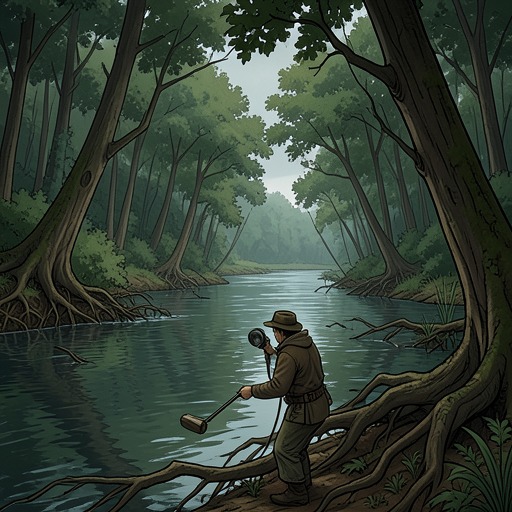
Felismena sees the river from a wooded height, where it runs through a wide, fertile plain toward mountains in the distance. The field is bordered in places by willows and green alders; elsewhere, its clear waters are exposed beside a broad stretch of sand. The crops are high and nearing harvest, and a temperate wind moves across them. The river is thus introduced not as an isolated landmark but as the central line of a cultivated landscape, framed by trees, open water, fields, and distant hills.
The plain is described as three miles across and somewhat longer, while the mountains lie twelve miles ahead. These measurements give the pastoral prospect an unusual breadth: Felismena has entered a settled region, yet the view still opens onto a countryside whose scale exceeds what she can take in from her vantage point. The river’s passage through that landscape leads her toward the city she has been trying to avoid.
Coímbra and the River
After meeting the Portuguese shepherdesses, Felismena asks what city lies in the direction from which the river comes. Duarda names it as Coímbra, describing it as one of the principal cities of the realm and of Europe. She identifies the river as the Mondego and the surrounding fields as the Fields of Mondego, fixing names to the geography Felismena has just encountered.
Duarda’s account places the river beside a dense cluster of landmarks. Coímbra’s buildings reach down from higher ground until the city wall meets the water, and a magnificent bridge crosses the river. The Mondego therefore marks both the city’s edge and a point of connection across it: the water borders the settlement, while the bridge makes passage possible. Felismena’s view joins natural setting and human construction in a single prospect.
The Nearby Castle
Duarda also directs Felismena’s attention to the castle on the highest mountain in view, naming it Castle of Montemor-o-Velho. She calls it the light of Spain, a description grounded in its remembered resistance to the besieging Moorish king Marsilio: despite years under siege, the castle had remained undefeated. Its renown is associated with the courage and skill of its inhabitants, as well as the virtues attributed to the ladies and knights who lived there.
The river’s setting consequently carries more than pastoral beauty. Coímbra, the Mondego, and the castle place Felismena amid a landscape whose natural features are interwoven with civic prestige and histories of conflict. The river helps orient her among those places, while Duarda’s explanation transforms the view from an unfamiliar scene into a geography marked by collective memory and reputation.
Narrative Significance
The river marks a change in the scale and character of Felismena’s surroundings. She has been wandering in search of relief and keeping away from towns; when she reaches the vast plain, she is astonished to find herself so close to a populated place. The Mondego is part of that discovery: it leads the eye from open countryside toward Coímbra and its bridge, bringing her journey into contact with a settled world.
The novel also gives rivers distinct roles in its pastoral geography. At the beginning, Sireno’s recollection is anchored to the banks of the Ezla River, where he remembers tending his flock and first seeing Diana. The Mondego belongs to Felismena’s later passage through Portugal, where a river landscape opens onto named cities, a castle, and local history. In both cases, water helps organize pastoral space; around the Mondego, however, the view explicitly joins the wandering shepherdess’s experience to the social and historical world beyond the fields.