OxyKills.com
DopesickOxyKills.com was a message board and memorial created by Ed Bisch after the death of his eighteen-year-old son, Eddie, from OxyContin. It transformed Bisch’s private search for answers into a shared record of overdose deaths, family warnings, and organizing: first a place where bereaved parents could recognize a pattern, then part of a grassroots campaign that confronted Purdue Pharma in public and political life.
The death that prompted the site
In February 2001, Bisch returned to his working-class Philadelphia neighborhood after his daughter called in alarm: she had found her brother unconscious and turning blue. Eddie was a high school senior, a soccer player with decent grades and plans to attend a local culinary school. His father had noticed that he had recently felt ill, but had not understood that he was experiencing opioid withdrawal. Bisch suspected alcohol and perhaps marijuana use, not pills. Father and son were due to fly to Florida for a fishing trip six days later.
Emergency workers were already at the house when Bisch arrived. Eddie had died. The first time his father heard the name OxyContin was after the death, when emergency personnel identified the drug. The suddenness of that discovery shaped the site’s purpose: Bisch was trying to understand a loss whose cause he had not known to look for while his son was alive.
Bisch went to his computer and learned that Eddie’s death was not an isolated event. It was the region’s thirtieth opioid overdose in three months. That number made the gap between a family’s experience and the wider crisis newly visible to him. The internet was still relatively new, and message boards were more common than dedicated websites; Bisch used the format he had at hand to warn other families and connect individual deaths to a growing pattern.
From message board to memorial record
Bisch built OxyKills.com himself, channeling his grief into computer code and choosing a name that made the site’s warning unmistakable. Within weeks, it had developed from a message board into a continually updated collection of mourning, warnings, and statistics. It gathered the latest OxyContin-related overdose figures reported by local medical examiners and the Drug Enforcement Administration, and Bisch used it to circulate news about the drug. Among the stories he promoted was The New York Times’s report that OxyContin sales reached $1 billion in 2001, surpassing Viagra.
The site also gave parents a place to memorialize their children. Families from Florida to California added the names and stories of the dead, including young athletes, mothers, and former beauty queens; many had not yet reached twenty. Bisch later recalled the scale of the work as consuming: he was answering every email, sometimes facing roughly ten new deaths a day and around a hundred emails in a week. OxyKills.com thus served two related purposes. Its figures registered the epidemic as a public pattern, while its memorials insisted that the pattern was made up of specific young people and grieving families.
For Lee Nuss, the site became a point of contact after she lost her eighteen-year-old son, Randy, to a single crushed 80-milligram Oxy bought from a friend. Nuss was too grief-stricken at first to contact Bisch herself; her daughter called him and asked him to speak with her mother. Their shared background in Philadelphia’s Fishtown neighborhood added a personal connection, but the site’s broader significance lay in making such encounters possible across distance. A parent who had only recently learned of a child’s death could find that another family had faced a similar loss and was already trying to make the drug’s harms visible.
An online record becomes public action
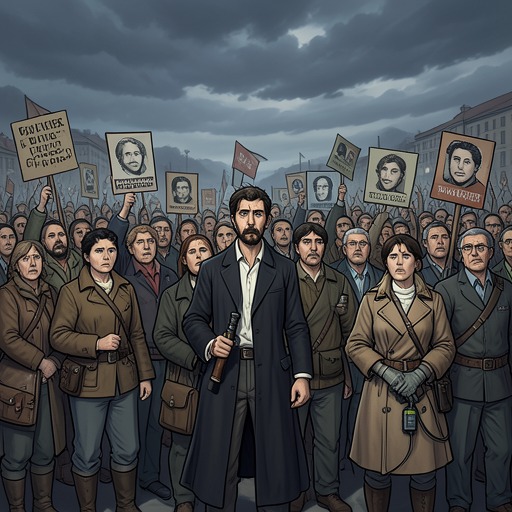
After reading Barry Meier’s 2003 book Pain Killer, the Fishtown parents joined forces with Art Van Zee and Sister Beth Davies. Ed Bisch and Lee Nuss helped launch Relatives Against Purdue Pharma, a grassroots nonprofit that carried the energy of OxyKills.com beyond the screen. The site had offered a place to gather evidence and testimony; the organization gave that gathering a public and political form. In the years that followed, its members pressed for statewide prescription monitoring programs so doctors could check patients’ prescription records, held drug-prevention workshops in schools, and protested outside Purdue Pharma’s headquarters with poster-sized photographs of their dead children.
The activists also encountered opposition from chronic-pain patients who said the drug helped them function and sleep. Bisch believed that some people posting contrary views on his website were paid advocates hired by Purdue Pharma; the book notes that he was correct in a few cases. The site was therefore not simply an archive of agreement. It became one arena in which bereaved families and people who valued the medication contested what its risks meant and who should be heard.
OxyKills.com’s memorial list also became material for public protest. In 2003, parents traveled from Rhode Island and New Jersey to rally outside a drug-abuse-prevention conference in Orlando because Purdue Pharma was exhibiting there. Bisch read aloud the names of 260 people memorialized on the site as the protesters stood in the rain. An unidentified woman turned on a sprinkler; a hotel executive denied involvement. The episode brought the site’s accumulated names into a physical confrontation, where the memorial was no longer only a record viewed by families online but a public demonstration against the company.
The growing list and its legacy
The connection between the online memorial and collective action continued at a later sentencing hearing. Before the hearing, parents took turns reading names from a printout Bisch had made from the site’s memorials. The document had grown to more than fifty pages. The readers made it through only ten pages before the proceedings began. The growing length measured the accumulation of loss, while the interrupted reading made plain how much of that record could not be contained in a single public ceremony.
OxyKills.com mattered because it changed the scale at which families could understand and respond to overdose deaths. Bisch had first encountered Eddie’s death as an incomprehensible private event, then discovered a regional count that had reached thirty in three months. By collecting reports, circulating news, and giving parents a place to memorialize their children, the site made dispersed experiences legible to one another. Its influence did not end with information: its memorials supplied names for rallies, helped bring grieving families into contact, and fed into Relatives Against Purdue Pharma’s sustained advocacy. The website’s record could not undo the deaths it documented, but it helped turn bereavement into organized public witness.