Adderall
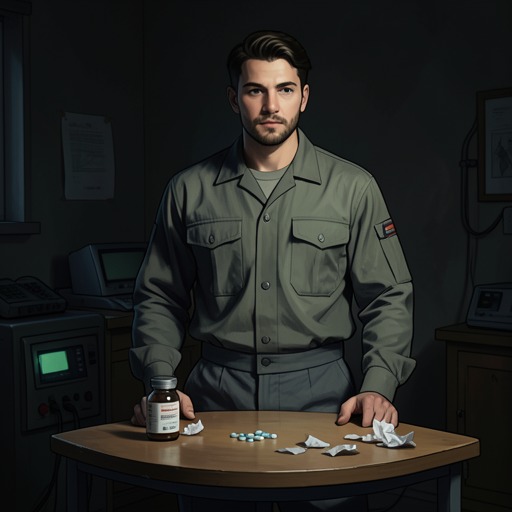
DopesickAdderall, a prescription medication for attention-deficit/hyperactivity disorder, occupies two roles in Dopesick: it is a treatment drug that young people sometimes traded or used outside its prescribed purpose, and part of a wider social landscape in which pills moved between friends before many families recognized the risks. Its significance lies less in any single person’s story than in how those stories connect: Adderall could be exchanged for painkillers or other drugs, used to extend drinking, and encountered years before opioid dependence became visible to parents.
Identity and Circulation
The book presents Adderall as an ADHD medicine and a stimulant, but also describes its movement beyond the person for whom it was prescribed. Among teenagers and young adults, pills could become a commodity exchanged for money or drugs. That circulation linked a medical prescription to peer networks and recreational use, making the drug’s social role different from its intended treatment role without implying that every prescribed user followed the same path.
The wider increase in stimulant prescribing provides context for this pattern. Between 1991 and 2010, prescriptions for stimulants rose tenfold across age groups; prescriptions for attention-deficit drugs among school-age children tripled between 1990 and 1995. By 2012, two-thirds of college seniors reported having been offered prescription stimulants for nonmedical use by friends, relatives, or dealers. These figures describe an expanding setting in which access and diversion were common enough to shape young people’s experience of drugs, not a direct measurement of Adderall use alone.
The book also notes why stimulants appealed to some young people beyond their intended medical use: students used Adderall to study or stay awake, while some took it to drink for longer without passing out. That perceived usefulness helped make the pills tradable. In the account, Adderall therefore sits within a mixed landscape of prescription drugs, peer exchange, and party behavior rather than appearing only in a clinical setting.
Jesse Bolstridge and Prescription-Pill Exchange
Jesse Bolstridge traded his ADHD medication to classmates who liked its association with staying awake while drinking. In return, they gave him painkillers obtained either on the black market or from relatives’ medicine cabinets. The exchange established an early link between Jesse’s access to Adderall and his access to opioids, although the book does not present the stimulant as a sufficient explanation for his later dependence.
Kristi Fernandez could not identify one precise moment when her son’s life became dominated by prescription pills. Jesse had been diagnosed with Lyme meningitis at fifteen and had sustained numerous football and snowboarding injuries that brought him to medical offices and emergency rooms. He received opioid painkillers, including Oxycodone, Vicodin, and Percocet. Against that history of both medical exposure and peer exchange, Adderall was one element in a developing pattern of access to drugs, not a substitute explanation for the painkillers he was prescribed or obtained elsewhere.
Kristi later understood that the drugs could calm Jesse and make him feel normal, but at the time she did not know that he and friends were circulating pills at parties. When another parent accused him of taking Percocet from a bathroom cabinet, Kristi defended him and suggested that the other boy might have taken the pills. Her response illustrates how difficult it was for a parent to interpret a single allegation as part of a larger pattern: the exchange of Adderall and opioids among young people was happening beyond the view of many adults.
Jesse and Dennis Painter had been friends since toddlerhood and began partying together at sixteen, when Jesse started trading his ADHD medication for painkillers. Their friendship later remained part of the route by which Jesse encountered heroin. In the book’s account, this history shows how a familiar relationship and an ordinary-looking exchange could connect adolescent pill use to later drug access, while leaving the precise course of one person’s addiction more complex than a simple gateway story.
A Repeated Pattern in Young People’s Lives
The author identifies a recurring sequence among interviewed suburban young adults: stimulant medication taken in childhood could shift, in adolescence, from a study aid to a party aid. Adderall and Ritalin were used by some to stay awake for schoolwork or to drink for longer, and could be traded for money or other drugs. This is presented as a pattern noticed across interviews, not as a universal outcome for young people prescribed ADHD medication.
Spencer Mumpower’s experience offers another example of pills functioning as exchange goods. He routinely traded Adderall for marijuana and Ritalin for cocaine. Later, when discussing drug risks with parents and teenagers, he described having taken black-market Adderall as often as hourly for eight consecutive days. He also recalled concealing his supply in places including computers, emptied markers, socks, and pockets in gym shorts worn beneath his jeans. The details show both the scale of his use and the lengths to which he went to hide it from his mother, Ginger Mumpower.
Spencer’s experience sits alongside the book’s account of Jesse’s rather than proving that their circumstances were identical. In one case, Adderall was traded for opioids; in the other, it was exchanged for marijuana and cocaine, and Spencer also described sustained, heavy use. The repeated presence of stimulants in young people’s accounts helps explain why the book treats Adderall as part of the broader drug environment, while keeping distinct the different substances, exchanges, and personal histories involved.
Families, Recognition, and Significance
Drenna Banks learned that her son Colton Banks was abusing Adderall when he was seventeen and monitored his use. She later grounded him after finding marijuana, and sent him to a twenty-eight-day rehabilitation program at nineteen after his drug use had progressed to pills. Her story places Adderall within a family’s gradual discovery of changing behavior: recognizing one drug problem did not mean the family could foresee or control every later development.
That recognition problem recurs in the book’s wider treatment of prescription drugs. In 2012, the author began reporting on heroin use in the suburbs of Roanoke, Virginia, where many families initially felt too ashamed to speak publicly. The account describes the distance between young people’s pill-sharing networks and the information available to parents, not simply a failure by families to notice a single warning sign. Adderall could be present in ordinary peer exchanges while the larger consequences remained hidden.
The book’s treatment of Adderall is thus both specific and limited. It documents trading, nonmedical use, concealment, and the drug’s appearance in several young people’s histories. It also places these details beside increased stimulant prescribing and the broad availability of pills among peers. Together, those strands make Adderall a revealing object in the narrative: a medication that could serve a medical purpose, acquire exchange value, and become part of a young person’s exposure to other drugs, without reducing the varied paths into opioid use to one cause.