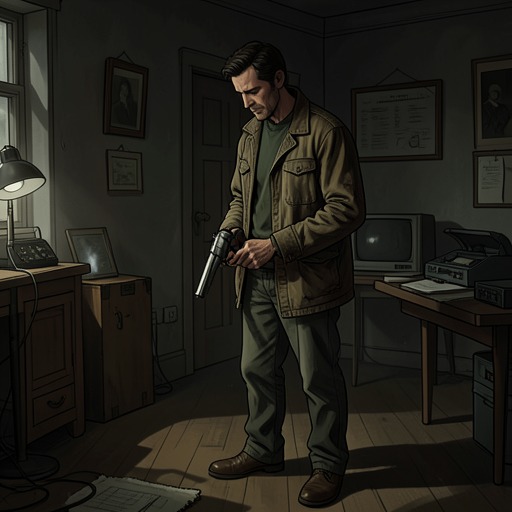
Charlie Dunlop hands his handgun over to Eileen
EileenCharlie Dunlop hands his handgun over to Eileen Dunlop after reports that he has been pointing it at children on their way home from school. The transfer is both an immediate intervention in a danger to others and a consequential change in Eileen’s relationship to a weapon associated with her father’s police career and their family home. She takes the gun to Moorehead, where she works, and eventually carries it away when she leaves X-ville.
The reported threat
The exchange follows a visit from a police officer, who tells Eileen that neighbors and the school principal had called the previous afternoon. Their concern was that Charlie had been sitting at the living-room window and aiming his gun toward children walking home from school. The report makes the weapon’s presence in the house more than a private family matter: children are about to pass the same window again, and the police treat the danger as urgent.
Eileen had been away when the officer and his colleagues first came by. On speaking with her, the officer explains that Charlie has agreed to relinquish the gun to her, on the condition that she promise not to use it against him. The arrangement gives Eileen immediate responsibility for the weapon without presenting the handover as a reconciliation or a resolution of the household’s deeper difficulties. Its terms are practical and pointed: the gun must leave Charlie’s control, while his fear of what Eileen might do with it remains part of the exchange.
The officer says that the order is to give the gun to Eileen immediately because children will soon be walking to school. He accompanies her along the front walk and up the steps. The compressed timing gives the scene its force: an everyday route to school has become the reason for an urgent police intervention, and the person placed in charge of preventing another incident is Charlie’s daughter.
The handover
Charlie emerges from the kitchen in a robe marked by soot from the fireplace. Eileen recognizes his drunken grin as a sign of compliance. He opens the hall closet, retrieves the gun, and gives it to the officer, who places it in Eileen’s open hands. As Charlie gestures around the deteriorated house while holding the weapon, the officer steps back; the episode briefly exposes how precarious an ordinary transfer can be when the object being passed is a firearm and the household is already strained.
Eileen has never handled the gun before, or any gun. She remembers its weight and appearance, including the name Dunlop engraved on its wooden handle. Looking it up in books later, she identifies it as a Smith & Wesson Model 10, with a four-inch barrel and a weight of nearly two pounds. These details make the weapon specific rather than incidental: it is not an unfamiliar object brought into the house from outside, but a marked possession with a history in Charlie’s life and a place in Eileen’s memory.
From the family home to Moorehead
The gun had been part of the family’s domestic landscape long before the police intervention. During Eileen’s childhood, it seemed to have its own place at the dinner table, opposite Eileen, Joanie, and their mother, with Charlie at the head. After Charlie retired from the police force, he carried it concealed in a holster under his clothes as he moved around the house. The handover therefore changes who controls a familiar object, but it does not make the gun’s earlier presence in the family disappear.
On the drive to work, Eileen considers what advantages the gun might offer her. At a red light, she takes it from her purse and considers putting it in the glove compartment, then decides against that because a dead mouse is already there. She keeps the gun on her lap. The small decision shows her trying to determine how to carry a weapon that has suddenly become hers, while the mouse occupies the very storage place she had considered for it.
The gun calms Eileen, and she carries it with her into Moorehead rather than locking it away in the trunk. At the prison, she leaves her purse open on her desk, with the weapon visible. Her response is a striking reversal of the intervention’s intended containment: the gun has been removed from Charlie’s reach, but it is now present in Eileen’s workplace. She describes feeling both fear and excitement when reaching toward it, a divided response that complicates any simple account of the handover as safety restored.
Aftermath and significance
Moorehead is a juvenile prison where Eileen maintains files on incarcerated boys and performs duties connected with visitors. The boys are restricted in ordinary activities, and the files that Eileen reads record their offenses as well as their circumstances. In one instance, she recalls photographing a boy who was no older than fourteen and later reading that his charge was infanticide by drowning. Her work places her in sustained contact with young people classified by their crimes, while her own emotional composure at the prison depends on hiding how strongly she reacts. Bringing the gun into that setting links the family emergency to the workplace where she has learned to keep distress out of view.
The weapon also remains part of Eileen’s later history after her departure from X-ville. She keeps it for several weeks after running away, then throws it off the Brooklyn Bridge. That later disposal gives the handover an ending beyond the immediate crisis: the gun passes from Charlie’s custody to Eileen’s, accompanies her into a new phase of her life, and is ultimately discarded. The episode thus turns a police-directed act of relinquishment into a lasting change in who possesses the family weapon, without suggesting that Eileen uses it against anyone.