Eileen plans to kill Mrs. Polk and frame her father
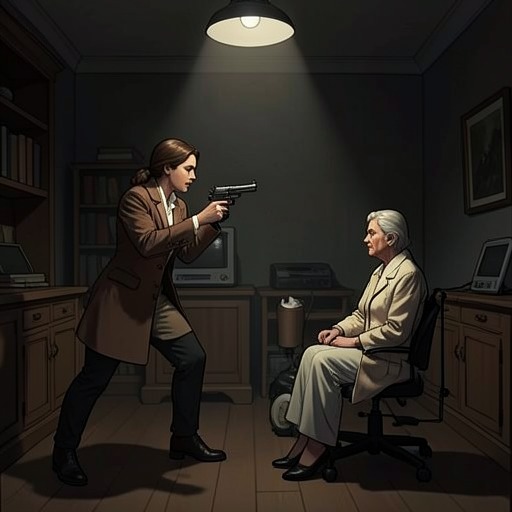
EileenEileen Dunlop’s plan to kill Rita Polk and frame Charlie Dunlop turns escape into a deliberately engineered crisis. Eileen intends to take Rita to the Dunlop home, kill her, leave the gun with her intoxicated father, and flee X-ville. She imagines that the same act could conceal her and Rebecca Saint John’s involvement, force Charlie into treatment, and finally propel Eileen out of a town she has long wanted to leave but could not bring herself to abandon. The plan’s logic is revealing precisely because Eileen treats murder as both a practical solution and a means of making other people change.
The Plan’s Immediate Stakes
By the time Eileen sets out her scheme, she and Rebecca are with Rita in a basement. Eileen describes the plan as a way to resolve everyone’s problems at once. Rita’s death, she reasons, would prevent others from discovering that she and Rebecca had been involved in the events surrounding Rita. With that connection hidden, the two women might be free to leave together. Eileen’s plan therefore joins an escape objective to a cover-up: she does not merely want to get away, but to erase the evidence that could tie her to what has happened.
Eileen proposes taking Rita to the Dunlop home and shooting her there. Charlie, whom Eileen expects to be passed out drunk, would be left holding the gun, making him appear to have committed the killing. The plan depends on arranging the scene so that blame falls on her father rather than on Eileen and Rebecca. In this account, the imagined flight into the sunrise is not an independent adventure; it follows the staged crime as its intended consequence.
Concealment as a Habit
Eileen’s confidence in managing appearances has a history. At Moorehead, she practiced a composed expression in a mirror, using plaster death masks of famous men as a model for a face that concealed her sensitivity. She called this expression her death mask and wore it at work to keep misery and shame from showing. Her plan against Rita extends that practice from facial expression to an entire false account of a crime: the appearance of Charlie’s guilt is meant to hide Eileen’s own agency.
That concealment was part of the labor of her job. Before visiting hours at Moorehead, Eileen drank vermouth and ate mint chocolates; she was nervous about receiving the imprisoned boys’ mothers, even after years of doing it. She directed visitors to sign the ledger and wait in the hallway, and, in the absence of female guards or officers, conducted the women’s security checks. She describes herself as appearing detached while the mothers’ distress affected her. At one visit, a young boy began to cry when he saw his mother’s face, but Randy stopped the mother from passing him a handkerchief because it was not allowed. Eileen’s work placed her close to private grief while requiring her to preserve institutional rules and a controlled exterior. The later scheme similarly makes control of appearances central, but now Eileen uses it to redirect responsibility for a death.
When upset at Moorehead, Eileen sought an empty room and used a private, painful ritual to make herself feel foolish and ashamed until she could regain composure. This is not the same as the later plan, but both episodes show her trying to manage intolerable feelings through deliberate acts rather than open expression. Her scheme gives that impulse a larger and more dangerous form: instead of controlling her own visible distress, she tries to control what the police and her father will believe.
Charlie as a Target and a Hope
Eileen’s plan is not only intended to punish or implicate Charlie. She believes that nothing she has done can make him stop drinking and become the father she wants, and that he cannot recognize the seriousness of his condition. She imagines that being blamed for killing an innocent woman might shock him into understanding his illness. In her hoped-for version of events, the authorities would see that he had lost control, imprison him or, more likely, take him to a hospital, where he could receive care.
Eileen also imagines an emotional consequence for Charlie. Once she has disappeared, she thinks he might miss her and regret what he had put her through. The plan thus treats a fabricated accusation as an intervention: Eileen would leave, but she hopes the crisis would make her father confront the truth and become capable of remorse. That hope remains speculative. The evidence presents what Eileen believes might happen, not an actual recovery or change in Charlie.
Persuading Rebecca
Rebecca asks whether Eileen herself will shoot Rita. Eileen answers that Charlie will be made to appear to do it, while she and Rebecca will actually pull the trigger. The distinction captures the scheme’s two levels: the actual violence belongs to the women, while the public story is designed to assign it to Charlie. Eileen’s answer makes Rebecca a participant in the proposed act, not merely someone who would benefit from the escape.
After Rita has been given pills and their effects have taken hold, Eileen and Rebecca wait, then speak quietly. Eileen says that the police should already have dealt with Charlie and suggests they might even conceal the matter; either way, she assures Rebecca that they will be fine. When Rebecca asks again who will shoot Rita, Eileen confirms that Charlie is the person they intend to frame. Eileen also minimizes the anticipated act, telling Rebecca that Rita is unconscious and would not suffer. These reassurances show Eileen trying to convert hesitation into agreement by presenting the plan as both manageable and justified. They do not establish that Rebecca is wholly persuaded or that the plan is carried out.
Escape by Compulsion
Eileen acknowledges that she has postponed leaving X-ville because fear and laziness have repeatedly outweighed her wish to go. She makes the proposed killing the device that would remove that hesitation: once it happened, she would have to leave, change her name, and disappear. In her reasoning, the plan creates a point of no return where ordinary indecision can no longer keep her in place.
The scheme is therefore built on a series of hoped-for transformations: Rita’s death would hide the women’s involvement; Charlie’s apparent guilt might force him into treatment; and Eileen’s exposure to consequences would compel her to escape. Its sharpest contradiction is that Eileen imagines freedom through an act that would bind her to a crime and rely on a false accusation. The plan reveals how she turns escape, care for her father, and protection of Rebecca into a single justification, without evidence that the outcomes she imagines will follow.