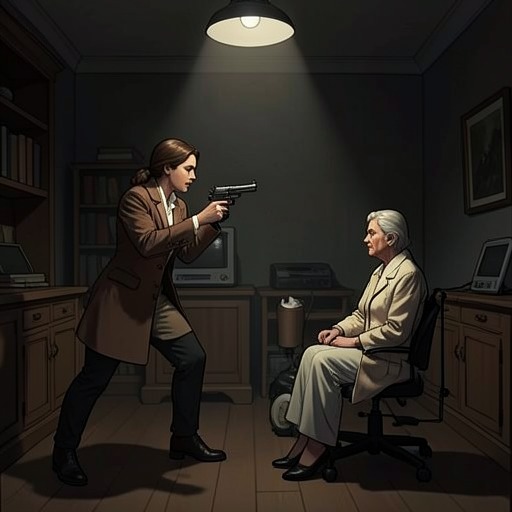
Eileen and Rebecca interrogate Rita Polk at gunpoint
EileenEileen and Rebecca’s armed interrogation of Rita Polk is a confrontation built around a deliberate fiction: the women want Rita to believe her life is at risk so that she will speak about the abuse of Leonard “Lee” Polk. Rebecca supplies the plan and its justification, but Eileen becomes its most forceful performer. The scene exposes how readily Eileen can turn practiced composure into intimidation, while ending only with Rita’s agreement to answer; it does not yet establish what she will confess.
Background and Purpose
The immediate plan arises as Eileen and Rebecca consider how to make Rita talk. Rebecca argues that if Rita believes she may die, she will have no reason to keep denying what happened and will be able to confess. She presents this coercion as a means of setting Rita free, even if Rita does not understand it that way. The gap between the stated aim of eliciting a confession and the means chosen to obtain it shapes the scene: the women call their action help, but deliberately create fear to produce compliance.
Rebecca identifies the subject they want Rita to address: the abuse her husband inflicted on boys, and Rita’s alleged participation in giving Leonard “Lee” Polk enemas. She asks why Rita did not tell anyone and urges her to explain what happened. These are Rebecca’s accusations and questions in the confrontation; at this point, Rita has not yet confirmed them. Eileen’s later recollection likewise distinguishes the interrogation’s immediate result from a completed disclosure: Rita says that the women have won, but the evidence here does not give her full account.
Preparation and Descent
Eileen brings a handgun from her purse and places it on the table. When Rebecca reaches toward it, Eileen keeps hold of it, tells her not to handle it, and says it might be loaded, although she assumes it is not. The uncertain weapon is central to the threat: Eileen and Rebecca do not need to establish that it can fire in order to use its apparent danger. Rebecca then takes Eileen’s scarf, covers her face so that only her eyes remain visible, and explains that Rita should not recognize her from Moorehead. She directs Eileen to demonstrate how she will hold the gun.
The disguise turns the familiar prison employee into an obscured figure, while the weapon gives that changed appearance practical force. Rebecca leads the way to the cellar, removes the chain from the door, switches on the light by tugging a string, and invites Eileen to follow. Eileen descends carrying her purse and the handgun. The movement into the cellar therefore completes the preparation: the pair have chosen a secluded setting, concealed Eileen’s identity, and arranged the encounter so that Rita meets them as captors rather than as recognizable visitors or acquaintances.
The Interrogation
Rita tries to shield her face with her bound hands and begs not to be killed. Eileen thinks the fear is unnecessary because she does not intend to shoot her, but she keeps the gun raised. The contrast matters: Eileen knows the threat is not an expression of her stated intention, yet she does not correct Rita’s belief. The covered face also prevents Eileen from offering the reassuring smile or expression that might otherwise soften the scene.
Rebecca begins by framing Rita as a woman who has suffered in a house marked by her husband’s abuse and guilt. She asks for an explanation and names Rita’s alleged part in what happened to Lee. When Rita screams, Rebecca calls Eileen into the exchange, prompting her to take a more active role. Eileen orders Rita to be quiet, then raises her voice when Rita does not stop. She points the gun toward Rita and borrows the logic of abandonment from her own experience, telling her that no one would miss her and that no one would come looking for her. The threat is designed not only to suggest physical danger but also to make Rita feel isolated and without recourse.
Eileen’s Performance and Escalation
Eileen later connects her capacity to unsettle Rita with years spent learning how to make people feel they had no choice but to obey. Her work at Moorehead had required a composed public face despite her distress. She had practiced a benign, resilient expression in the mirror, calling it a death mask, and used it to hide her feelings while receiving visitors. Before visiting hours, she sometimes drank sweet vermouth and ate mint chocolates to steady herself; her duties also included patting down mothers who came to see imprisoned boys. These routines do not make the cellar scene equivalent to her job, but they establish a long habit of disguising emotion and managing encounters in which other people are vulnerable.
In the cellar, that practiced control gives way to an anger she recognizes as partly produced by her own performance. She tells Rita that death would be a blessing, calls her pathetic, and presses for an admission. She rushes closer with the gun, then makes a threatening gesture that barely touches Rita’s hair but intensifies Rita’s distress. Eileen later says she would have handled the moment more calmly, placing the gun at Rita’s heart and leaving the talking to Rebecca. Her retrospective embarrassment marks a difference between the plan and its execution: she is meant to enact menace, but becomes swept up in the role and exceeds the controlled approach she believes would have worked better.
Outcome and Significance
Rebecca watches Eileen’s escalation with wide eyes and a smile, while Eileen’s voice and gestures become increasingly forceful. Their roles are therefore unequal but shifting. Rebecca designs the ruse, explains its supposed liberating purpose, and first questions Rita; when Rita’s screaming disrupts the exchange, Rebecca summons Eileen, whose threats take over the encounter. The scene makes their alliance operational without presenting them as following a settled script: Eileen later describes them as improvising, and her conduct is both effective as intimidation and, in her own judgment, uncontrolled.
After Eileen insists that Rita explain what happened in the house, Rita finally says that the pair have won. That response is the scene’s immediate turn, not the end of the inquiry: it signals that the pressure has brought Rita to the threshold of answering, while leaving the contents and consequences of any confession beyond this moment. The interrogation thus rests on an unresolved contradiction. Rebecca describes coercion as a route to freedom, and Eileen uses a weapon she believes is probably unloaded to make that coercion credible. Their stated aim is disclosure, but the method depends on Rita’s fear and on the obscured identity of the person holding the gun.