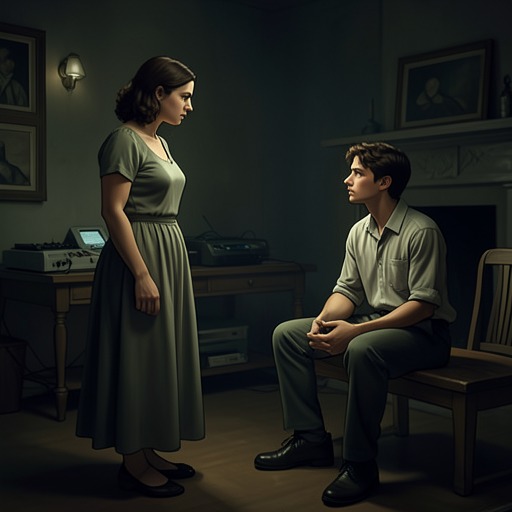
Eileen drives to Boston to test her escape route
EileenEileen drives to Boston to test her escape route, turning an ordinary Sunday drive into a practical rehearsal for leaving X-ville. The trip gives her a sobering answer: her car cannot safely carry her far in winter, and the escape she imagines will have to wait. The episode makes departure tangible by testing it against roads, weather, fatigue, and a vehicle she loves but cannot trust.
The mask and the wish to leave
At Moorehead, Eileen has learned to present a controlled face while carrying distress privately. She studies plaster casts of dead public figures and practices a composed expression in a mirror, calling the result her death mask. At work, she uses that expression to conceal her feelings, including nervousness about receiving the mothers of imprisoned boys. Before visiting hours, she drinks sweet vermouth and eats mint chocolates stolen from a drugstore in X-ville; her duties include recording visitors’ names and directing them to wait in the hallway. This practiced concealment matters to the road test because the plan to leave is not announced openly: it is something she rehearses alone, while outwardly continuing her life.
Her work also places her in close contact with people whose distress she has to manage rather than answer. With no female guards or officers, she is assigned to pat down women visitors, whom she remembers as sad, passive, and remorseful. She imagines Randy noticing her through those encounters, but instead feels reduced to a pair of hands that other people scarcely register. This account of invisibility does not explain the drive by itself, but it helps establish the contrast between Eileen’s constrained daily role and the possibility of choosing a road out.
A Sunday departure from X-ville
The trip begins when Eileen drives to the X-ville library on a Sunday and finds its large red door locked. The small library occupies the town’s old meeting house, and its sole librarian, Mrs. Buell, keeps hours according to her own schedule. Eileen knows the collection so well that she recognizes books by their spines and remembers stains on pages. Rather than abandon the returned books, she pushes them through the return slot and decides to drive toward Boston.
The timing lends the decision a brief, unreliable lift. Although it is late December, Eileen senses a hint of spring in the air. She describes the bright excitement that can follow drinking too much as a temporary state: it fades into gloom by noon. The drive therefore begins between hope and reservation. It is not yet an escape, but a test of whether escape might be physically possible.
The roads are slick with melting ice. Eileen lowers the windows because she fears exhaust fumes, pulls on a knit hat she found a few nights earlier, and lets the cold air reach her face. The car has already proved dangerous when she is tired: several times that winter she nearly fell asleep at the wheel, and on one night, returning from Randy’s, she veered into a snowbank. The car did not strike hard because her foot had slipped off the pedal. These earlier incidents turn the Boston drive into more than a matter of distance; they show that the vehicle and the conditions have already put her safety at risk.
Fatigue, interruption, and the failed test
Eileen had considered stopping at her former college on the way, but could not summon the courage. She had spent a little over a year in its small town, living in a dormitory, attending classes, and eating in the cafeteria. Having a coffee percolator and sheets of her own had made that period feel like a limited independence, though she had been pulled out of school halfway through. On this trip, even that earlier setting remains only a possible detour; she continues toward Boston instead.
As the cold becomes severe, Eileen rolls up the windows. She plays the radio and drives fast for a while, then encounters traffic near the city, apparently because of an accident ahead. While waiting for the cars to move, she becomes intensely drowsy: her eyelids droop, her head feels heavy, and her brain aches. She believes fumes have entered her brain tissue and may have caused lasting damage. The narrative preserves that as her belief, while the immediate danger is clear in her account: she is struggling to stay alert behind the wheel.
A police car comes up behind her after she has apparently swerved out of her lane. The officer lets her go when she promises to leave at the next exit and get coffee, adding that her father needs her. Eileen hates the police but feels compelled to obey. She puts on her death mask, nods, and takes the exit. At a coffee shop on Moody Street, whose windows are decorated with cutout elves and a Santa face, she orders hot tea and sits down still angry and worried about the car. The stop interrupts the drive and makes its physical limits impossible to ignore.
What the road test establishes
At the coffee shop, Eileen recognizes that the car is not a dependable getaway vehicle. In the cold, she would not get much farther than Moody Street before freezing or fainting. She understands the Sunday outing as a road test and a dress rehearsal, and the car has failed. That conclusion does not erase her wish to leave; it changes its timetable. She feels demoralized and decides she will have to wait until spring, while still doubting whether she will truly go.
The episode’s decisive movement is from imagined departure to practical constraint. The library’s locked door sends Eileen onto the road, but the same journey that briefly carries her away from X-ville exposes the danger of relying on this particular car. The death mask links the public composure she maintains at Moorehead with the controlled response she gives the officer; neither composure nor determination can make the vehicle safer. Boston remains a destination she has tested in thought and approached on the road, not a place she reaches in this episode.