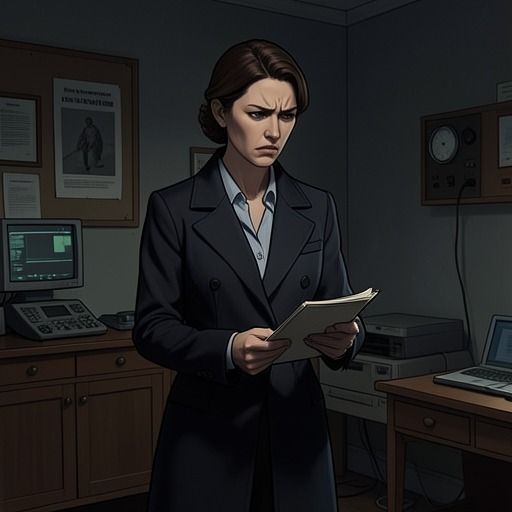
Rebecca takes Leonard Polk's file
EileenRebecca takes Leonard Polk's file from the Moorehead office in a small but consequential act of appropriation: a document Eileen has secretly found and examined passes into Rebecca's briefcase, giving her access to the institutional record of a boy confined in solitary. The transfer unfolds amid Eileen's fascination with Rebecca and her unease about being caught snooping; Rebecca calls the file borrowed, but leaves with it.
Discovery in the office
Earlier that afternoon, as Mrs. Stephens was preparing to leave, Eileen asked why Leonard Polk had been put in solitary. Mrs. Stephens dismissed him as a troublemaker and a nasty boy. Once the office staff had gone, Eileen located his folder and read through its yellowed papers. The official charge was patricide. A newspaper clipping said that Leonard had slit his sleeping father's throat, while the report described him as having no prior history of violence and quoted neighbors who remembered a quiet, well-mannered child. His mug shot showed a tired-looking boy, and a note in Eileen's own schoolgirl handwriting recorded that he had been mute since the crime.
The folder was substantial, filled with Dr. Frye's notes, dates, times, and technical language Eileen could not understand. Its contents set the sparse public account of the killing beside the institutional record of Leonard's continuing silence and confinement. Eileen had obtained the file without asking permission; when Rebecca arrived, she was still trying to put it back in order. That circumstance makes the handover more than a routine exchange of paperwork: Rebecca encounters the file because Eileen's private search has left it exposed.
Rebecca encounters the case
Rebecca came into the office after the Christmas pageant, having said good night to James. As Eileen fumbled with the folder, its papers fell across the floor. Rebecca helped gather them and read one of the documents. She reacted to the idea of a son killing his father, then framed the case as an old and familiar story of family violence. Looking at the photograph, she read Leonard's name aloud. Eileen explained that he had been in solitary, that she had never seen him outside it, and that he had no visitors.
Rebecca's response shifted from comment to inquiry. She called the lack of visitors a shame and opened her hands to ask for the folder. Eileen gave it to her, then tried to make her own presence seem ordinary by explaining that she had only been filing. While Rebecca read, Eileen busied herself with an old questionnaire, a small performance of distraction that contrasts with her close attention to Rebecca. The exchange therefore reveals two kinds of interest at once: Rebecca is looking at the record, while Eileen is acutely conscious of how Rebecca sees her.
The transfer and its limits
After flipping through the papers, Rebecca said she would borrow the file and slipped it into her briefcase. Her joking description of it as bedtime reading softened the directness of taking an institutional folder away, but did not change the practical result: the file left the office with her. The narrative records no permission from Moorehead staff and no explanation from Rebecca about what she intends to do with the material. It establishes the transfer, not a later investigation or any eventual consequence for Leonard.
The briefcase makes the change of possession concrete. Just before leaving, Rebecca comments on the pageant, and Eileen answers that the institution stages it every year. Rebecca calls the annual performance cruel and unusual punishment, then puts on a shawl and departs. The scene thus places her pointed judgment of Moorehead's spectacle beside her removal of a record concerning one of its confined boys. The juxtaposition suggests attention to the institution's treatment of its residents, without proving what action she will take.
Eileen's perspective and the action's significance
The episode is filtered through Eileen's retrospective account. She recalls Rebecca's voice and movements closely, but also admits that she had treated Mrs. Stephens as an enemy even though the woman had never really harmed her. That admission complicates Eileen's reading of the office encounter: her desire to impress Rebecca and her anxiety about being judged shape how she describes the exchange. Her account is not evidence that Rebecca's motives are fully known; the file-taking remains clear, while its purpose remains unstated.
For Eileen, the interaction ends less with the file's disappearance than with the sense that she has failed to make an impression. As Rebecca leaves, Eileen resolves to be cooler, more charming, smarter, funnier, and more alive the next time they speak. The moment therefore links a concrete change in custody—the folder moves from Eileen's hands into Rebecca's briefcase—to Eileen's intensifying attention to Rebecca. It also brings Leonard's largely unseen case into their shared conversation: his confinement, silence, and lack of visitors are no longer merely entries Eileen has read alone, though the scene stops before showing what Rebecca will make of them.