Oliver Byrne
ElementsOliver Byrne appears in this work not as a fictional protagonist but as its author, dedicated servant, and educational reformer. His decisive significance lies in the method he places before the reader: the propositions of Euclid are recast through coloured lines, angles, and figures so that geometry can be apprehended as a visible system of relations rather than as a sequence of verbal formulas to be memorized.
Identity and Intellectual Background
Byrne’s authorial presence is established in the dedication, where the work is offered by his “obedient and much obliged servant,” followed by his name. The volume was digitized by the Internet Archive in 2011, but its intellectual project belongs to Byrne’s earlier printed work: to make an established mathematical discipline more accessible without abandoning its demonstrative structure.
His argument begins from the breadth of the sciences and the practical importance of helping learners acquire them. Geometry is presented as a discipline that strengthens inquiry, elevates the mind, and trains the reasoning faculties. The text places this ambition within a long educational history, invoking Plato, Greece, and Johann Heinrich Pestalozzi while identifying Euclid’s Elements as the foundation of mathematical science across the civilized world. Byrne therefore joins classical authority to reforming pedagogy: Euclid supplies the intellectual foundation, while Byrne seeks a more effective route into it.
The Coloured Method
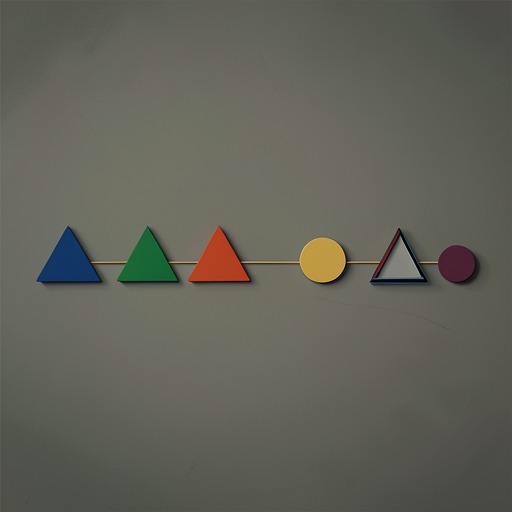
Byrne’s central innovation is the substitution, or supplementation, of arbitrary letter-names with visual distinctions. In conventional diagrams, letters attached to points and lines must be traced and remembered during a proof. In his system, differently coloured parts are made to “name themselves”: their forms, together with their corresponding colours, identify them in the demonstration. A red angle, a blue line, or a yellow figure can thus be referred to immediately, without requiring learners to reconstruct the relevant magnitude from a chain of labels.
The colours do not alter the mathematical entities themselves. Byrne insists that colour merely names the lines, angles, and magnitudes; a mathematical line, being length without breadth, cannot literally possess colour. The junction of two colours on the same plane gives a familiar visual approximation of a mathematical line, but the learner is expected to understand the relation represented, not mistake pigment for geometry. This distinction allows the system to remain a teaching aid rather than a claim about the substance of mathematical objects.
The method is demonstrated through relations among coloured parts. A red angle added to a yellow angle and then to a blue angle is described as equal to twice the yellow angle and therefore to two right angles; the red and blue angles together equal the yellow angle. In another example, the square of the yellow line is presented as equal to the sum of the squares of the blue and red lines. These examples show Byrne’s larger purpose: colour is not decoration surrounding a proof but a stable visual index through which the proof’s parts can be followed.
Teaching, Memory, and Accessibility
Byrne claims that the coloured presentation permits the Elements of Euclid to be acquired in less than one third of the time usually employed, while making retention more permanent. He attributes these conclusions to numerous experiments conducted by himself and by others who adopted his plans. Whether treated as a measured result or as a forceful pedagogical claim, the assertion reveals the standard by which he evaluates the method: not novelty alone, but speed of acquisition and durability of understanding.
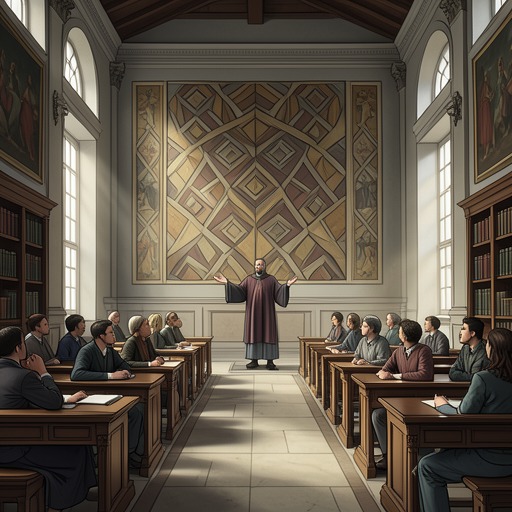
He gives particular weight to the simultaneous action of sight and hearing. In oral demonstrations, the teacher can speak of a colour while the class sees the corresponding part at the same moment. This is, in Byrne’s view, especially valuable for teaching geometry and other linear arts and sciences in classes. A reference from text to diagram becomes more rapid and certain when it identifies forms and colours, or parts and their colours, than when it requires students to name letters scattered across a figure.
The same arrangement is intended to prevent a familiar educational failure. Because equal parts can be given the same colours, the diagram provides an ocular demonstration of the equality that must be proved. The learner retains the data throughout the reasoning instead of committing the demonstration to memory as a fixed verbal performance. Byrne’s method may supplement older procedures even when it does not replace them, serving for introduction, rapid reminiscence, and more permanent memory.
The educational ambition extends beyond ordinary classroom efficiency. Byrne points to coloured representations, pictures, cuts, and diagrams as forms more easily fixed in the mind than unmarked sentences. He also states that tangible diagrams provide the only medium through which geometry and other linear arts and sciences can be taught to blind learners, while describing the visual system as adapted to the needs of deaf and mute learners. The claim reveals both the reach and the limits of his conception: he imagines instruction through multiple sensory routes, yet continues to define the system chiefly through visual form and colour.
Social and Intellectual Program
Byrne treats geometry as preparation for practical life as well as an exercise in abstract reasoning. Arithmetic, land-surveying, mensuration, engineering, navigation, mechanics, hydrostatics, pneumatics, optics, and physical astronomy are all described as dependent on geometrical propositions. His coloured method therefore promises not merely a more pleasant school lesson but a more efficient entrance into the technical vocations that geometry supports.
He is equally attentive to the first encounter between learner and science. Excessive formalism, repetitive demonstrations, and the conspicuous apparatus of rigor can obscure the evidence they are meant to clarify. Byrne argues that such instruction turns a subject capable of cultivating close thinking into a dry exercise of memory. Against this, he sets curiosity, visual appeal, and the awakening of dormant powers in younger minds. His reform is thus directed as much against the emotional experience of instruction as against its mechanical inefficiency.
The intended audience includes schools, public places of instruction, private learners, and those concerned with the education of women. Byrne welcomes the fact that the Elements of Mathematics forms a considerable part of sound female education and calls attention to the coloured method as an attractive means of communicating knowledge in that context. At its broadest, his program imagines that the same forceful address to sight and hearing could teach geometry and other branches of mathematics to a million people as readily as to one. Its ultimate educational purpose is expressed as teaching people “how to think, and not what to think.”
Narrative Role and Significance
As a character, Byrne is deliberately less a dramatic personality than the organizing intelligence behind a reforming book. The text supplies no personal plot, private conflict, or transformation in the fictional sense. Instead, his development is argumentative: he moves from diagnosing the obscurity of conventional instruction to proposing colour as a remedy, then from classroom demonstration to claims about memory, public education, female education, disability, and social improvement.
His method also occupies a carefully balanced position between reverence and innovation. Byrne calls the coloured system perhaps the only improvement plain geometry has received since the days of Euclid, while acknowledging the overwhelming historical reputation of Euclid himself. The comparison with Aesop suggests how completely a successful cultural figure can eclipse predecessors, but it also makes Byrne’s own intervention legible: he does not seek to replace the classical authority; he seeks to make its reasoning newly visible.
The result is a theory of geometry in which diagrams become more than illustrations. Geometry is defined through the relations of figures, and those relations are made available through colour, spatial arrangement, oral reference, and proof. Byrne’s enduring role in the work is therefore that of mediator between abstract demonstration and embodied learning. His central wager is that when reasoning is made visible without being reduced to ornament, the eye can help the mind follow evidence, preserve it, and eventually use it independently.