Emma Woodhouse
EmmaEmma Woodhouse, handsome, clever, and rich, with a comfortable home and happy disposition, seemed to unite some of the best blessings of existence; and had lived nearly twenty-one years in the world with very little to distress or vex her. She was the youngest of the two daughters of a most affectionate, indulgent father; and had, in consequence of her sister's marriage, been mistress of his house from a very early period. Her mother had died too long ago for her to have more than an indistinct remembrance of her caresses; and her place had been supplied by an excellent woman as governess, who had fallen little short of a mother in affection. The real evils of Emma's situation were the power of having rather too much her own way, and a disposition to think a little too well of herself; these were the disadvantages which threatened alloy to her many enjoyments.
Identity and Background
Emma Woodhouse is the central figure of Highbury society, the first in consequence there. The Woodhouses had been settled for several generations at Hartfield, the younger branch of a very ancient family. Their fortune, from other sources, was such as to make them scarcely secondary to Donwell Abbey itself in every other kind of consequence. Emma's mother died when she was very young, and her place was filled by Miss Taylor, who served as governess and companion for sixteen years, becoming more a friend and sister than an employee. Miss Taylor's marriage to Mr. Weston, which Emma proudly claims to have orchestrated, leaves Emma feeling the loss acutely, as she now faces intellectual solitude with only her valetudinarian father for company. Her father, Mr. Woodhouse, is a nervous man, easily depressed, fond of every body that he was used to, and hating to part with them; hating change of every kind. He is no companion for her, as he cannot meet her in conversation, rational or playful.
Arc Through the Plot
Emma's journey is one of progressive disillusionment and moral awakening. She begins by taking up Harriet Smith, a pretty, uneducated girl of unknown parentage, as her protégée, determined to improve her and find her a suitable husband. She persuades Harriet to refuse a proposal from the respectable farmer Robert Martin, believing Harriet destined for a higher station, and schemes to match her with the vicar, Mr. Elton. This plan collapses when Mr. Elton, far from being in love with Harriet, proposes to Emma herself, revealing his mercenary motives. Emma is mortified by her misjudgment. She then becomes entangled in a flirtation with Frank Churchill, the son of Mr. Weston, and imagines herself in love with him, while simultaneously suspecting Jane Fairfax of an improper attachment to her friend's husband, Mr. Dixon. Both of these self-deceptions are shattered when Frank Churchill's secret engagement to Jane Fairfax is revealed. The final and most painful revelation comes when she discovers that Harriet, whom she had been steering away from Robert Martin, has instead set her heart on Mr. Knightley, the man Emma herself loves. This crisis forces Emma to recognize her own heart and the folly of her matchmaking.
Relationships and Conflict
Emma's most significant relationship is with Mr. Knightley, a sensible man about seven or eight-and-thirty, who is a very old and intimate friend of the family and the elder brother of her sister's husband. Mr. Knightley is one of the few people who can see faults in Emma, and the only one who ever tells her of them. He consistently criticizes her interference in Harriet's life and her treatment of others, most notably after her cruel remark to Miss Bates at Box Hill. Their relationship evolves from one of friendly opposition to mutual love, with Mr. Knightley's reproaches serving as a crucial catalyst for Emma's self-reflection. Her friendship with Harriet Smith is initially based on Emma's desire to be useful and to mold a companion, but it becomes a source of repeated error and eventual pain. Emma's relationship with Jane Fairfax is marked by jealousy and suspicion, which she later regrets. Her interactions with Frank Churchill are characterized by flirtation and mutual amusement, but ultimately reveal her capacity for self-deception.
Change and Ending
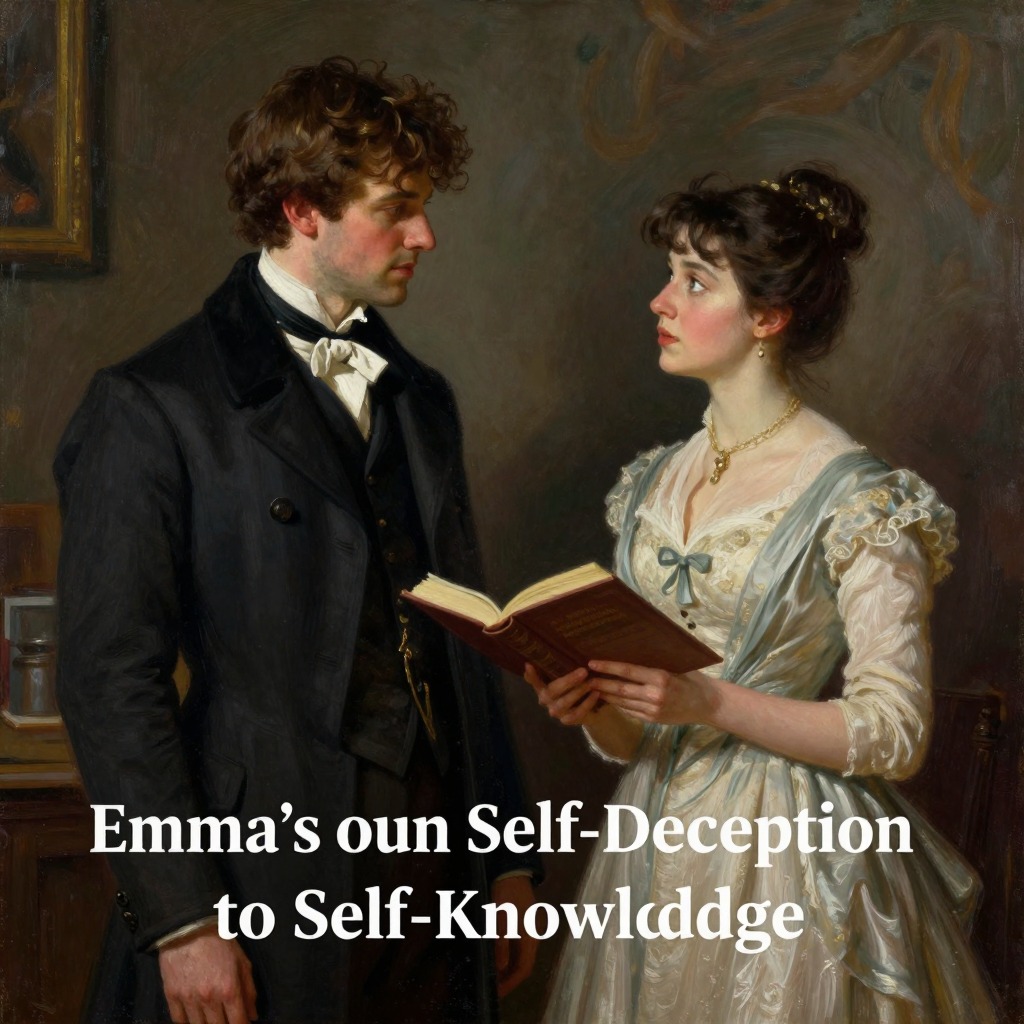
Emma's transformation is marked by a series of humiliations that lead to genuine self-knowledge. The first major blow is Mr. Elton's proposal, which forces her to acknowledge her blindness. The second is Mr. Knightley's stern rebuke after her insult to Miss Bates at Box Hill, which fills her with shame and a resolve to reform. The final and most profound crisis is the discovery that Harriet loves Mr. Knightley, which reveals to Emma her own deep and long-standing love for him. She realizes that she had never really cared for Frank Churchill at all, and that her vanity and arrogance had led her to misunderstand everyone around her. The resolution comes when Mr. Knightley proposes to her, and she accepts, with the understanding that they will live at Hartfield to care for her father. Harriet, meanwhile, marries Robert Martin, a match that Emma now wholeheartedly approves. Emma's final state is one of humility, gratitude, and a determination to grow more worthy of the man she loves.
Thematic Significance
Emma Woodhouse embodies the central themes of the novel: the dangers of self-deception, the folly of matchmaking, and the importance of social and moral education. Her journey from a confident, meddling young woman to a self-aware and repentant one illustrates the novel's concern with the growth of the individual through experience and correction. Her initial belief in her own infallibility, her manipulation of others' affections, and her snobbery regarding social rank are all gradually corrected. The novel ultimately affirms the value of genuine feeling, honest judgment, and the importance of recognizing one's own limitations. Emma's final happiness is earned through her painful but necessary education in the realities of human nature and her own heart.
The novel's reception was notably strong, with more contemporary reviews than any of Austen's other works. Prior to publication, John Murray's reader William Gifford praised the manuscript, offering to oversee its revision. Sir Walter Scott, writing anonymously in the Quarterly Review in March 1816, commended Austen's ability to draw characters from ordinary life with a precision he likened to the Flemish school of painting, though he noted that Emma has even less story than her previous novels. The character has also been widely adapted for stage and screen. Stage versions include a 1991 adaptation by Michael Fry, a 2000 musical by Stephen Karam, and a 2007 musical by Paul Gordon. Television adaptations range from a 1948 live BBC broadcast starring Judy Campbell to a 2009 BBC miniseries with Romola Garai. A 2025 stage adaptation by Ava Pickett, set in contemporary Essex, further demonstrates the enduring appeal of Emma Woodhouse as a character whose flaws and growth continue to resonate with audiences.