Dragon armor
EragonDragon armor is a rare protective harness from the age of the Dragon Riders, preserved among the treasures of the dwarves and later given to Saphira. More than equipment, it is a physical remnant of a destroyed order: a relic forged before the Riders’ fall that is recovered for a new Rider and dragon when the old conflict has begun again. Its fitting marks the point at which the memory of the Riders becomes materially useful in the present.
Origin in the Rider Age
The armor belongs to the technological and martial inheritance of the Dragon Riders. Brom’s history presents that order as an ancient institution formed to protect and guard the land. For thousands of years the Riders maintained peace, and their powers supported flourishing cities and towers built from living stone. Their strength in battle was legendary, and their alliance with the elves and friendship with the Dwarves made them the central stabilizing force of the age. Dragon armor therefore comes from a civilization remembered not merely for warfare, but for the political and cultural order that warfare once served.
The armor also carries the shadow of that order’s destruction. The Riders were eventually defeated from within when Galbatorix recruited allies, mastered forbidden magic, and joined with the Thirteen Forsworn. The collapse that followed ended the golden age and drove the surviving elves into secret places. In this history, armor is an especially eloquent relic: it was made to protect dragons at the height of their power, yet it survives into a world in which the Riders have become nearly legendary and Galbatorix rules the Empire with Shruikan.
Rediscovery among the Dwarves
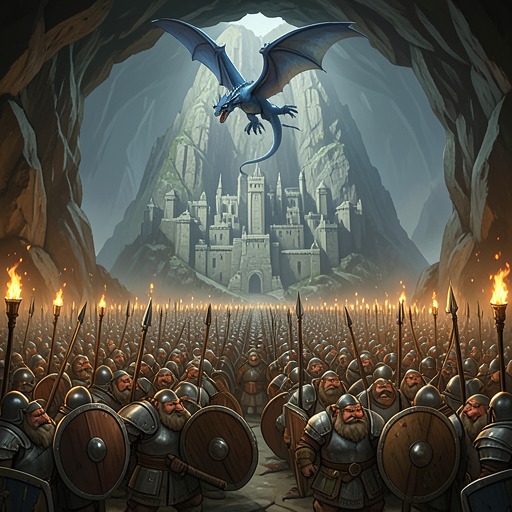
The armor is recovered in the Varden’s underground refuge during preparations for battle. After Eragon and Saphira finish eating, Orik leaves the battalion and returns with dwarves carrying tall piles of plate armor. He hands Eragon one section of the set, whose polished metal is intricately engraved and decorated with gold filigree. The pieces are exceptionally thick and heavy, in places an inch thick, and their number initially makes Eragon wonder how a single person could use them.
Orik explains that the armor is a gift from Hrothgar. It has rested so long among the dwarves’ treasures that it was almost forgotten, and it was forged in another age, before the fall of the Riders. Its survival in a hoard gives the object a double identity. It is at once a forgotten treasure, preserved by a people with long memories, and a weapon whose original purpose has become urgent again. Hrothgar’s gift also establishes a relationship of trust between the dwarven king and the young Rider: the past is not merely being displayed to Eragon but placed in his service.
Construction and Fitting
The armor is specifically made for dragons rather than men or elves. Orik stresses that complete sets are rare because they required enormous time to forge and because dragons were constantly growing. Saphira is still small enough for this particular set to fit her reasonably well, making her youth a practical condition of its use. The armor’s rarity thus reflects both the specialized skill required to create it and the biological difficulty of maintaining a dragon-sized suit over time.
The fitting is laborious. Eragon and Orik struggle with the pieces before stepping back to inspect the result. Triangular plates overlap across Saphira’s entire neck, leaving the ridge spikes uncovered. The heaviest protection covers her belly and chest, while lighter plates extend along her tail. Her legs and back are completely encased, and a single molded plate rests on her head while leaving the lower jaw free to bite and snap. Her wings remain bare, preserving the surfaces essential to flight. The design balances protection with movement rather than treating the dragon as a stationary armored beast.
Saphira tests the result by arching her neck, and the armor flexes smoothly with her body. She recognizes its cost as well as its value: it will slow her down, but it should help stop arrows. Eragon calls her appearance intimidating, a judgment that pleases her. Their exchange makes the fitting more than a technical preparation. Saphira actively evaluates the armor and accepts the compromise it imposes, while Eragon sees the transformed image of his companion as both formidable and newly prepared for war.
Military Function and Symbolic Weight
The armor’s immediate function is protection against battlefield missiles. Its plates shield the vulnerable neck, chest, belly, back, legs, tail, and head while leaving the wings free and the jaw usable. The arrangement reveals the conditions of dragon combat: Saphira must remain mobile and capable of flight, yet a body of her size presents a large target to archers. Dragon armor answers that vulnerability without removing the dragon’s natural weapons or essential movement.
Its symbolic function is equally important. Eragon receives a Rider’s sword, Zar’roc, as an inheritance of the old order, but Saphira’s armor supplies the corresponding inheritance for the dragon herself. The sword’s perfect balance and unending sharpness evoke the secret craftsmanship of the elves; the armor’s survival among dwarven treasures evokes the material continuity of the Riders’ alliances. Together, these objects make the new pair legible as successors to a broken tradition rather than isolated fugitives improvising their identities.
The armor also contrasts with the history of Galbatorix. The ancient Riders used their powers for good and maintained peace, whereas Galbatorix and his followers turned Rider strength toward revenge, domination, and slaughter. Saphira’s armor is therefore not simply a weapon inherited from a violent past. In the present narrative it is reclaimed from that past and redirected toward resistance against the regime that destroyed the Riders. Its meaning depends on who wears it and what purpose the protection serves.
Place in the Renewed Rider Tradition
The recovery of dragon armor belongs to a larger pattern of lost Rider history returning in altered form. The Riders’ ancestral home, Vroengard, is remembered as a looted and empty shell haunted by strange beasts, with the abandoned city of Dorú Areaba at its center. The order’s former glory survives in ruins, maps, weapons, stories, and scattered memories rather than in an intact institution. Dragon armor is one of the rare relics that can cross that gap directly: it moves from a forgotten dwarven storehouse onto a living dragon preparing for battle.
That movement gives the object a quiet narrative force. The past is not restored exactly as it was; the old order, its cities, and its political world remain broken. Yet its skills, symbols, and protective practices can be adapted by Eragon and Saphira. Later, when Eragon is told by Osthato Chetowä, also called Togira Ikonoka, to trust Arya and go with her to Ellesméra, the summons points toward further knowledge and preparation. Dragon armor anticipates that movement toward inheritance: before the deeper instruction begins, Saphira already receives a tangible sign that the history behind her bond with Eragon has not vanished completely.
In this way, dragon armor stands at the intersection of memory and action. Brom’s account insists that time cannot be stopped and that what has been lost may survive in memory; the armor gives that principle weight, shape, and battlefield purpose. It is an artifact from the golden age, nearly forgotten in a dwarven treasury, that becomes useful precisely because a new generation has begun to reopen the struggle that ended the Riders. Its decisive significance lies in that transformation from relic into protection, and from protection into a visible claim that the Rider tradition can continue without repeating the corruption that destroyed it.