Zar’roc
EragonZar’roc is a former Rider’s sword and one of the most charged objects in the story. Its flawless craftsmanship makes it a practical weapon of extraordinary quality, but its history gives it a second life as a bearer of memory: the blade once belonged to Morzan, the brutal Rider who became one of Galbatorix’s Forsworn. When Brom gives Zar’roc to Eragon, the sword passes from the wreckage of the old order into the hands of a new Rider, carrying both inheritance and warning.
Appearance and Craftsmanship
Zar’roc is introduced as a weapon whose physical presence is difficult to separate from its aura of power. Its gold pommel is shaped like a teardrop, with its sides cut away to expose a ruby the size of a small egg. Silver wire wraps the hilt and gleams like starlight, while the wine-red sheath is smooth as glass and marked only by a strange black symbol. A matching symbol is inscribed on the blade itself.
The sword feels almost uncannily suited to Eragon. Its handle fits his hand as though made for him, and its red blade slides soundlessly from the sheath. The metal shimmers in the firelight, its edges curve cleanly toward a sharp point, and its balance makes it feel like an extension of his arm rather than an unfamiliar tool. The weapon was made for battle and for ending lives, yet the narrative presents its terrible beauty alongside its lethal purpose. That contrast establishes Zar’roc as more than equipment: it is an object in which refinement and violence coexist.
Brom explains that Zar’roc was forged as a Rider’s blade. When a Rider completed training, the elves presented that Rider with a sword made by secret methods. Such blades remained eternally sharp and would never stain. The customary design matched the blade’s color to the Rider’s dragon, although Brom says an exception can be made in Eragon’s case. Zar’roc’s name is left unexplained; Brom does not know its meaning and suggests that it may have been personal to the Rider who first carried it.
Brom’s Gift and Eragon’s Inheritance
Brom gives Zar’roc to Eragon after revealing the sword from a long, carefully wrapped bundle. He refuses to explain where he obtained it, saying only that acquiring it required a series of dangerous and unpleasant adventures. Rather than reclaiming it after Eragon examines the weapon, Brom tells him to consider it his, arguing that Eragon has more claim to it and will need it before his journey is complete.
The gift quietly binds Eragon to the older history Brom has been withholding. Brom’s account of the Dragon Riders describes an order formed to protect the land, unmatched in battle, and associated with a golden age in which cities rose, peace was maintained, and humans, elves, and dwarves lived in alliance. That order was destroyed from within when Galbatorix turned against the Riders. Zar’roc therefore arrives not as an unmarked heroic sword but as a surviving fragment of the institution whose fall shaped the present world.
The connection becomes more intimate when Brom discloses that he was once a Rider himself. His dragon was named Saphira, and she was killed during the fighting at Dorú Areaba on Vroengard after Morzan’s betrayal. Brom’s history turns Zar’roc into an object of concealed grief as well as military inheritance: the sword comes from the same ruined Rider world that took Brom’s dragon and left him with hatred for Galbatorix. His warning that Eragon must guard Saphira with his life gives the weapon an implicit counterpoint. Zar’roc represents what the old age lost; Saphira represents what Eragon must prevent from being lost again.
Morzan’s Sword Revealed
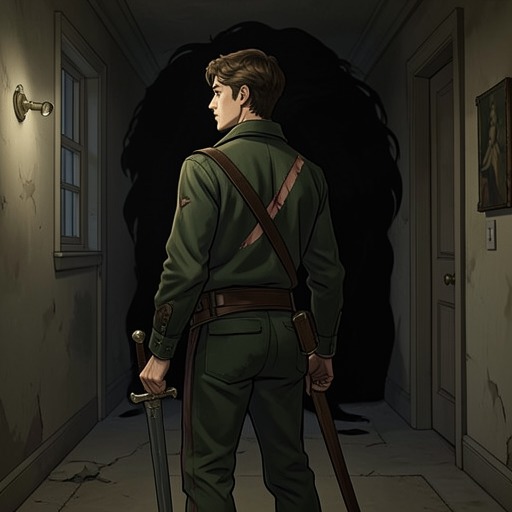
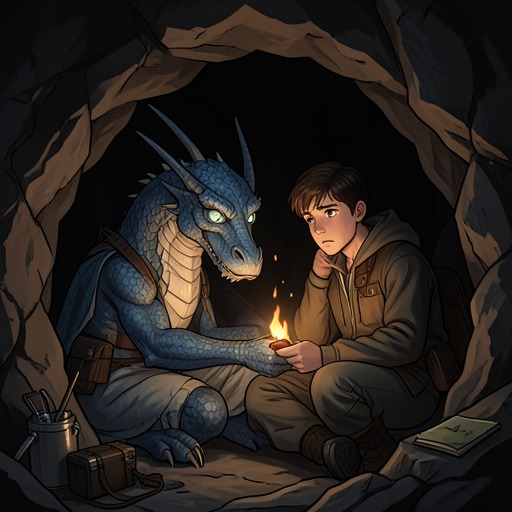
Zar’roc’s most important revelation occurs after Brom’s death. While preparing to leave a cave, Eragon uncovers the red sheath among Brom’s belongings and weighs the sword in his hands. Until then, he has avoided carrying it openly, using it only when sparring with Brom because he did not want others to see it. The Ra’zac’s apparent surprise and fear of the weapon change his calculation. Eragon straps Zar’roc on, abandons the concealment that had governed his conduct, and declares inwardly that he will live by the sword and let the world see what he is.
That decision is both practical and symbolic. Eragon is no longer treating Zar’roc as an embarrassing relic or an object to be hidden; he is accepting the public identity of a Rider. The sword becomes the outward sign of a transformation that has already begun through his bond with Saphira and his conflict with the Empire. Yet the act of claiming it also exposes him to a history he does not understand.
Murtagh recognizes the weapon immediately. He studies the symbol on the blade, then reacts with anger when Eragon says Brom gave it to him. Murtagh explains that the sword was once as famous as its owner and identifies its last Rider as Morzan, a savage and brutal man. To Murtagh, Eragon’s possession of one of the Forsworn’s swords is alarming evidence: a person who claims to oppose the Empire is carrying the weapon of one of its most notorious enemies.
Eragon is shocked because Brom never told him the sword’s origin. He realizes that Brom must have taken it from Morzan after their fight in Gil’ead, but he cannot know why Brom concealed that fact. The delayed identification changes Zar’roc’s meaning retroactively. What had seemed like a mysterious ancestral weapon becomes a tangible remnant of betrayal, murder, and the destruction of the Riders. Its red color and black markings no longer signify only elegance and power; they also mark a contested inheritance.
Reputation and Political Burden
Zar’roc’s history follows Eragon into Farthen Dûr. Hrothgar, the dwarf king, notices that Eragon carries an enemy’s sword and has been told both of that fact and of Eragon’s association with the son of a Forsworn. The weapon displeases him enough that he asks to examine it personally. Hrothgar draws the sword, studies its red blade, tests its point with his palm, and acknowledges its masterful forging.
Hrothgar also confirms the exceptional quality of elven swordcraft. Elves rarely choose to make swords, preferring bows and spears, but when they do, the results are unmatched. His judgment separates the weapon’s craftsmanship from its history: Zar’roc is technically magnificent even though its reputation is ill-fated. Hrothgar permits Eragon to carry it, while making clear that the sword’s presence is unwelcome and that its luck may or may not have changed.
This encounter shows that Zar’roc functions socially as well as militarily. It is a credential, a suspicion, and a political problem at once. Those who see it do not encounter a neutral blade; they read Morzan, the Forsworn, and the old catastrophe through it. Eragon cannot fully control that reading, because the sword’s past precedes him. Carrying it means accepting that his identity as a new Rider will be judged through the failures of a predecessor.
Symbolic and Narrative Significance
Zar’roc belongs to the story’s larger pattern of broken legacies. The old Dragon Riders are remembered through songs, histories, ruined places, surviving weapons, and the testimony of those who endured their fall. Brom’s public tale presents the Riders’ lost golden age and Galbatorix’s calculated corruption of it; the sword gives that distant history a material form that Eragon can hold, wear, and eventually use. It turns historical memory into an immediate burden.
Its passage from Morzan through Brom to Eragon also reverses, without erasing, the meaning of inheritance. Morzan used Rider power in betrayal and slaughter. Brom, who fought him and lost his dragon, preserves the sword rather than allowing its history to vanish. Eragon receives it without knowing its origin, then chooses to carry it openly once its association with the Riders’ past becomes unavoidable. The weapon thus moves through three relationships to power: corruption, remembrance, and attempted renewal.
The sword’s meaning remains deliberately unstable. Its forged perfection suggests the high achievement of the Riders and elves; its name is unexplained; its reputation is stained by Morzan; and Hrothgar leaves open the possibility that its ill fortune has changed. Zar’roc is therefore neither purified by Eragon’s possession nor permanently condemned by Morzan’s. It is a relic whose significance depends on the acts of the person who bears it, while its earlier history continues to constrain how those acts are understood.