Skilna Bragh
EragonSkilna Bragh is a rare poison administered to Arya during her imprisonment, and its importance lies in the way it converts captivity into a continuing bodily threat. It does not merely injure her at the moment of capture: without regular treatment, it will kill her within hours, making survival dependent on access to an antidote controlled by forces beyond her immediate reach.
Nature and Method of Use
During her captivity, Arya was given Skilna Bragh together with a drug that suppressed her power. Each morning, her captors forced her to take the antidote for the previous day’s dose, turning treatment into another form of coercion. The poison therefore worked alongside physical torture and magical restraint: it weakened Arya while preserving her captors’ ability to keep her alive, compliant, and vulnerable.
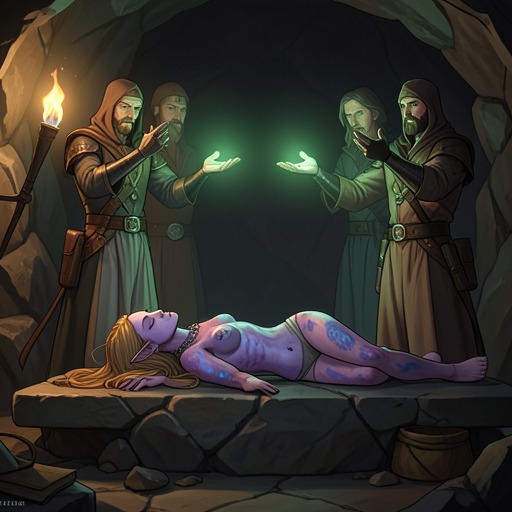
The regimen also explains why Arya remains in a trance after Eragon reaches her. Dormancy slows the poison’s progress but cannot stop it. Her stillness is consequently not ordinary sleep or recovery; it is a desperate physiological defense against a substance already moving through her veins.
Threat to Arya’s Survival
Arya tells Eragon that she has only three or four days to live unless she receives the antidote. The danger is immediate even though the poisoning began earlier, because the treatment that had temporarily sustained her is no longer available. Her body carries the captivity forward after the prison itself has been escaped, making the rescue incomplete until the poison can be counteracted.
The poison also shapes Arya’s decision-making. She considered waking in order to end her own life and deny Galbatorix the victory of using her, but refrained because she hoped Eragon might be an ally. Skilna Bragh thus places her between two forms of death: the deliberate death she might choose and the imposed death advancing through her body.
The Search for the Antidote
The antidote exists in only two places outside Galbatorix’s Empire: with Arya’s own people and with the Varden. Arya’s home, however, lies beyond the reach of dragonback, so Eragon cannot simply carry her there by air. The Varden becomes the practical destination and the narrow possibility of survival, linking a medical necessity to the larger political struggle against Galbatorix.
This restriction gives the poison a structural role in the plot. The rescue from captivity creates a new obligation rather than resolving the crisis: Eragon and his companions must transport an incapacitated Arya through danger while racing a deadline measured in days. The antidote’s scarcity makes knowledge, allegiance, and geography matters of life and death.
Bodily Violence and Narrative Significance
Skilna Bragh appears within a wider pattern of damaged bodies. Garrow lies beneath the ruins of his house with deep burns across most of his body, while the rescued Arya bears bruises, cuts, scabs, brands, and marks from repeated beatings. Eragon later discovers that Durza’s attack has left a huge scar from his right shoulder to his opposite hip. Against this background, the poison extends violence inward: it is invisible, gradual, and dependent on repeated administration rather than a single visible wound.
Its narrative effect is therefore both physical and psychological. Arya’s body becomes a record of enemy power, but her trance also denies that power a complete victory by preserving her until an ally can act. The poison makes rescue a process rather than a gesture, and it forces the characters to confront the material cost of resistance. Skilna Bragh is not simply a dangerous substance; it is the mechanism by which captivity continues after escape, keeping Arya’s freedom conditional until the antidote is found.