Dragons
EragonDragons are among the oldest and most consequential beings in Alagaësia, presented not as animals but as elemental inhabitants of the world whose fate is inseparable from the land’s own. Their history explains the rise of the Dragon Riders, the flourishing of the ancient golden age, the catastrophe brought by Galbatorix, and the uncertain possibility that the old order has not entirely vanished.
Ancient Nature and Place in the World
According to Brom, dragons have no known beginning unless their origin lies in the creation of Alagaësia itself. If they possess an end, it will come only when the world perishes, because dragons suffer as the land suffers. They lived in Alagaësia before the arrival of the elves, alongside the dwarves and a few other peoples, and existed in an elemental state that was strong, proud, and originally unchanging.
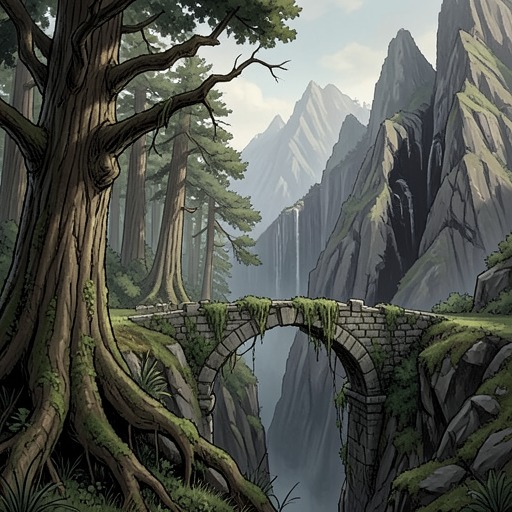
Their antiquity makes them more than one species among many. The Spine, where Eragon hunts, is a harsh mountain range extending through Alagaësia, and its isolation preserves strange histories and dangerous creatures. Later, the Hadarac Desert appears as an immense, nearly lifeless sea of reddish-gold dunes, while the Beor Mountains contain forests so old and hostile that Saphira recognizes their age. These environments establish the world as something more than a human possession: dragons belong to the same deep order of nature, and their powers are repeatedly associated with forces that human beings do not fully comprehend.
War, Reconciliation, and the Riders
The relationship between dragons and elves began in violence. When the first elves sailed to Alagaësia, the elves initially regarded dragons as mere animals. An elven youth hunted and killed a dragon as though it were a stag; the dragons retaliated by ambushing and slaughtering the elf, and the conflict widened into a war between the two peoples. The fighting lasted five years and became increasingly destructive as each side fought for survival, although both later regretted the bloodshed.
The war ended only after an elf also named Eragon found a dragon egg. He secretly raised the hatchling and named him Bid’Daum in the Ancient Language. Once the dragon had grown, the two traveled among the dragons and persuaded them to make peace with the elves. Treaties followed, and the two races established the Riders to prevent the war from beginning again.
At first, the Riders served chiefly as a means of communication between elves and dragons. Their authority expanded over time, however, until they became the strongest political and military power in Alagaësia. They settled on Vroengard and built Dorú Areaba, and before Galbatorix’s overthrow they possessed more power than all the kings of the land. The Riders therefore represent not the domination of dragons by humans or elves, but an institution founded on interspecies cooperation and mutual survival.
Power, Bond, and Uncertainty
Dragons are linked to Alagaësia in ways that even the Riders never completely understood. Brom explains that mysterious things occur around them that would be impossible elsewhere, and that dragons may not know the full extent of their own abilities. Saphira demonstrates this uncertainty when she touches Zar’roc with her nose: the sword’s iridescent red metal ripples against her scales and then returns to its ordinary appearance. The moment turns a legendary weapon into evidence that dragons possess powers beyond established knowledge.
The dragon-Rider relationship is consequently more than a practical partnership. Saphira’s presence alters what Eragon can perceive and accomplish, while Eragon’s emerging identity as a Rider depends upon a bond that cannot be reduced to training or weaponry. The sword Zar’roc, with its ruby set in a gold pommel, silver-wrapped hilt, wine-red sheath, and eternally sharp Rider-forged blade, belongs to the history created by that bond. Its beauty and purpose preserve the contradiction at the center of the Riders’ legacy: dragon-linked power can protect the world, yet it is also forged for battle and the ending of human lives.
Extinction Under Galbatorix
The fall of the dragons and Riders began when Galbatorix turned his extraordinary ability toward revenge. After his first dragon died and the Riders’ council refused his demand for another, he concluded that the Riders were responsible for his loss. He manipulated a sympathetic Rider, used dark secrets learned from a Shade, and helped lure an elder to his death before slaughtering his own accomplice. Later he persuaded Morzan to leave a gate unbolted at Ilirea, now called Urû’baen, entered the citadel, and stole a dragon hatchling.
That hatchling became Shruikan, Galbatorix’s black dragon. Galbatorix and Morzan learned forbidden magic in a place where the Riders feared to go; once Shruikan had fully grown, they revealed themselves and hunted the Riders. Twelve additional Riders joined them through desire for power or resentment, forming the Thirteen Forsworn with Morzan. The Riders were unprepared for the assault, and the elves were eventually overthrown and driven into secret places.
The dragons suffered the most devastating consequence. Galbatorix spared dragons willing to serve him, but the only ones who accepted were the twisted dragons of the Forsworn. The rest were slaughtered, leaving Shruikan as the known surviving dragon in Galbatorix’s service and making the existence of any other living dragons one of the greatest mysteries in Alagaësia. Their disappearance is not merely a biological loss: it is the destruction of the beings whose alliance once connected peoples, stabilized kingdoms, and made the Riders possible.
Remnants and Narrative Significance
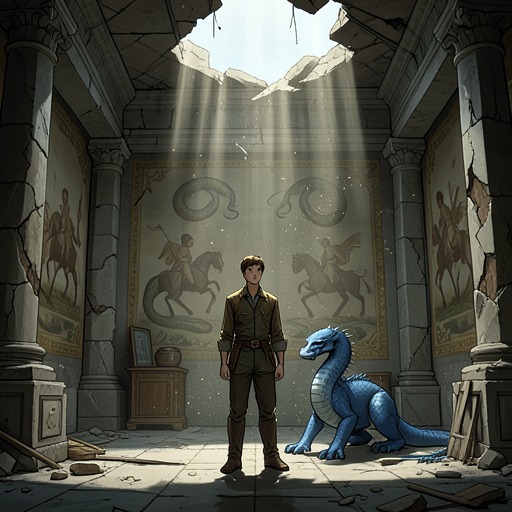
The maps of Alagaësia preserve the physical memory of the dragons’ vanished civilization. Vroengard, their ancestral home, is described as a looted and empty shell haunted by strange beasts, with the abandoned city of Dorú Areaba at its center. The island remains a monument to former glory, but its emptiness makes the Riders’ fall tangible: a place once built around dragon-linked power has become a ruin.
The novel nevertheless refuses to treat the dragons as wholly erased. Eragon discovers Saphira’s egg, and Saphira’s hatching restores a living dragon to the world. During the journey across the plains, Saphira drinks from the Anora River alongside Eragon and Brom; in the Hadarac Desert, her enormous need for water becomes a practical obstacle, since she and the horses consume more water at one time than the travelers do in a week. These details make her magnificence inseparable from material dependence. The dragon is an ancient power, but she must still drink, travel, and endure the same landscapes as her companions.
When Eragon later encounters the Beor Mountains, Saphira’s awareness of the old forest reinforces her status as a being whose history reaches deeper than human settlement. Her presence also gives the surviving resistance a future that the earlier rebellion lacked. A mysterious voice identifies itself as Osthato Chetowä, the Mourning Sage, and Togira Ikonoka, the Cripple Who Is Whole, then tells Eragon that he must trust Arya and go with her to Ellesméra. The command follows Eragon’s defeat of a great evil and places the young Rider within a continuing history rather than at its end.
Dragons thus function simultaneously as creatures, ancestors, political partners, weapons, victims, and promises. Their near-extinction records the violence of Galbatorix’s regime; their bond with Eragon and Saphira reopens the possibility of cooperation; and their uncertain survival gives the story its largest horizon. The fate of Alagaësia is inseparable from whether dragons remain only memories of a lost golden age or become living agents in the struggle to change the world.