Dwarves
EragonDwarves are one of the oldest peoples of Alagaësia and a civilization shaped by mountains, tunnels, metal, memory, and guarded sovereignty. They are presented not as a vanished legend but as a powerful society whose history predates the Riders, whose sealed realms survived the Empire’s rise, and whose political allegiance remains conditional even when their interests overlap with the Varden.
Origins and Ancient History
Brom places the Dwarves among the true inhabitants of Alagaësia, alongside dragons and a few other peoples. They lived in the land before the arrival of the first elves, when the world of the dragons and its older inhabitants was still unchanging. This antiquity gives the Dwarves a status different from that of later settlers: they are not newcomers to the continent but one of the peoples rooted in its original history.
Their relationship with the Dragon Riders was cooperative but never absolute. The Dwarves fought beside the Riders during the first battles against Galbatorix, joining the struggle when the danger threatened the established order. Once it became clear that Galbatorix would prevail, however, they sealed every known entrance to their tunnels and disappeared underground. No one knew what had become of them, and Brom could say only that not one Dwarf had been seen since. Their retreat preserved their people but also turned their civilization into one of Alagaësia’s great absences, a hidden power surviving beyond the reach of ordinary human knowledge.
Appearance and Mountain Environment
The first Dwarf Eragon sees is strikingly compact and heavily equipped. The man is no taller than Eragon’s elbow, with a stocky chest, muscular arms, and a long braided beard. He wears a chain-mail jacket cut off at the shoulders, carries a war ax, and keeps an iron-bound oxhide cap on his head; the cap bears a hammer surrounded by twelve stars. His physical scale contrasts with his martial presence. Small in stature, he is nevertheless visibly prepared for battle and eager to join the fighting when Urgals attack.
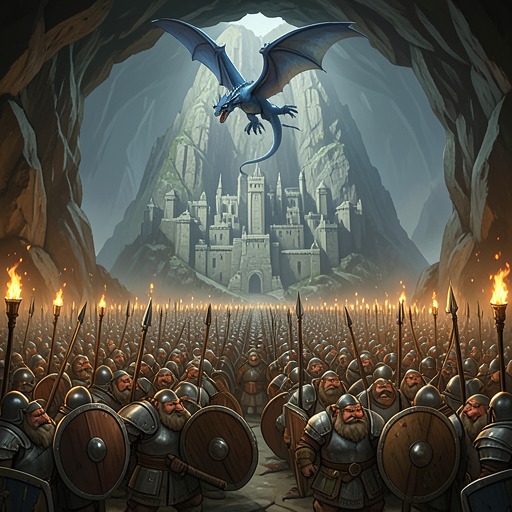
The Dwarves’ environment is not merely a refuge but the material basis of their culture. Their hidden entrance opens through massive stone doors in the Beor Mountains, and a broad tunnel lit by flameless lamps leads into the depths. Farthen Dûr is an immense mountain crater discovered by Korgan, the father of the Dwarf race, while tunneling for gold. At its center stands Tronjheim, a city-mountain built from the purest marble. The architecture makes Dwarf history visible: their civilization is carved into the earth, and its greatest monument is at once a city, a fortress, and a geological wonder.
Life in Farthen Dûr depends on the limits of that underground world. There is too little sunlight for ordinary farming; moss, mushrooms, and mold can grow, but Tronjheim cannot survive without supplies from the surrounding valleys. This scarcity helps explain why many Dwarves choose to live elsewhere in the Beor Mountains. Their underground independence is therefore real but not complete. The kingdom controls its entrances and protects its internal spaces, yet it remains tied to external valleys for food and other necessities.
Political Structure and the Varden
The Dwarves are connected to the Varden without being subordinate to them. They permit the resistance to live in Tronjheim and provide assistance in its struggle against the Empire, but their loyalty belongs primarily to their own king. Ajihad has no authority over them except what King Hrothgar grants him, and even Hrothgar must contend with the independent power of the Dwarf clans.
Thirteen clans are subject to Hrothgar, but each clan chief possesses enormous influence. The chiefs choose the next Dwarf king when the reigning monarch dies, giving the clans a direct role in succession and limiting the king’s freedom of action. Hrothgar sympathizes with the Varden’s cause, yet he cannot openly anger chiefs who oppose it without risking the support of his own people. The Dwarves thus add an internal political dimension to the resistance: the Varden must negotiate not only with the Empire’s enemies but also with an allied society whose consent is divided and carefully guarded.
Their suspicion of Eragon, Saphira, and the Riders arises from a long memory of conflict. Before the elves made peace between dragons and Dwarves, dragons regularly ate Dwarf flocks and stole their gold. The Dwarves never fully accepted the Riders or permitted them to police the Dwarf kingdom. Galbatorix’s ascent deepened that distrust, because the Riders’ catastrophic collapse seemed to confirm the danger of allowing Riders and dragons influence over Dwarf affairs. Ancient grievances therefore remain politically active in the present, shaping the reception of the new Rider even though he opposes the same tyrant the Dwarves resist.
Role in Eragon’s Journey
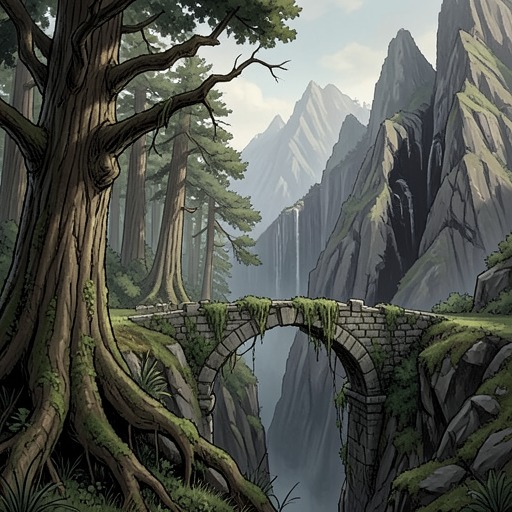
The Dwarves enter Eragon’s story through danger rather than ceremony. During the flight toward the Beor Mountains, Eragon, Saphira, Murtagh, and Arya pass through a hostile forest beneath the mountains. Its ancient trees, black bark, massive cones, tangled wolfsbane, and watchful openings create the sense of a territory that resents intrusion. The Beartooth River runs beside the travelers, while the dense growth separates Eragon and Murtagh from Saphira and Arya. This landscape prepares the Dwarves’ world as a realm of difficult passage, concealed routes, and nonhuman age.
At the lake below the mountain entrance, a Dwarf rescues Eragon from drowning. As Urgals are trapped under volleys of arrows from the cliffs, Dwarf warriors emerge behind them, preventing the attackers from retreating. The rescue immediately establishes the Dwarves as an organized military force rather than an isolated curiosity. Their hidden doors open into the mountain, and their archers turn the terrain itself into a defensive weapon.
Eragon’s arrival at Farthen Dûr is also a public political event. When the tunnel opens onto the crater, crowds of Dwarves and humans line the cobblestone path in numbers reaching into the thousands. Every face is turned toward him, and the gathered people remain silent. The scene places Eragon under collective scrutiny: entering the Dwarf realm means entering a society that can shelter the resistance while also judging the Rider who may determine its future.
The journey to the Dwarves is made possible by the severe geography of the continent. Eragon and his companions must plan around water consumption before crossing the Hadarac Desert, where the horses and Saphira require more water at once than the human travelers drink in a week. Beyond the desert, the Beor Mountains offer a destination whose forests, rivers, cliffs, and subterranean passages transform survival into political arrival. The Dwarves are therefore not simply encountered at the end of a route; their realm is the consequence of adapting to landscapes that defeat ordinary travel.
Significance
The Dwarves embody survival through withdrawal, but their seclusion is not neutrality. They preserve an ancient identity by sealing their tunnels, yet the same hidden kingdom becomes a shelter for the Varden and a strategic center in the war against Galbatorix. Their history shows that resistance depends on more than battlefield courage: it also depends on who controls food, entrances, territory, succession, and the memory of old betrayals.
Their presence complicates the simple division between allies and enemies. Hrothgar supports the Varden, while many clan chiefs distrust the cause; the Dwarves help the resistance, but they do not surrender their sovereignty to it. Their hostility toward dragons and Riders survives alongside their opposition to the Empire. Through them, the narrative presents political legitimacy as something negotiated among peoples with unequal memories and competing obligations, not as a reward automatically granted to anyone fighting a common tyrant.