Kull
EragonKull are the elite of the Urgals, distinguished from the Urgals Eragon has previously encountered by their extraordinary size, endurance, and battlefield purpose. Their emergence changes the scale of the danger facing Eragon, Saphira, and Murtagh: the pursuers are no longer merely a persistent enemy column but a force capable of overwhelming skilled opponents through physical superiority and numbers.
Identity and Physical Nature
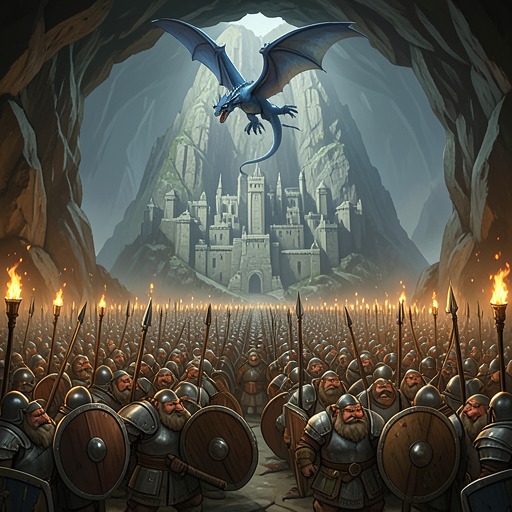
Kull stand chest and shoulders above a tall man, and Murtagh later specifies that none is under eight feet tall. Their size is not presented as ornamental monstrosity but as a practical military advantage. They are so heavy that horses cannot carry them, yet they can run for days without sleep and remain ready for battle. Murtagh estimates that killing one may require five men, making each Kull a serious combatant rather than an ordinary soldier in a massed formation.
Their bodily scale also distinguishes their homeland and way of life from the ordinary human world. Saphira observes that the Kull are larger than any Urgals the travelers have previously seen and wonders what harsh land could produce such brutes. The description joins physical extremity to an implied environment of violence, presenting the Kull as products of a fierce place as well as instruments of war.
Appearance in the Pursuit
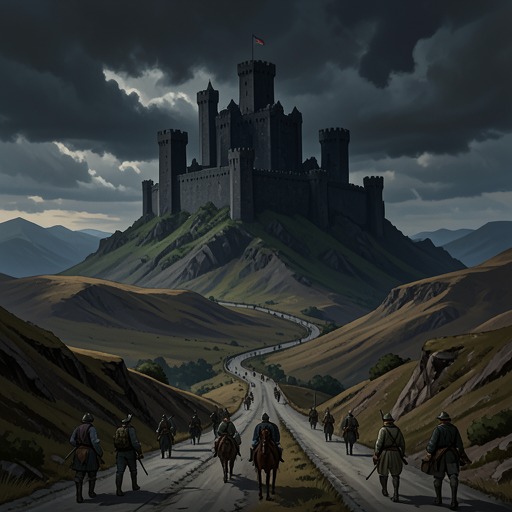
The Kull are first recognized from the air, when Eragon and Saphira watch an Urgal column moving rapidly toward the valley’s mouth. Their speed puzzles Eragon, who cannot see the details that Saphira detects from above. Once Saphira identifies the pursuers as unusually large, Murtagh connects that detail with the otherwise inexplicable pace and endurance of the column.
Murtagh identifies them as Kull and explains that they never leave their caves except for war. Their presence in such force therefore reveals the scale of the enemy’s intention: this is not a routine patrol or an incidental pursuit, but a deployment made in expectation of a great slaughter. The Kull’s unusual mobility on foot allows them to maintain the chase despite the travelers’ horses and Saphira’s assistance.
The threat becomes immediate at the shore of Kóstha-mérna. While Eragon, Murtagh, and Saphira are making their way toward the waterfall, Murtagh warns them that Urgals have appeared behind them. Hulking figures stream from the forest and mass beside the lake. The horde divides, moving around both sides of the water and closing the available routes of escape. The narrow shore forces the bulky Kull to march single file, but even that restriction does not remove the danger; it merely shapes the pursuit into a tightening corridor.
Combat Function and Narrative Stakes
Kull are defined by war. Their size, stamina, and resistance make them a force that cannot be dismissed even by Eragon, Murtagh, and Saphira together. Murtagh acknowledges that their combined skill and Saphira’s power would not be enough to hold off the Kull. This assessment gives the creatures a rare form of military credibility: they are not simply frightening because they look monstrous, but because experienced fighters calculate that direct resistance may fail.
Their deployment also links individual danger to wider political conflict. The Kull are pursuing the travelers as part of a larger hostile operation connected to the forces opposing the Varden. Their appearance near the lake compresses the broader war into a physical problem of terrain, speed, and survival. The travelers must reach the falls or find another escape rather than treat the encounter as a contest that can safely be won by force.
Cultural and Thematic Significance
The Kull sharpen the book’s recurring contrast between inherited legend and present violence. Brom’s account of the Dragon Riders describes an earlier age in which extraordinary strength was placed in the service of protection, peace, and flourishing cities. The Kull embody a different use of exceptional strength: their abilities are organized around war, pursuit, and slaughter. The contrast does not make power inherently moral or immoral; it shows how power acquires meaning through the purposes and structures that direct it.
They also belong to a world in which ancient conflicts continue to shape the present. Brom’s histories recount the Riders’ fall, the rise of Galbatorix, and the long war between elves and dragons, while the travelers’ map preserves the empty shell of Vroengard and the abandoned city of Dorú Areaba as remnants of lost greatness. Against that background, the Kull are not relics of a vanished age but living evidence that the continent’s history remains militarized. Their bodies carry the immediate force of old enmities into the current journey.
The Kull’s eventual recognition functions as a revelation within the chase. At first the travelers see only an Urgal column moving with impossible speed. Saphira supplies the first visual distinction; Murtagh supplies the name, military knowledge, and implications. The sequence turns a vague pursuit into a specific threat and makes knowledge itself a survival resource. By the time the Kull emerge from the forest at Kóstha-mérna, their identity has already transformed the travelers’ understanding of what is following them.