The Golden Age of the Riders
EragonThe Golden Age of the Riders is the vanished period when the Dragon Riders stood at the center of Alagaësia’s political and cultural order. In Brom’s account, they protected the land for thousands of years, used their extraordinary powers for good, and maintained a peace under which cities, alliances, and prosperity could grow. Its decisive significance lies in the contrast between that idealized age and the later collapse caused not by an external enemy, but by betrayal within the Riders themselves.
Definition and Historical Setting
The age began with the creation of the Riders after the long and bloody war between the elves and the Dragons. The conflict originated in a fatal misunderstanding: an elven youth killed a dragon as though hunting an ordinary animal, and the Dragons retaliated against the elves. The war lasted five years and might have continued much longer if an elf named Eragon had not found a dragon egg. By raising Bid’Daum and helping establish peace between the two peoples, he made possible the institution that would become the Riders.
At first, the Riders served chiefly as a means of communication between elves and Dragons. Their role expanded over time, however, and they were granted increasing authority. They eventually established their home on Vroengard and built Dorú Areaba there. Before Galbatorix overthrew them, the Riders possessed more power than all the kings in Alagaësia, making the Golden Age not merely a period of military strength but a supranational order that stood above ordinary monarchies.
Achievements and Political Order
The Riders’ original mission was to protect and guard. For thousands of years they succeeded: their prowess in battle was said to be unmatched, each Rider possessing the strength of ten men, and they were effectively immortal unless killed by a blade or poison. Their powers were used for good, and under their tutelage tall cities and towers were built out of living stone. While they kept the peace, the land flourished, wealth flowed into cities, and both elves and humans prospered. The elves were allies of the Riders, while the dwarves were their friends.
Hrothgar’s memory gives the age a more personal and political dimension. He had lived long enough to see the Riders in their fleeting glory and had spoken with their last leader, Vrael, within the walls of Farthen Dûr. He remembered the peace they maintained as a practical condition of everyday safety: in that earlier order, a traveler could walk unharmed from Tronjheim to Narda. The Golden Age therefore survives not only as heroic legend but also as a recollection of roads made safe and communities allowed to endure.
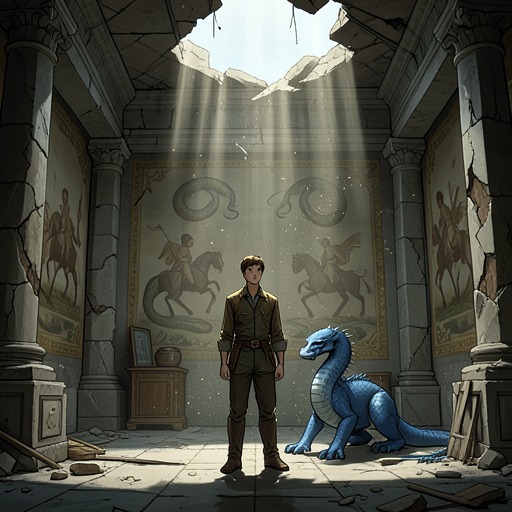
The later geography of the world preserves the material remains of this greatness while also displaying its ruin. Vroengard, once the ancestral home of the Riders and a place of glory, has become a looted, empty shell haunted by strange beasts. At its center stands the abandoned Dorú Areaba. The contrast between the former city and its desolation turns the Golden Age into a history written in ruins: its achievements remain visible, but the institution that gave them meaning has vanished.
Internal Betrayal and the End of the Age
The Riders could not be destroyed by an outside enemy, yet they failed to guard against themselves. Their downfall began with Galbatorix, a gifted boy from Inzilbêth who was accepted by the Riders after testing revealed great power in him. When his first dragon died, Galbatorix demanded another. The council’s refusal deepened his belief that the Riders were responsible for his loss, and he began to brood over revenge.
Galbatorix then corrupted another Rider through persistent argument and dark secrets learned from a Shade. Together they lured and killed an elder. Afterward Galbatorix slaughtered his own accomplice, leaving the Riders to find him with blood on his hands. His escape gave the coming disaster a distinctive character: the first breach in the Golden Age was not a battlefield defeat but the deliberate conversion of Rider knowledge, trust, and authority into instruments of revenge.
Years later, Galbatorix found Morzan, a young Rider described as strong in body but weak in mind. He persuaded Morzan to leave a gate unbolted at Ilirea, later called Urû’baen, entered the citadel, and stole a dragon hatchling. Galbatorix and Morzan then concealed themselves in a place where the Riders would not venture, studying forbidden magic and dangerous secrets. When Galbatorix’s black dragon, Shruikan, had fully grown, they revealed themselves and began killing the Riders they encountered.
Twelve Riders eventually joined Galbatorix, motivated by power and resentment over perceived wrongs. With Morzan, they became the Thirteen Forsworn. The Riders were unprepared for their coordinated assault and fell beneath it. The elves fought bitterly but were overthrown and driven into secret places. Thus the end of the Golden Age repeats its defining paradox: an order built to mediate between peoples and restrain violence was destroyed when its own members turned inherited power against its guardians.
Memory, Inheritance, and Narrative Significance
The Golden Age reaches the reader through imperfect memory rather than direct experience. Brom introduces his account by emphasizing that time cannot be stopped, that what has been lost may survive in memory, and that the story is fragmented and incomplete. This framing makes the age both authoritative and fragile. It is a source of guidance for the present, but it cannot be recovered whole; every later generation encounters it through recollection, ruins, surviving objects, and the consequences of its fall.
The Riders’ legacy is also embodied in Zar’roc, the sword Brom gives Eragon. The weapon was once a Rider’s blade, forged by the elves according to methods that remain secret. Its red blade is eternally sharp and will never stain, and its beauty is inseparable from its purpose as a weapon made to end human lives. Zar’roc therefore carries the Golden Age’s unresolved contradiction: the Riders’ civilization depended on immense martial power, even while their public mission was peace.
The revived Rider Eragon stands inside this inheritance without simply restoring the past. His name recalls the first Eragon, the elf who helped end the war between elves and Dragons and made the Riders possible, while the surviving world still bears the damage caused by Galbatorix’s overthrow. Later, the voice of Osthato Chetowä, also called Togira Ikonoka, tells Eragon that he will not be safe until he finds him and directs him to trust Arya and go to Ellesméra. That summons links the present Rider to a deeper, unfinished tradition: the Golden Age is not merely a lost paradise, but a burden of knowledge and responsibility passed into a new generation.
The period’s political meaning remains active as well. The Varden are a rebel group formed after Galbatorix’s rise, and their existence reflects the vacuum left by the Riders’ destruction. They raid the Empire, accept fugitives and those who hate Galbatorix’s rule, and have gathered sympathy by evading his efforts to destroy them. Their uncertain history and hidden location show how thoroughly the old order has been replaced by resistance, secrecy, and contested legitimacy. When the Urgals threaten Farthen Dûr, Ajihad declares that the Varden must hold the city or face their own death, the downfall of the dwarves, and the eventual defeat of Surda and the elves. The Golden Age thus remains the standard against which the present crisis is measured: a remembered peace makes the stakes of its possible disappearance unmistakable.