Monk's literary marginalization
ErasureThelonious Ellison’s literary marginalization is not a simple consequence of obscurity or lack of ability: his novels are described as intellectually accomplished, yet readers and institutions repeatedly judge them against narrow expectations of Black life. The resulting bind is that his work is treated as insufficiently representative when it resists racial categorization, while a novel published under the name Stagg R. Leigh draws attention precisely because reviewers take it as an authentic portrait of a stereotyped Black experience.
Intellectual and Professional Background
Ellison is a novelist, Harvard graduate, and professor whose work includes a reworking of Aeschylus’ The Persians, retellings of Euripides, and parodies of French poststructuralists. He graduated summa cum laude, though he recalls disliking his time at Harvard. His academic ability and literary ambition sit uneasily beside the commercial judgment that his writing is too difficult to sell. The rejection of his latest novel is the seventeenth he has received, and even the welcome news that he has been promoted to professor does not lift the depression caused by that rejection.
The divide between how Ellison understands himself and how others classify him is central to this exclusion. He describes his race as something society assigns on the basis of his dark skin, curly hair, broad nose, and ancestry that includes enslaved people. Yet he did not grow up in an inner city or the rural South, and his family’s background includes doctors and a home near Annapolis. He says that he rarely thinks about race except when he feels guilty for not thinking about it. At the same time, he recognizes that people who believe in race may target or obstruct him because of his appearance and ancestry. The publishing dispute thus concerns more than personal taste: it turns on who is presumed able to write about Black life, and what kind of writing is allowed to count as evidence of it.
Editorial Expectations and Rejection
Ellison’s agent, Yul, forwards a rejection of his latest novel that concedes its intellectual brilliance, challenge, and careful construction before dismissing it as too difficult for the market. The editor also questions the intended readership, invoking its plot about Aristophanes and Euripides killing a younger dramatist and contemplating the death of metaphysics as an example of its distance from commercial expectation. The judgment does not dispute that the novel is carefully made; it treats that achievement as beside the point if the work is not readily marketable.
Other editorial responses make the racial terms of the problem more explicit. Yul tells Ellison that publishers regard him as not Black enough. When Ellison asks how they know his race and why it should matter, Yul points to the photograph on his first book and to the fact that people have seen him. Ellison challenges the implication that he must make his characters display familiar racial markers to become acceptable. Yul’s answer suggests that such signals might help. The exchange exposes a demand for legibility: the author’s appearance is already known, but his fiction is still expected to prove that it belongs to a prescribed category.
The rejection pattern continues while Ellison is occupied with his family. Three more editors turn down the novel, calling it too dense, saying it is not for them, or judging that the market cannot support it. Yul can offer no clear next step and suggests that Ellison write another book like The Second Failure. The advice treats repetition of a previously acceptable work as a possible route forward, rather than asking whether the rejected novel’s difficulty or subject might warrant a different readership. Ellison’s literary isolation is therefore reinforced by both individual refusals and an agent’s limited sense of what the market will permit.
Classification in Bookstores and Reviews
A visit to Border’s gives Ellison a physical view of the same problem. In Literature and Contemporary Fiction, he cannot find his books. After stepping back, he sees four of them arranged alphabetically in African American Studies, including The Persians, whose only ostensibly African American feature is its jacket photograph. The placement makes the books visible to readers seeking a racial category, but less visible to readers looking for contemporary fiction or an unusual reworking of Greek tragedy. Ellison concludes that either kind of reader may pass them by. The bookstore’s shelving turns a question of interpretation into a practical barrier to discovery and sales.
The classification echoes a critical complaint about The Persians. A reviewer praises the novel’s developed characters, rich language, and subtle plotting, but cannot see what its reworking of Aeschylus has to do with the African American experience. The review acknowledges the qualities of the writing while making its value contingent on an expected connection to racial experience. At a New York literary party, a book agent makes the commercial prescription more blunt: Ellison should abandon retellings of Euripides and parodies of French theory in favor of what the agent calls true, gritty stories of Black life. Ellison responds that he is living a Black life. The agent then turns away to talk with a performance artist who had posed in front of a governor’s mansion as a lawn jockey. The scene places Ellison’s refusal beside a spectacle that is readily legible within the very racial imagery he resists being required to reproduce.
The Stagg R. Leigh Contrast
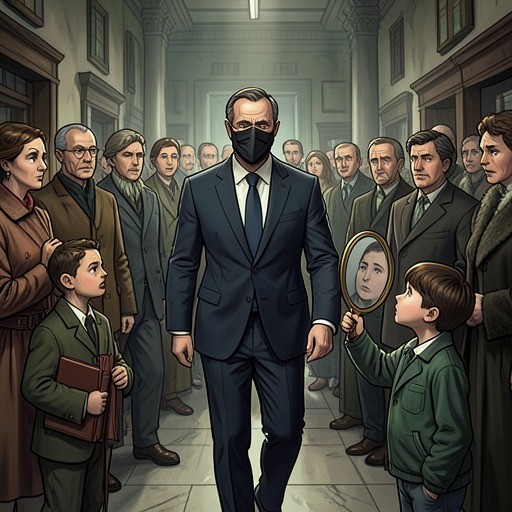
The account of Ellison’s marginalization gains a bitter reversal when he writes under the name Stagg R. Leigh. Reflecting on the work, he recognizes the irony: he had resisted writing as racial testimony or as an attempt to portray the supposedly real life of his people, yet he can now receive a check by wearing the mask others expect. The pseudonym lets the writing enter a commercial channel that Ellison’s other novels have struggled to reach, while separating that opportunity from his publicly recognized identity.
A review of the new novel by the unknown Leigh illustrates the cost of that recognition. The reviewer praises the book as raw, gritty, and real, insists that it must be understood as a Black work, and presents its protagonist, Van Go Jenkins, as a figure whose violence and resistance to education supposedly express recognizable Black life. The review also describes him as a young man with no father and treats his conduct as natural to the portrait it has constructed. Its confidence in the novel’s authenticity contrasts with the doubts cast on Ellison’s earlier work, despite the reviewer’s reliance on a reductive account of what Black life should look like. The reception does not resolve Ellison’s marginalization; it shows how readily the market can reward the expected image while leaving other forms of Black authorship difficult to place.