Thelonious Ellison's creative crisis
ErasureThelonious Ellison’s creative crisis is not simply a failure to produce another novel; it is a crisis of artistic identity. He recognizes that his ironic distance from popular fiction has not kept him outside its influence, and that his public success has left him questioning both his literary judgment and his capacity for ordinary connection. The strain surfaces in his argument with Marilyn Tilman, his retreat from correspondence and readings, and a late-night effort to attend to notes for a real novel while his current work prospers.
Recognition and Artistic Conflict
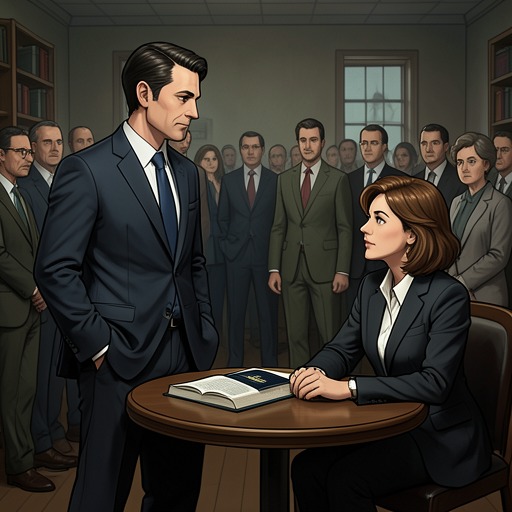
The crisis becomes explicit when Ellison recalls the quarrel that ended his brief relationship with Marilyn. Discovering a novel by her bedside, he insists to himself, was not primarily a response to her taste. The book recalled what he believed he had become: an ironic, cynical, self-conscious, yet faithful copy of Juanita Mae Jenkins, the author of the runaway bestseller We’s Lives In Da Ghetto, soon to be adapted as a major motion picture. The comparison unsettles the distinction between the literary stance he associates with himself and the popular form he has entered. Irony has not placed him beyond imitation; in his account, it has become part of the imitation.
That recognition makes the argument with Marilyn more than a dispute over a book. Ellison admits that his circumstances and constitution seem to disqualify him from even basic friendships, whether new or longstanding, and make romantic involvement feel nearly absurd. He considers whether the outburst was also a well-timed retreat. His literary indignation may have been genuine, but it could serve a second purpose: ending an intimacy he already regarded as difficult to sustain. The crisis therefore reaches beyond questions of craft into his ability to remain in contact with other people.
Control over the Work
Ellison’s insistence on changing his novel’s title gives the creative conflict a concrete form. His agent is astonished by the demand and questions whether Ellison has lost his judgment; Ellison answers by recalling that the agent had reacted similarly when he first proposed sending the manuscript out. The exchange establishes a pattern of decisions that appear unreasonable from the outside but are connected, for Ellison, to the purpose he assigns the work.
He describes the novel as a work of art for him and says it must do the work he wants it to do. The statement asserts a private artistic standard against the expectations of his agent and, more broadly, against the commercial identity attached to his writing. Yet his brief answer to the agent’s dismissal does not resolve the disagreement. The exchange leaves the claim of artistic control intact while showing how precarious it is: Ellison can name what he wants the novel to accomplish, but the record does not show that this confidence has restored his ease with writing or with his place in literary life.
Withdrawal from Readers and Colleagues
By the time Ellison describes himself as a hermit, withdrawal has taken a practical shape. He has unopened mail from friends and sealed letters from people at universities. He guesses that the university letters concern recommendations for job applicants or students seeking admission, but acknowledges that he has not opened them. He feels guilt about these professional requests more keenly than about the personal letters, suggesting that the silence is not simply indifference; he remains aware of obligations he is avoiding.
He also suspects that some letters from institutions contain invitations to give readings. Ellison dislikes the custom, preferring that audiences read the book rather than watch its author perform. He imagines an event in which audience members and author would read silently, making the author’s presence seem unnecessary. This fantasy converts his dissatisfaction with the reading circuit into a critique of the occasion itself. He has never been a popular reader and says that this did not previously hurt his feelings; now, however, he can imagine that failing to answer invitations makes him more desirable. That thought folds professional recognition back into the crisis: absence may increase demand, even as it deepens his separation from the people seeking his participation.
Reading Against His Own Judgment
Ellison’s crisis also complicates his standards for fiction. He reads three novels in one night and much of the following day, finding them sterile, predictable, and conventionally constructed, yet acknowledging that he enjoyed reading them. Their ordinariness does not make them unreadable to him. Instead, the pleasure unsettles his assumption that his critical familiarity with novels has left him able to recognize literary value without difficulty.
He compares himself to a surgeon familiar with blood and concludes that he may be jaded. His proposed remedy is to contact an innocent inner self, the part capable of being amazed by dull and commonplace things. The formulation does not provide a cure; it identifies how much effort is required for him to approach familiar material without the defenses of expertise. His response to the novels also echoes his earlier recognition of imitation: he can condemn predictable writing and still be drawn into it, just as he can see popular fiction reflected in his own work without simply stepping free of it.
The Unfinished Alternative
The late phase of the crisis is marked by sleeplessness and evasion. After Christmas and New Year pass without distinction, Ellison’s existing novel reaches number one on the New York Times bestseller list and is taken up by two additional book clubs. At the same time, he stays awake for several nights, pretending to look over notes for a real novel. The contrast places commercial success beside an unresolved desire for another kind of work. The notes are present, but the account does not establish that he begins or completes the novel they represent.
Near delirium, Ellison turns to intellectual and mythical allusions rather than reporting a breakthrough in the manuscript. He recalls Icarus and Daedalus, deciding that although Icarus fell, Daedalus flew; he rejects Zeno as too slow to reach his point and finds Thales’ theory wanting. These reversals and judgments give his sleepless thinking a restless, self-correcting rhythm, but they do not settle the creative problem. His conclusion that there is no alternative to madness, followed by the observation that removing blue from purple does not leave red so much as something that only looks that way, preserves uncertainty rather than resolving it. The crisis ends in this evidence not with a completed work or a recovered confidence, but with Ellison awake, mentally feverish, and still trying to distinguish the real novel he hopes to write from the successful work already bearing his name.