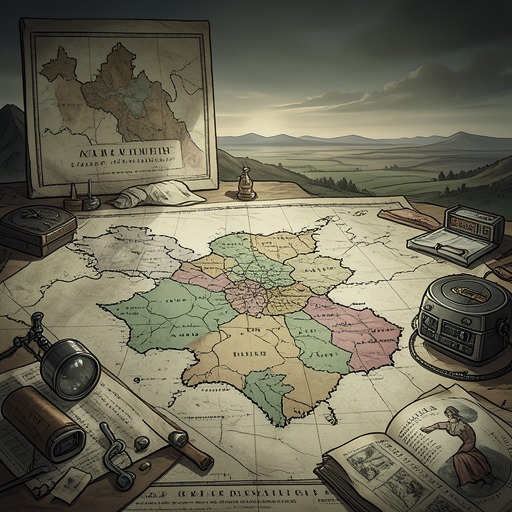
Germany's 1943 defeat of Soviet conventional forces
FatherlandGermany's 1943 defeat of Soviet conventional forces is recalled as a turning point in the alternate history of the novel: the Wehrmacht’s campaign severed the Red armies from the Baku oilfields, leaving Stalin’s war machine without fuel. In the official broadcast narrative it became a triumph attributed to Adolf Hitler’s strategic genius; in March’s recollection, it is one island in a sequence of state announcements whose public certainty contrasts with private fear and the machinery of propaganda.
Background and Course
The victory followed the Wehrmacht’s summer offensive of 1942, which cut Moscow off from the Caucasus and separated the Soviet armies from Baku’s oil supply. The novel describes the result starkly: Stalin’s military system ground to a halt for want of fuel. The defeat is thus linked not only to battlefield success but to control of a resource on which continued Soviet warfare depended.
The Victory as a Broadcast
March remembers that he was at sea during the broadcasts announcing victory over Russia in the spring of 1943. The announcement framed the outcome as proof of Adolf Hitler’s strategic genius. Its confident formula belongs to the regime’s public account of the war, in which military developments were converted into demonstrations of the Führer’s competence.
The recollection appears among the milestones March mentally reviews while waiting for another important announcement. He recalls being a schoolboy when German troops entered Vienna in 1938, and, in 1939, hearing Adolf Hitler declare that he would not take off his uniform until victory was secured or he failed to survive the outcome. That youthful response—welcoming war as a chance to live up to his father’s example—stands in sharp contrast to the later March, who recognizes how official narratives shape what the public is permitted to hear.
Place in the Alternate History
The Soviet defeat is one stage in the novel’s altered history of the Second World War. March’s recollection continues from the 1943 victory to peace with Britain in 1944, which propaganda attributed to Adolf Hitler’s counterintelligence, and then to peace with the United States in 1946 after the V-3 rocket exploded over New York. The sequence presents military victory not as an isolated outcome but as the opening of a new German imperial order and a prolonged Cold War, with guerrilla conflicts continuing on its fringes.
The later history of the Reich gives this remembered triumph a darker context. March’s investigation uncovers documentary evidence of the mass murder concealed behind administrative euphemism: the Wannsee minutes describe the intended treatment of millions of Jews, while other records detail killing facilities and the reuse of prisoners’ possessions and hair. The military victory is not itself the subject of those documents, but the contrast matters: a regime that broadcasts triumph and manages public memory also records mass violence in bureaucratic language.
Narrative Significance
The victory reaches the reader through retrospective recollection rather than a battle scene. March’s compressed sequence of announcements makes the official history feel familiar through repetition, then unsettles it by placing that history within his changed understanding of the state. The spring 1943 broadcast is remembered as a boast of strategic mastery, while the surrounding plot exposes how carefully the regime controls information and conceals the human consequences of its power.
The novel’s author’s note distinguishes its counterfactual wartime outcomes from the real biographies of historical figures, noting that the characters’ biographical details are accurate only up to 1942 and that their later fates differ. The Soviet defeat therefore belongs to the novel’s imagined chronology, not to real history; its narrative function is to establish how an altered military outcome sustains the regime whose crimes March later tries to expose.