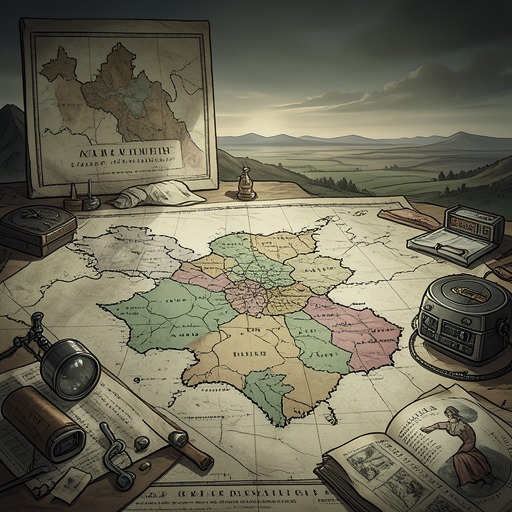
Nazi Germany's 1939 invasion of Poland
FatherlandNazi Germany's 1939 invasion of Poland is both a foundational military event in the novel’s alternate history and the beginning of a longer system of occupation and appropriation. When Xavier March crosses the Oder decades later, the river is described as Germany’s natural frontier with Poland, yet there is no longer a Polish frontier because Poland itself has ceased to exist. The invasion survives in the landscape as a route of remembered victory—and in the evidence of what the victors took.
The Invasion Remembered
March’s journey east brings the invasion into the present through a specific road and a recalled image. He recognizes the route as the one down which the Wehrmacht’s Tenth Army advanced in September 1939. In his mind, old newsreels return: horse-drawn artillery, tanks, marching troops. The remembered mood is collective exhilaration; victory had seemed easy, and people had cheered.
The exit sign for Gleiwitz, identified as the town where the war began, makes the journey more than a passage through occupied territory. It connects the physical road to the regime’s founding account of the conflict. The crossing of the Oder and the sight of the sign place March inside a landscape where the official memory of conquest remains legible even as its consequences surround him.
Occupation and the Erasure of Poland
The invasion’s result is conveyed in the blunt contrast between frontier and reality: the Oder still marks a natural boundary, but Poland no longer exists as a country. In the novel’s political geography, the General Government is a zone of German rule, and official appeals urge Germans to settle there with promises of free farms and guaranteed income for five years.
The advertised promise conceals a harsher account that has filtered back: poor soil, exhausting work, and Germans returning at dusk to drab satellite towns for fear of local partisans. The General Government is described as worse than Ukraine, Ostland, or Muscovy. These details show that conquest did not produce the uncomplicated prosperity suggested by propaganda; it created an occupied territory marked by coercion, hardship, and continuing resistance.
Plunder and the Bureaucracy of Appropriation
The occupation also provides opportunities for officials to turn state access into private wealth. March’s colleague Halder links the luxury enjoyed by Hans Frank’s administration, based at Wawel Castle in Krakau, to paintings, tapestries, church treasures, jewelry, and bribes. March responds by connecting that account to Josef Buhler’s house on Schwanenwerder, suggesting how the visible comfort of an official could point toward the profits of occupation.
A secret inventory compiled by Polish museum authorities gives the scale of cultural losses a concrete measure: from Warsaw alone, it lists 2,700 paintings of the European school, 10,700 paintings by Polish artists, and 1,400 sculptures. In the account of the scheme, Buhler, as state secretary, could arrange for works to be shipped under escort to Wilhelm Stuckart at the Interior Ministry, with paperwork that made the transfers look legal. Stuckart could then store the works or smuggle them out of the Reich in exchange for portable, hard-to-trace assets. The chain of officials and procedures makes plunder appear administrative while redirecting Polish property into private hands and other collections.
The Invasion’s Long Shadow
The novel sets images of victory against the consequences that official memory omits. March recalls the cheering newsreels, but the present-day road leads through a Germany whose eastern boundary has swallowed the country it once invaded. Meanwhile, the settlement advertisements, reports of partisan danger, and records of stolen cultural property reveal what conquest meant beyond the military advance.
That contrast extends into ordinary life. In the novel’s Berlin, family routines and public celebrations proceed within a political order shaped by occupation, while the absence of Poland is treated as a settled fact. The invasion’s significance therefore lies not only in the advance of the Tenth Army, but in the durable system that followed: territorial erasure, German settlement, exploitation, and the conversion of occupied Poland’s resources and heritage into instruments of power and private gain.