Nazi-dominated Europe
FatherlandNazi-dominated Europe is the novel’s postwar political landscape, a continent reshaped by German conquest and kept in its orbit through territorial reorganization, economic dependence, and bureaucratic control. Its apparent order rests on coercion and extraction: occupied lands supply territory, labor, and stolen wealth, while the paperwork of the state obscures the violence that makes the system work.
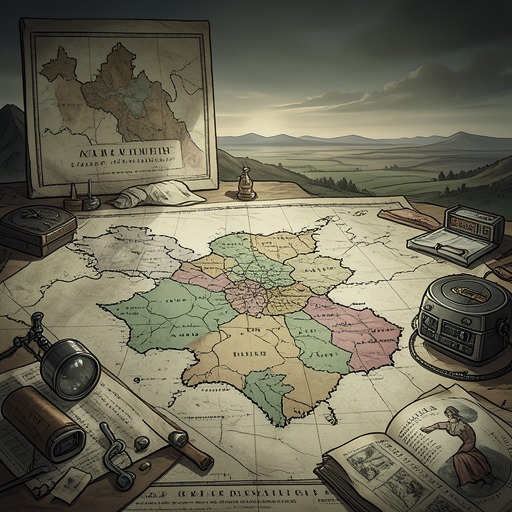
A German-remade map
The names on the map record the transformation. Luxembourg has become Moselland, Alsace-Lorraine Westmark, and Austria Ostmark; Czechoslovakia has been reduced to the Protectorate of Bohemia and Moravia. Poland and the Baltic states have disappeared as independent countries. In the East, the German Empire is divided into the Reichskommissariate of Ostland, Ukraine, the Caucasus, and Muscovy. These labels do more than mark administration: they present conquest as settled geography.
In the West, twelve countries—Portugal, Spain, France, Ireland, Great Britain, Belgium, Holland, Italy, Denmark, Norway, Sweden, and Finland—have been gathered into a German-directed trading bloc under the Treaty of Rome. German has become the official second language in schools, while German cars, radios, televisions, factories, and tourist resorts shape ordinary commercial life. The novel sets this everyday integration against the bloc’s political subordination: German influence is made routine as well as imposed.
Occupation and extraction
The eastern territories reveal the gap between the regime’s public promises and the conditions of life under occupation. Ministry advertisements invite Germans to settle in the General Government with offers of free farms and guaranteed income. Accounts filtering back describe poor soil, exhausting work, and satellite towns where settlers return at dusk for fear of local partisans. The General Government is represented as harsher even than Ukraine, Ostland, or Muscovy. Propaganda’s promise of a prosperous frontier thus conceals both the hardships of settlement and the coercive order imposed on the region.
The system also channels the wealth of occupied Poland through officials and institutions. A secret inventory compiled by Polish museum authorities in 1940 recorded 2,700 paintings from the European school, 10,700 paintings by Polish artists, and 1,400 sculptures removed from Warsaw alone. Some objects went to planned destinations such as the Führermuseum, Hermann Göring’s museum at Carinhall, and galleries in Vienna and Berlin. But the discrepancy between Polish records and German receipts points to another route: Josef Bühler, as state secretary, could arrange escorted shipments to Wilhelm Stuckart at the Interior Ministry; Stuckart then arranged storage or smuggling beyond the Reich in exchange for cash, jewels, or gold. Official transport and legal-looking documentation gave private theft the appearance of administration.
Switzerland and the limits of the Reich
Switzerland stands apart from this continental arrangement. Surrounded by German power and its allies, it remains neutral, though the Führer had not intended that outcome. By the time the German military had designed a strategy to subdue the Swiss state, the Cold War stalemate had begun. Switzerland consequently persists as a useful no-man’s-land, where opposing sides can meet and conduct business in secret.
Its financial system becomes part of that role. German numbered-account business had collapsed by 1939 amid the dangers of dealing with German clients, the difficulty of communication, abandoned accounts, and public scrutiny. After the war began, however, people urgently sought ways to move property out of Germany. Banks such as Zaugg offered a numbered deposit account for a fee of 200 francs, issuing a box, a number, a key, and a letter of authorization. The bearer could later claim the contents without the bank acting as intermediary, and holders could purchase multiple keys and letters. The arrangement made wealth transferable across time and borders, connecting the threats inside the Reich with Switzerland’s function as a discreet refuge for assets.
The machinery behind the public order
The novel places the regime’s euphemistic official language beside the mechanisms of mass murder. The minutes of the Wannsee conference identify a meeting on January 20, 1942, at Am Großen Wannsee 56–58, and state that about eleven million Jews were included in the planned “final solution.” Their language of direction and labor utilization is exposed as a mask for killing. Draft minutes record Reinhard Heydrich’s discussion of shooting, gas trucks at Kulmhof, and Zyklon B experiments at Auschwitz; Heydrich’s handwritten objection, and the reduction of this discussion in the final version, show how the surviving record was edited to conceal operational detail.
Martin Luther’s inspection notes supply a different kind of record: a sequence of places, times, and administrative observations. At Auschwitz, a train carrying Jews from France arrives at a guarded rail siding; the deportees are separated, and nearly 2,000 people are directed toward an underground chamber presented as a bathing and disinfecting room. The notes then describe the processing of possessions and the disposal of bodies. In the area called Canada, the recorded property includes 132,000 men’s shirts, 155,000 women’s coats, and 3,000 kilograms of women’s hair. The camp’s four gas-chamber and crematorium installations are reported to have a combined capacity of 8,000 bodies a day. These particulars connect transport, deception, murder, and systematic appropriation as parts of one administrative apparatus.
That apparatus extends even to the use of prisoners’ hair. An SS circular dated August 6, 1942, orders that hair cut in concentration camps be processed into industrial felt and thread. It specifies that female prisoners’ hair is to be disinfected and stored, that male prisoners’ hair is usable only if at least 20 millimeters long, and that monthly quantities be reported beginning September 5. The detail is chilling not because the document speaks emotionally, but because it treats the products of persecution as an inventory to collect and report.
Narrative significance
Nazi-dominated Europe is therefore not merely a backdrop of altered borders. It is a political economy in which conquest is normalized through new territorial names, economic integration, settlement propaganda, official-looking transfers, and meticulous records. Switzerland’s neutrality offers a contrast but not an escape from the system: it becomes valuable precisely because the Reich’s reach creates demand for secrecy beyond its borders.
The novel’s movement between maps, financial procedures, conference minutes, and camp records reveals the order’s central contradiction. Its public language promises development and regularity; its documents disclose dispossession, extermination, and the conversion of stolen property and human remains into usable resources. The same bureaucratic precision that makes the empire appear governable also preserves evidence of how its order was built.