Nostradamus’s Book
FaustNostradamus’s Book is the book of mystery Faust turns to when the learning surrounding him no longer answers his desire for a fuller relation to nature and the spirit world. By presenting first the sign of the Macrocosm and then the sign of the Earth Spirit, it carries him from contemplation of universal order to an attempted encounter with a particular spirit. The book’s decisive role is therefore not simply to supply knowledge: its symbols provoke Faust to act, and his invocation brings him face to face with a power he cannot master.
Identity and Place in Faust’s Study
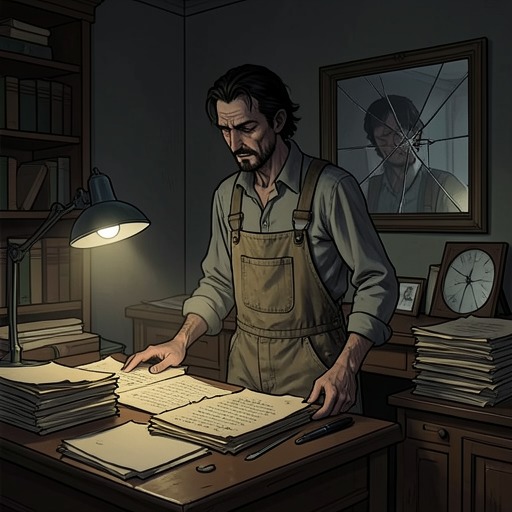
In the opening scene, Faust sits among heaps of old books and dusty instruments in a confined study, surrounded by the accumulated materials of scholarship. Against this setting, Nostradamus’s Book represents the possibility that knowledge might lead out of abstraction and into direct communion with nature. Faust asks whether this single book can serve as sufficient company, then turns to it as a guide to the courses of the stars and to nature’s instruction. It stands within the scholar’s world, but promises a passage beyond that world’s limits.
The book is also described as coming from Nostradamus’s own hand. That attribution lends authority to the volume within Faust’s search, but the scene shows its effect through the signs Faust encounters rather than through any exposition of its history or contents. Its significance lies in what reading sets in motion: the book offers images for interpretation, and Faust responds by seeking the powers he believes those images disclose.
The Sign of the Macrocosm
Faust opens the book and perceives the sign of the Macrocosm. The image fills him with sudden rapture and a sense of renewed life. He reads it as revealing the powers of nature around him, and the sign’s effect briefly makes the world seem intelligible as a connected whole. His response is not detached analysis: he feels that the vision speaks to his senses and heart as well as to his understanding.
As he contemplates the sign, Faust describes a system in which each part gives substance to the whole and acts within the other. He imagines forces rising and descending, sustaining a harmony that fills the universe. Yet the vision also exposes its own limit. For all its grandeur, it remains a show: Faust can behold the order of nature but cannot make it his own. Nostradamus’s Book thus gives him an image of unity without granting the intimate participation he seeks. The distance between seeing and possessing becomes the pressure that drives him to turn the pages.
From Symbol to Invocation
Faust turns the leaves impatiently and encounters the sign of the Earth Spirit. The change in sign produces a different response. Where the Macrocosm had presented a vast arrangement to contemplate, this symbol seems to bring the spiritual power closer. Faust feels stronger and more prepared to meet the world, and he welcomes both its suffering and its joy. The book’s signs therefore mark a progression: from an encompassing vision of nature to the prospect of immediate contact with one of its powers.
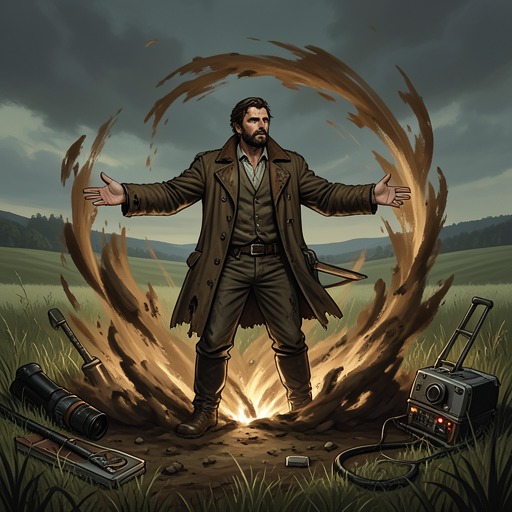
That prospect becomes action when Faust takes up the book and pronounces the sign associated with the spirit. The scene’s directions make the volume a concrete part of the invocation, not merely a source of ideas. A flame appears, and the Earth Spirit is revealed in it. The sequence establishes the book’s practical consequence within the scene: Faust’s reading and use of its sign help precipitate the encounter he has sought.
Knowledge, Limits, and Consequence
The book does not promise a safe or complete command of what it reveals. The vision of the Macrocosm leaves Faust dissatisfied because observation cannot make nature his own; the sign of the Earth Spirit then intensifies his aspiration into an appeal that exceeds his control. As Faust calls for revelation, he experiences the encounter as an overwhelming force. The passage therefore distinguishes symbolic knowledge from mastery: a sign can direct Faust toward the spirit world, but it cannot ensure that he is prepared for what answers.
Nostradamus’s Book also stands in contrast to the inherited, dusty learning that fills Faust’s study. It is still a book, handled and opened amid other books, yet its signs change the scene from solitary study into an attempt at supernatural contact. That transition gives the object its narrative importance. It turns Faust’s dissatisfaction with merely intellectual knowledge into a consequential experiment, while leaving clear that the power he approaches is not simply another subject for study.