Witch’s Rejuvenating Potion
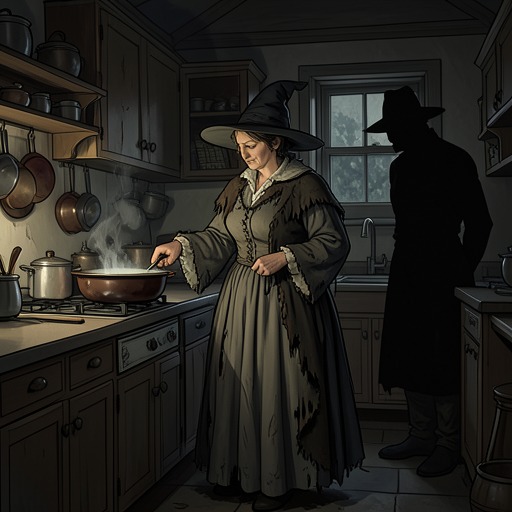
FaustThe Witch’s Rejuvenating Potion is a magically prepared drink that Mephistopheles offers to Faust as a means of restoring youth. Its preparation turns the hope of renewal into a risky ritual: the Witch warns that an unprepared drinker could die within an hour, yet Mephistopheles insists that Faust can safely take it. When Faust drinks, a flame rises from the cup; the Witch breaks the circle, and Mephistopheles immediately leads him away, linking the potion’s effects to renewed desire and Faust’s pursuit of an idealized woman.
Purpose and Danger
Faust approaches the potion with distrust. The Witch’s signs repel him, and he questions whether a foul preparation from an old woman can truly remove thirty years from his life. His complaint reaches beyond the drink itself: he asks whether nature or a noble mind has any more potent remedy. The potion thus answers a crisis of aging and disappointed hope, but it does not offer a natural cure. Its promise comes from witchcraft, which Faust regards as chaotic and suspect.
The Witch makes the danger explicit before preparing it. She says that if Faust drinks without the proper preparation, the brew will kill him within an hour. The warning establishes that the liquid is not simply a beverage with a predictable effect: its use depends on conditions known to the Witch and on the ritual that accompanies it. Mephistopheles dismisses the concern by calling Faust a friend who will be able to withstand it, and argues that Faust deserves the best drink in her kitchen. His confidence overrides the Witch’s caution rather than resolving it.
Preparation and Drinking
At Mephistopheles’ request, the Witch supplies a goblet of her oldest brew, explaining that age has made it stronger. She then draws a circle and places mysterious articles within it. The glasses begin to ring and the cauldron sounds, forming a musical accompaniment to the rite. A great book is brought into the circle, where the apes serve as a reading desk and hold the torches. These actions make the drink’s preparation a staged magical operation, not a simple act of pouring.
The Witch performs further adjurations before Mephistopheles urges her to fill the beaker. He tells Faust that the drink will do him no harm, describing him as a man of many degrees who has known many draughts. As Faust raises the cup to his lips, a light flame appears. Mephistopheles tells him to drink it quickly and challenges his apparent fear of fire, invoking Faust’s association with the Devil. The Witch then breaks the circle and Faust steps out. The scene moves swiftly from ritual enclosure to departure, with Mephistopheles directing the next stage.
Effects and Narrative Consequences
The immediate effect attributed to the potion is an awakening of desire. Mephistopheles tells Faust that walking will bring on perspiration and carry the liquor’s power through his frame; afterward, he promises to teach him to value indolence and predicts the stirring of Cupid. The potion is therefore framed not merely as a return to youth but as the beginning of a renewed erotic appetite. Its action is inseparable from Mephistopheles’ plan for Faust’s conduct after he has drunk.
Faust’s first response is to ask for a quick look in the mirror, where he sees a beautiful woman’s form. Mephistopheles refuses to treat the reflection as the final object of desire, promising that Faust will soon see the paragon alive and warm. Aside, he reveals a broader consequence of the drink: it will compel Faust’s blood so that every woman appears beautiful to him. This private assurance complicates the potion’s apparent promise of personal rejuvenation. It does not simply restore an earlier state; in Mephistopheles’ account, it alters Faust’s perception and helps propel him toward the encounter he has planned.
Significance
The potion’s scene is built on a contrast between skepticism and submission. Faust calls the witchcraft irrational and laments the lack of a better remedy, but he drinks when Mephistopheles assures him that the danger does not apply to him. The Witch’s warning remains in the scene even as the ritual proceeds, giving the promised renewal an undertone of risk rather than certainty.
The cup, the circle, the book, the apes, and the flame mark the transformation as both material and theatrical: Faust must physically drink, while the surrounding rite presents the act as an entry into a new condition. Mephistopheles controls the interpretation of what follows, describing the drink first as harmless, then as a force that will kindle desire and make women seem beautiful. The potion consequently serves as the hinge between Faust’s dissatisfaction with age and his renewed pursuit of erotic experience, while exposing how that renewal is mediated by Mephistopheles’ assurances and designs.