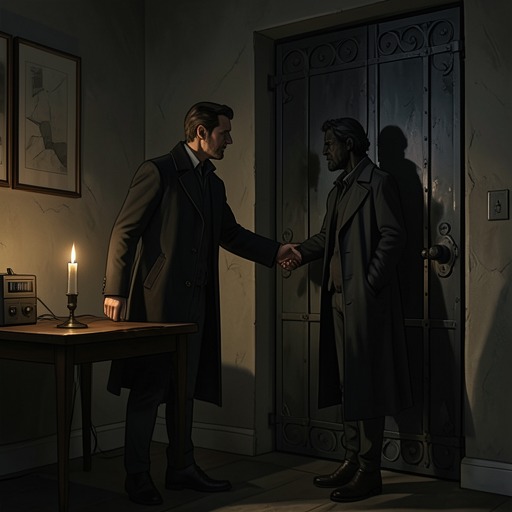
Faust–Mephistopheles Pact
FaustThe Faust–Mephistopheles Pact makes service reciprocal but postpones the reckoning: Mephistopheles will attend Faust in this world, and Faust will serve him in the next. Its defining condition is Faust’s own satisfaction. If he becomes content enough to wish an instant would remain, the pact grants Mephistopheles his claim. Written not merely as a contract but as a wager against repose, it gives dramatic form to Faust’s resolve to exchange abstract knowledge for experience and unceasing activity.
Terms and Exchange
Faust first asks what service Mephistopheles expects in return for his promised attendance. Mephistopheles does not demand an immediate payment; instead, he offers to be an untiring servant, obedient to Faust’s wishes here, on the condition that Faust do the same for him when they meet again beyond this world. The future exchange is explicit, but its setting and consequences are left for later: Faust says that he will not settle his doubts about the afterlife, and that his present pleasures and sorrows are rooted on earth.
Mephistopheles presents the bargain as access to experiences Faust cannot obtain by ordinary means. Faust challenges whether the Devil can satisfy a human soul in its highest striving, then names desires that resist lasting possession: gold that slips away, winnings no one can predict, desire drawn toward another, honor that flashes and vanishes, and fruits that decay before they can be gathered. Mephistopheles claims that he possesses such treasures. The terms therefore hinge on a tension between promised abundance and Faust’s suspicion that no offered pleasure can answer the scale of his desires.
The Wager on Satisfaction
The pact’s crucial test is not simply whether Faust enjoys what Mephistopheles provides. Faust names the moment that would count as defeat: if he lies quietly on an idle bed, pleased with himself and ruled by flattering enjoyment, the wager may end at once. He declares that if he ever greets a passing moment as so fair that it should delay, Mephistopheles can bind him and declare his ruin. The stopped clock and broken hand express the consequence as an arrest of time itself; the condition makes lasting contentment, rather than any particular pleasure, the measure of the claim.
This formula lets Faust wager against the possibility of satisfaction while continuing to pursue it. The pact does not specify a list of services Faust must perform during his earthly life, nor does it define a fixed duration for Mephistopheles’ service. Instead, the decisive event depends on Faust’s own response to experience. The arrangement turns a spiritual and temporal question into a test that can be recognized in a single utterance: whether Faust ever wishes the present moment to remain.
Blood, Speech, and Record
When Mephistopheles asks for a written document to secure the agreement, Faust objects to the demand for proof. He questions whether a spoken promise, made today and meant to hold through all his future days, should not suffice. His speech contrasts the living word with the material record: a promise can die in the pen, while wax and leather retain authority. He then allows Mephistopheles to choose the medium, naming brass, marble, parchment, paper, and clay.
Mephistopheles answers that any material will do, provided Faust subscribes his name with a drop of blood. Faust agrees to this procedure, calling it a farce, while Mephistopheles remarks on blood’s unusual value. The exchange moves from an argument about whether an inward promise can bind a person to a physical sign that records the pact. The contrast is central to the scene: Faust distrusts the permanence of documents, yet consents to the inscription that gives the agreement its tangible form.
Faust’s Resolve and the Pact’s Meaning
The agreement reflects Faust’s stated exhaustion with the limits of study and knowledge. He says that thought has broken off, knowledge has brought disgust, and the Mighty Spirit gives him no answer while Nature keeps her gate closed. He turns instead toward sensual experience and the changing movement of events, accepting that delight and distress, worry and success may alternate. His closing principle is that restless activity proves the human being.
That resolve clarifies why the pact’s test is framed around rest. Mephistopheles offers service and marvels, but Faust’s declared aim is not a particular reward; it is to enter the tumult of time and circumstance. The wager gives that aim a limit: if experience ever becomes so complete that he wants no further change, he will have surrendered the very striving on which his challenge depends. The pact thus binds Faust not only to Mephistopheles but to a continuing contest between the desire for fulfillment and refusal to stop seeking it.