Sylvie
FirebugSylvie is Ava’s coworker at Broken Spines and a close friend whose humor, imagination, and earnest concern offer Ava a rare connection to ordinary life. Their friendship is genuine but incomplete: Ava deliberately conceals her supernatural identity and the danger surrounding her, while Sylvie continues to care for her without knowing why she sometimes vanishes. Through books, the shop, and small acts of worry and kindness, Sylvie becomes a vivid measure of the everyday attachments Ava wants to keep even as the Coterie’s violence puts them at risk.
Identity and Introduction
Ava regards Sylvie as the nearest example she has of normal teenage behavior, then immediately undercuts that comparison. Sylvie likes kaiju movie marathons, cosplays as obscure anime characters, has apparently mastered Elvish and Klingon, and reads old chemistry books that arrive at the bookstore. Ava jokingly imagines that, left alone with household cleaners, Sylvie might build a bomb, a spaceship, or Godzilla. The list is comic exaggeration, but it also conveys Sylvie’s technical curiosity and the unusual interests that make her a poor guide to conventional teen life.
Sylvie’s energy is as distinctive as her hobbies. When Ava calls her during the fugitives’ flight, Sylvie is excited and relieved to hear from her, then launches into a rapid account of the fire at Broken Spines. In another conversation, she tries to comfort a sulking Lock by offering kitten pictures, then otter pictures, and finally an illustrated, infographic-filled comparison of the two. Her elaborate efforts show an affectionate, inventive social manner: she responds to another person’s sadness not with solemnity but with an improvised catalogue of possible cures.
Friendship with Ava
Ava traces the beginning of their friendship to a literary dispute. After Sylvie objected to Lord of the Flies, Ava had to read two books in its place and write a five-page protest essay explaining her reasons. The two then staged a dramatic sock-puppet reenactment of the essay, making puppets modeled on the book’s characters. Sylvie made an angry clam puppet and accompanied her song, Clams, the Better White Meat, on the mandolin; she even considered developing the joke into a full-length musical. Ava remembers the episode as the day she and her hyperactive coworker really became friends. Their connection is built from shared play and intellectual irreverence, not from Sylvie knowing the most important facts about Ava’s life.
That limit is explicit in Ava’s private accounting of her relationships. She counts Sylvie as a friend, but says she has to keep a great deal from her. Sylvie does not know that Ava, Lock, and Ezra are different from ordinary people, and Ava believes concealment is safer. The friendship therefore has an unusual imbalance: Sylvie offers uncomplicated companionship, while Ava must continually partition that companionship from the secret work and danger that govern her days. Sylvie is not an accomplice or confidante in those matters; she is someone Ava wants to protect from them.
Broken Spines and the World Sylvie Shares with Ava
Broken Spines is Ava’s home away from home and the job she considers real. It is a small, crowded used bookstore furnished with paperbacks and comfortable chairs, with Horatio the shop cat among its regular inhabitants. Sylvie’s connection to the store is practical as well as social: she works alongside Ava there, and the shop gives their friendship a shared setting built around books, eccentric interests, and familiar routines.
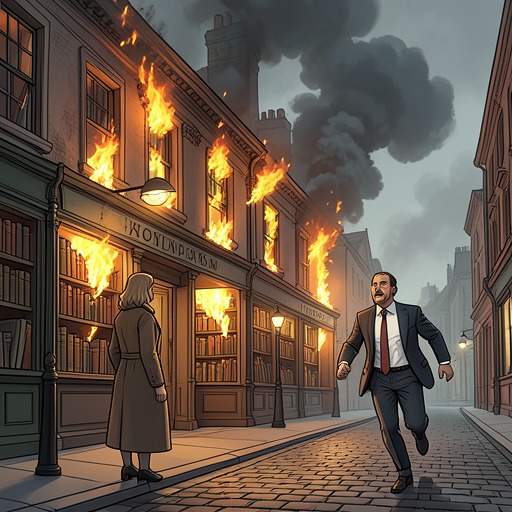
The fire that destroys the bookstore turns that setting into a loss Sylvie has to confront without knowing the danger behind it. On the phone, she worries that she may have to find another job, perhaps at a lobster restaurant, and mourns the store as a resource for the community. The nearest bookstore is two towns away and does not sell used books; she contrasts it with the disorganized Goodwill stacks, whose smell and cleaning chemicals she has even wanted to analyze. Her distress is not just about losing a workplace. She understands Broken Spines as a local place people need, and her detailed complaints make the absent shop feel concrete: its books, its character, and the alternatives that cannot replace it.
Before the shop’s closure, Cade brings Horatio to Sylvie and leaves her money for food and cat-sitting, explaining that the store will be closed for a few days. After the fire, Sylvie realizes that Cade did not say when he would return and had given her an unusually large amount for the cat’s care. Her brief silence gives way to a quiet question about whether Ava and Cade are all right. She has no full account of the crisis, but she reads the warning in Cade’s arrangements and in Ava’s absence. Her attention to the cat becomes an indirect sign that the people she cares about have been forced away.
Concern for Lock and the Missing Friends
Sylvie’s affection extends to Lock, whom she likes enough for Ava to imagine that Sylvie names her gaming avatars Mrs. Sylvia Lock. That imagined married name is Ava’s teasing speculation, not a confirmed declaration from Sylvie, but it reflects how readily Ava recognizes her friend’s crush. Sylvie herself makes her preference plain in the small particulars Ava reports: she asks whether Lock is with Ava, dislikes seeing him sad, and attempts to cheer him with kittens, otters, and her comparison list. The comedy comes from how seriously she applies her own elaborate logic to a simple wish to make him feel better.
When Ava reaches Sylvie after the fire, Sylvie’s anxiety surfaces through her torrent of talk about employment and the bookstore. Once Ava interrupts, Sylvie explains that Cade left Horatio with her and that the arrangement now seems likely to last longer than expected. She recognizes that something is wrong, but does not demand the secret. Instead, she asks Ava to be careful, agrees not to tell anyone they spoke, and insists that Ava come back safely. Her anxious references to the pharmacy and lobster restaurant return the conversation to her comic practical worries, without diminishing the seriousness of her appeal.
Narrative Role and Significance
Sylvie’s scenes give the story a view of friendship beyond the group bound together by supernatural danger. She cannot know the full circumstances of Ava’s disappearances, yet she notices the gaps: the absent Cade, the closed shop, the money for Horatio, and the sudden need for secrecy. Her response is characteristically her own—fast, digressive, funny, and finally direct. That combination allows concern to appear without transforming Sylvie into someone who understands more than the evidence permits.
The contrast between Sylvie’s ordinary claims on Ava and Ava’s concealed life sharpens the cost of secrecy. A bookstore, an eccentric coworker, a cat left in someone else’s care, and a promise to return safely are modest details beside the Coterie’s violence, but they represent the social world Ava hopes to preserve. Sylvie’s friendship matters precisely because it is not founded on supernatural knowledge or shared combat. It begins with a protest essay and an angry clam puppet, continues through the daily life of Broken Spines, and persists in Sylvie’s effort to keep Ava and the others safe without insisting that Ava explain everything.