Andy McGee's recovery of his mental-control ability
FirestarterAndy McGee's recovery of his mental-control ability is the reversal that makes an escape plan possible and exposes how badly the Shop has misjudged him. Though the organization considers his power permanently lost, Andy can still use the push to make Cap Hollister disclose sensitive information and carry out instructions. Each exertion comes at a physical cost, however, and the ability's return is revealed not as a clean restoration but as a dangerous capacity Andy must ration.
Identity and the Shop's Assessment
The recovery concerns Andy's mental-domination ability, a power the Shop believes he has permanently lost. When Andy presses Cap for an explanation of the organization's renewed activity, Cap reports the prevailing judgment: there is no ability left in McGee, and everyone agrees that he has been permanently tipped over. The certainty of that assessment is striking because Andy is making Cap answer under the push even as Cap describes him as powerless. The scene thus separates the institution's diagnosis from what is happening in front of it.
The Shop's assessment is bound up with its failure to produce results. Cap says Andy is no longer useful as a demonstration of Lot Six's effects, while Charlie has refused to light fires. He also reports that people had accused him of fixating on Lot Six and that he had run out of prospects. The claim that Andy's power is gone therefore functions as more than a medical-sounding conclusion: it helps explain why the Shop is considering moving him and why Cap has been under pressure to show results.
The Power in Use
Andy tests Cap's knowledge by asking why the Shop has resumed testing. Cap answers that Charlie has completed three tests and that, the previous day, she set a piece of sheet steel alight. According to Cap's report of Patrick Hockstetter's measurement, its surface temperature exceeded twenty thousand degrees for four seconds. The information jolts Andy: he had not known Charlie was lighting fires again, and the discovery intensifies his distress even as the questioning demonstrates that his push is reaching Cap.
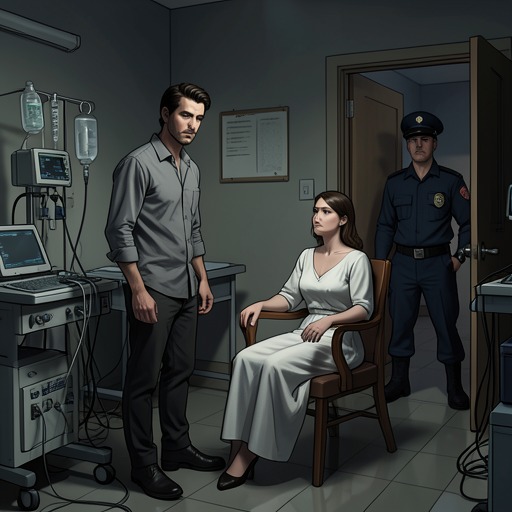
When an intercom interrupts, Andy pushes much harder than he intended. Cap shudders as if struck by an electric cattle prod, makes a gagging sound, and loses color. Andy's headache abruptly worsens. He recognizes that a stroke in Cap's office would not help Charlie, but the thought does not undo the force he has just used. Instead, he orders Cap to refuse calls for the next ten minutes. The exchange makes the power's return unmistakable while marking its danger: Andy can impose his will, but he is operating under strain and cannot treat the ability as cost-free.
Cap also explains how the Shop has coaxed Charlie into cooperating. The approach combines rewards and pressure, beginning with permission to take walks outside and progressing to the prospect of riding a horse. Andy learns that John Rainbird proposed this strategy. When Andy asks who Rainbird is, Cap gives a compressed account: Rainbird is a Shop operative badly wounded in Vietnam, where he lost an eye; he led the operation that captured Andy and Charlie at Tashmore Pond; and he used the blackout as the first step toward persuading Charlie to perform under test conditions. Cap says Rainbird's personal interest is Charlie's life after the deception surrounding the tests ends. Andy receives this intelligence while exerting the push, and its contents turn his effort from a test of Cap's compliance into a source of urgently consequential knowledge.
A Costly Instrument of Escape
Andy continues using the push despite the pain. In the car, Cap initially resists the idea of accompanying him, but Andy renews the pressure; Cap jerks in his seat, and the car swerves slightly. Andy worries that he is close to causing an echo in Cap's mind. That concern makes the exertion more than a simple contest of wills: an effect that can force compliance may also rebound, so every additional command carries a risk Andy cannot ignore.
As they approach the Longmont exit, Andy asks whether a destination such as San Diego will work. Cap answers that all is clear. Andy holds a folded slip of paper in his lap, then directs Cap to tell two Shop men who are traveling to Hawaii to meet them at Andrews Air Force Base. The small, concealed paper and the revised destination belong to the mechanics of an escape plan, not to a public display of recovered power. Andy's ability is useful because it can turn Cap into an unwitting intermediary while Andy preserves control over what the Shop's personnel are told.
The same struggle appears in the arrangements for leaving. When Cap asks about checking the bags for snakes, Andy uses a push, but deliberately not a hard one: he wants to save as much strength as possible for an emergency. Cap picks up one suitcase while Andy takes the other. At a later checkpoint, Cap identifies the stable as their destination and says they are going to collect Andy's daughter so they can escape. Andy counters with Andrews Air Force Base and pushes; the official record changes to Andrews. His headache returns as a dull, heavy pain. This sequence shows him using the ability selectively, not simply overwhelming everyone around him: he corrects a dangerous disclosure and keeps the escape route intact, while accounting for the physical toll.
Rainbird's Detection and the Limits of Certainty
John Rainbird reaches his own conclusion by examining the Shop mainframe. He sees a contradiction in Herman Pynchot's decisions: Pynchot had judged Andy useless and was preparing to send him to the Maui compound, yet then changed course and scheduled another round of tests. Rainbird also connects Pynchot's actions to an attempt to clear a running garbage disposal. These anomalies lead him to question whether Andy is truly incapacitated rather than accept the Shop's consensus.
The computer initially returns a 35 percent probability that Andy retains mental-domination ability when the query is cross-referenced with Herman Pynchot. Without that cross-reference, the probability falls to 2 percent. Rainbird then adds Captain James Hollister to the calculation; the result rises to 90 percent. The figures do not prove that Andy has recovered, but they show how dramatically the evidence changes when Pynchot's and Cap's behavior is taken into account. Rainbird recognizes that the Shop's initial picture of Andy was misleading, and he suspects that a note Cap passed to Charlie contains an escape plan.
Andy’s return to using the push is therefore both a practical reversal and a contest over who can interpret the evidence. The Shop treats him as spent; Rainbird notices that its own personnel are acting as though the matter is not settled; Andy, meanwhile, demonstrates the power in increasingly consequential acts. The ability restores leverage in the effort to reach Charlie, but every use threatens to worsen his headache or provoke an echo. Its recovery changes the balance of control without making Andy invulnerable, and the difference between apparent incapacity and hidden capacity becomes the opening through which the escape can proceed.